Choosing the right fish is the single most important decision you’ll make when setting up an aquaponics system. The species you pick shapes every other variable — water temperature requirements, tank dimensions, filtration demands, and your harvest timeline. Get this decision right from day one and the rest of the system falls into place naturally.
- Aquaponics uses up to 90% less water than conventional soil farming — but that efficiency only holds when the right fish are stocked at the right density.
- Tilapia, goldfish, and koi are the top picks for beginners, offering resilience and tolerance for the minor fluctuations that come with learning a new system.
- Water temperature is your first filter — it immediately eliminates most incompatible species before you even consider tank size or feed costs.
- Filtration capacity, not tank volume alone, sets the real ceiling on how many fish your system can sustainably support.
- Breeding behaviour matters more than most new growers expect — fast-reproducing species can overwhelm a small or under-designed system within just a few months.
What Makes a Fish “Perfect” for an Aquaponics System?
The perfect aquaponics fish ticks four boxes: it tolerates your water conditions, produces enough waste to nourish your plants, fits within your available space, and doesn’t require specialist-level care to stay alive. Nail that combination and your system practically manages itself.
Aquaponics works through a carefully balanced loop. Fish produce ammonia-rich waste. Beneficial nitrifying bacteria — colonising your grow media, NFT channels, or raft beds — convert that ammonia first into nitrite, then into plant-friendly nitrate. Your plants absorb those nitrates as fertiliser, cleaning the water before it cycles back to the fish. Disrupt any link in that chain and the whole system suffers.
Researchers at the University of the Virgin Islands (UVI) — one of the world’s leading aquaponics research institutions — have consistently found that the most successful home and small commercial systems make their fish selection before choosing tank size, grow media, or plant varieties. Every downstream decision is calibrated around the fish. Starting with the fish first saves significant time and money later.
Before you purchase a single fingerling, answer these five questions honestly: What water temperature can I reliably maintain year-round? How much tank space do I have? What is my filtration budget and capacity? Am I producing fish for food or running an ornamental system? And what are my local regulations around raising aquatic species? Your answers will narrow the field considerably before any other research is needed.
Which Fish Species Are Best for Beginners?
If you’re new to aquaponics, keep it simple: tilapia, goldfish, or koi. These three have earned their beginner-friendly reputation through decades of widespread use. They handle fluctuating pH, tolerate minor temperature swings, resist common pathogens, and bounce back from the inevitable mistakes that come with learning a new system. For most beginners, starting here is the right call.
Tilapia leads the pack for food-producing systems. It grows quickly, accepts a wide variety of commercially available pellet feeds, and shrugs off the kinds of water quality fluctuations that would stress more sensitive species. Goldfish and koi suit ornamental systems beautifully — they’re not typically eaten, but they’re inexpensive to replace, remarkably forgiving, and available from virtually any aquarium supplier.
Channel catfish are the next step up — still beginner-accessible but with more impressive food production credentials. They tolerate dissolved oxygen swings, pH ranges from 7.0 to 8.0, and temperatures between 65°F and 90°F, making them almost as forgiving as tilapia while offering a flavoursome harvest with strong market appeal. Blue catfish and flathead catfish are also used in aquaponics, though they require more space and are less commonly available as fingerlings.
Largemouth bass, yellow perch, and jade perch work well in more established systems. Jade perch is gaining popularity in Australian aquaponics for its exceptionally high omega-3 fatty acid content. The consistent rule: don’t chase exotic species until your system has cycled and run stably for at least three months.
How Does Water Temperature Shape Your Fish Choice?
Water temperature is the biggest single filter when shortlisting fish species — and it’s non-negotiable. A fish kept outside its optimal thermal range will stop growing, become immunocompromised, and eventually die. No amount of excellent nutrition or pristine water chemistry compensates for chronic thermal stress. Match your species to your climate, not the other way around.
Warm-water species — tilapia, catfish, largemouth bass, barramundi, and jade perch — thrive when water stays above 65°F (18°C). Tilapia performs best between 77°F and 86°F (25°C–30°C). In cooler climates, maintaining these temperatures means investing in aquarium heaters or an insulated greenhouse setup. Factor those energy costs in before choosing a warm-water species.
Cold-water species — primarily rainbow trout and Atlantic salmon — prefer water between 55°F and 65°F (13°C–18°C). These fish also require higher dissolved oxygen levels than most warm-water species, typically above 7 mg/L. In temperate climates with naturally cool ambient temperatures, trout can actually be the easier choice — no heating infrastructure required, and the fish are perfectly suited to your conditions without any intervention.
Choosing a species whose natural temperature range aligns with your local climate eliminates one of the most significant ongoing operating costs in aquaponics. For a detailed breakdown of warm-water options across species, this guide to warm-water fish for aquaponics covers the top choices with practical advice on temperature management and seasonal planning.
What Tank Size Do Your Fish Actually Need?
Tank size is directly linked to the maximum adult size of your chosen species and your target stocking density. Undersizing the tank is one of the most common and costly beginner mistakes. It leads to elevated ammonia, depleted oxygen, increased disease pressure, and stunted fish that take far longer to reach harvest weight — or simply never do.
A practical starting rule: plan for 0.5 lbs (225g) of fish per gallon of total system water at maturity. A 100-gallon system comfortably supports around 50 lbs of fish at full stocking — assuming your biological filter is mature and your aeration is adequate. Beginners should start conservatively at 0.3 lbs per gallon until they’ve confirmed the system is cycling reliably.
Species-specific requirements: catfish need a minimum of 8 gallons per fish. Tilapia, which reach 1.5 to 2.5 lbs at harvest, need 5–10 gallons each depending on filtration efficiency. Rainbow trout grow larger and are more active swimmers — a 200-gallon tank is a practical minimum for a productive trout system. Goldfish and koi are more flexible, but they still require genuine swimming room to stay healthy and active over the long term.
Choosing the right tank format — round tanks, IBC totes, rectangular beds — also affects water circulation and oxygen distribution. Getting this decision right early saves significant retrofitting costs later. For a full breakdown of tank types and their suitability for different species and system sizes, this overview of aquaponics fish tanks covers the main options with their respective trade-offs.
How Do You Balance Fish Numbers with Filtration Capacity?
Here’s a truth most beginners discover the hard way: your filtration capacity — not your tank volume — sets the real ceiling on how many fish your system can support. A large, well-designed tank with an undersized biofilter will crash just as spectacularly as an overcrowded small one. Filtration is where most beginners underinvest, and it’s responsible for the majority of early system failures.
In an aquaponics system, the biological filter lives in your grow media, NFT channels, or DWC rafts — wherever nitrifying bacteria colonise on surfaces. The more established and well-oxygenated these surfaces are, the more ammonia the system can process safely. A mature biofilter running for six or more months handles significantly higher stocking density than one established six weeks ago.
The warning thresholds are clear: ammonia and nitrite levels above 1 mg/L are toxic to most fish species and signal an overloaded system. If you see these numbers climbing, act immediately — reduce feeding, increase aeration, and consider temporarily removing fish until the system recovers. Never add fish to an uncycled system. Cycling typically takes four to six weeks and cannot be safely rushed without risking the entire fish population.
Getting your fish-to-plant ratio calibrated correctly is one of the highest-leverage decisions in aquaponics. The fish-to-plant ratio calculator for aquaponics takes the guesswork out of stocking decisions and helps you size your grow beds relative to your fish population before you buy a single fingerling.
What Should You Feed Your Aquaponics Fish?
Fish diet matters beyond the fish themselves — what you feed your fish directly shapes the nutrient profile of your water, which in turn feeds your plants. A nutritionally complete fish feed produces a richer, more balanced nutrient load in the system. That means healthier plants, faster growth, and better yields from the same water volume.
Commercial pellets are the recommended foundation for most aquaponics systems, especially for beginners. They’re formulated to meet species-specific nutritional requirements, dissolve at a predictable rate, and floating pellets make it easy to spot and remove uneaten feed before it degrades water quality. Look for protein content matched to your species — omnivorous fish like tilapia thrive on 28–32% protein feeds; carnivorous species like trout need 38–45%.
The golden rule of aquaponics feeding: offer only what your fish can consume within five minutes, once or twice daily. Overfeeding is the number one cause of ammonia spikes in home systems. Underfeeding slows growth and reduces the nutrient output your plants depend on. Both are easily avoided with a consistent feeding schedule and a digital kitchen scale for portioning.
Alternative feeds — black soldier fly larvae, duckweed, azolla, compost worms — are genuinely sustainable options that can supplement or partially replace commercial pellets, reducing input costs and supporting a more closed-loop system. They require careful attention to ensure nutritional completeness, however. For a thorough comparison of feed types, feeding schedules, and species-specific requirements, this guide to aquaponics fish food covers both commercial and alternative options in depth.
How Do Breeding Habits Affect Your System?
Breeding behaviour is one of the most underestimated factors in fish selection — and it’s one that can derail an otherwise well-designed system if not planned for. Fast-reproducing species can generate more juvenile fish than your system can support within a surprisingly short timeframe, leading to overpopulation, declining water quality, and stunted growth across the whole population.
Tilapia are the prime example. In warm, well-fed systems, a single female can produce several hundred fry every four to six weeks. Left unmanaged, this leads to rapid overpopulation. Experienced tilapia growers typically manage this through single-sex stocking — all-male populations grow faster and don’t reproduce — or through scheduled harvesting and separate breeding tanks. None of these approaches are particularly complex, but they all need to be planned for before the fish are in the water.
Trout, catfish, and most perch species reproduce far less aggressively in captivity, making population control considerably simpler. If you’d prefer to avoid the complexity of managing breeding cycles entirely — especially in a smaller backyard system — these species offer a more predictable population trajectory. If breeding your own fingerlings is part of your long-term cost-reduction plan, set up a dedicated breeding tank separate from your main production system from the outset.
Is Tilapia the Right Fish for Your Aquaponics System?
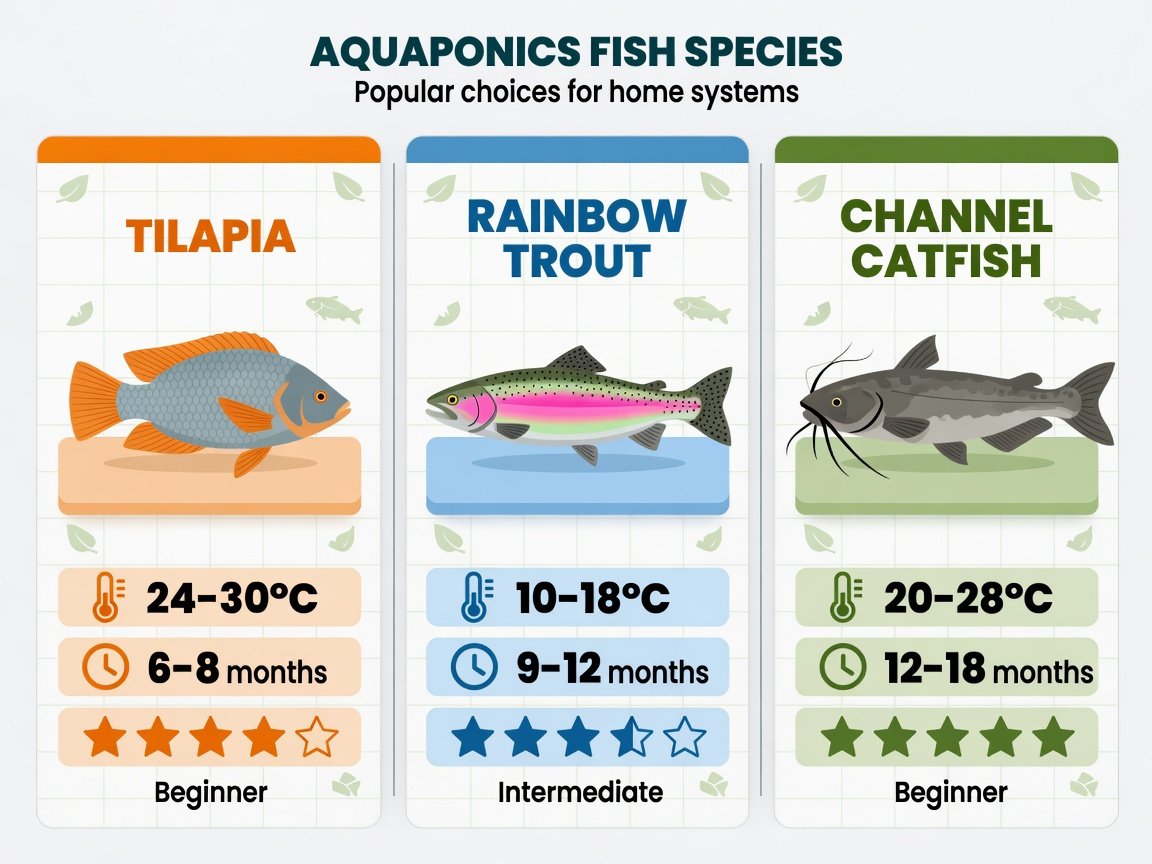
Tilapia is the world’s most widely farmed aquaponics fish, and its dominance isn’t accidental. Under optimal conditions — water temperatures between 77°F and 86°F — tilapia reaches a harvestable weight of 1 to 1.5 lbs in just six to nine months. That’s a production cycle roughly 20–30% faster than many comparable warm-water species, which makes it attractive for both home growers and small commercial operations alike.
Under optimal conditions, tilapia can reach a harvestable weight of 1 to 1.5 lbs in just six to nine months — roughly 20–30% faster than many comparable warm-water species.
The species handles pH fluctuations between 6.5 and 8.5, resists most common fish pathogens and parasites, and accepts a wide variety of commercially available feeds. For a beginner managing their first aquaponics system, these qualities add up to something genuinely valuable: margin for error. When the inevitable mistakes happen — an ammonia spike, a missed feeding, a brief temperature dip — tilapia is far more likely to survive them than a more sensitive species.
The trade-offs are real, though. Tilapia need warm water — sustained temperatures below 55°F will kill them, and growth slows significantly below 65°F. In cooler climates, heating costs become a significant ongoing expense. Their rapid breeding also requires active population management. And in several US states and countries, specific tilapia strains are classified as invasive species with possession restrictions. Check your local regulations carefully before purchasing.
If your climate is warm and your system is insulated or heated, tilapia is genuinely hard to beat as a first fish. If your ambient temperatures run cool, explore cold-water species like trout or temperature-flexible options like catfish before committing to a species that will require significant ongoing heating infrastructure.
Is Trout Worth Considering for Your Aquaponics Setup?
Trout is the premium cold-water alternative to tilapia — slower-growing, more demanding in its dietary and oxygen requirements, but highly prized for its flavour and retail value. Rainbow trout is the most commonly raised species in aquaponics, thriving in water between 55°F and 65°F (13°C–18°C) with dissolved oxygen levels maintained above 7 mg/L. Get those conditions right and trout is a remarkably productive and satisfying fish to raise.
As carnivores, trout require a high-protein diet — typically pellets containing 38–45% protein. Feed costs are noticeably higher than for omnivorous species like tilapia, but the premium retail price of locally raised, fresh rainbow trout often compensates. Trout also tolerate higher salinity levels than most aquaponics fish, which opens up some interesting possibilities for system design and experimentation.
Growth rate is the main trade-off. Rainbow trout typically takes 12–18 months to reach 1 lb under aquaponics conditions, compared to tilapia’s 6–9 months. That’s a longer investment cycle. For market growers, the premium price point and consistent consumer demand for fresh, locally raised trout can more than justify the extended production window.
Trout systems shine in temperate climates — Scotland, northern Europe, Canada, the Pacific Northwest — where ambient temperatures naturally stay cool without expensive chilling equipment. In these environments, trout may actually be the lower-effort choice. Anyone in a cooler climate who has been defaulting to tilapia out of habit should give trout a serious look before committing to ongoing heating costs.
What Other Fish Work Well in Aquaponics Systems?
The aquaponics world extends well beyond tilapia and trout. A growing range of species have been raised successfully in systems worldwide, and the best choice for your setup depends on your climate, your harvest goals, and what’s legally available in your region. Here’s a practical overview of the most viable options.
| Species | Optimal Temp | Growth to Harvest | Beginner Friendly | Best For |
|---|---|---|---|---|
| Tilapia | 77°F–86°F | 6–9 months | Yes | Warm climates, food production |
| Rainbow Trout | 55°F–65°F | 12–18 months | Intermediate | Cool climates, premium food |
| Channel Catfish | 65°F–90°F | 8–12 months | Yes | Flexible climates, food production |
| Jade Perch | 77°F–86°F | 12–18 months | Intermediate | Warm climates, health-focused market |
| Yellow Perch | 55°F–75°F | 18–24 months | Intermediate | Cool climates, premium niche market |
| Goldfish / Koi | 50°F–75°F | N/A (ornamental) | Yes | Ornamental and educational systems |
- Channel Catfish: Hardy, flavourful, and forgiving of water parameter fluctuations. Requires a minimum of 8 gallons per fish and a protein-rich diet. Grows to harvest weight in 8–12 months — a strong choice for North American and warm-climate growers.
- Largemouth Bass: Popular in US backyard systems. Reaches 1–2 lbs in 12–18 months. Juveniles often require live or frozen food initially, which adds management complexity. Best suited to growers with prior fish-keeping experience.
- Jade Perch: An Australian native species with exceptional omega-3 fatty acid levels — reportedly among the highest of any farmed freshwater fish. Grows well in warm water and accepts pellet feeds readily.
- Yellow Perch: Slower-growing at 18–24 months to harvest, but increasingly valued for its mild flavour and premium retail price in North American and European markets. Disease-resistant and well-suited to cooler water systems.
- Barramundi: A tropical species with fast growth rates comparable to tilapia. Needs water above 77°F and becomes stressed below 68°F. Increasingly used in commercial aquaponics operations across Australia and South-East Asia.
- Goldfish and Koi: The default choice for ornamental systems where fish harvest isn’t the goal. Extremely hardy, widely available, and visually striking. Ideal for educational setups, display systems, or beginners whose primary interest is the plant side of aquaponics.
For a broader look at how different fish species interact with specific plant types, system designs, and environmental requirements, this guide to optimising aquaponics fish, plants, and system requirements is an excellent reference for aligning all the moving parts of your system from the start.
How Do You Keep Water Quality in Check?
Water quality is the invisible foundation that every other aspect of aquaponics rests on. Even the hardiest species will deteriorate if key parameters drift too far outside their tolerance range. The good news: a well-established, correctly stocked system tends to self-regulate once the nitrogen cycle is running smoothly — but consistent testing remains essential, especially during the first three months.
Six parameters demand regular attention: ammonia, nitrite, nitrate, pH, dissolved oxygen, and water temperature. In a cycled, healthy system, ammonia and nitrite should read at or near zero. Any reading above 1 mg/L for either is a red flag. Act immediately — reduce feeding, increase aeration, and check for dead fish or decaying organic matter. Don’t wait to see whether it resolves on its own.
pH should sit between 6.8 and 7.2 for most aquaponics species. Below 6.5, nitrifying bacteria become less effective at converting ammonia — and the whole system slows down. Above 7.8, key nutrients become chemically locked out and unavailable to plants. Stability within this sweet spot is the goal, and small, gradual adjustments are always preferable to sharp corrections.
Dissolved oxygen should stay above 5 mg/L at all times — 7 mg/L or higher is ideal, particularly in densely stocked systems. Low dissolved oxygen is one of the fastest routes to fish mortality. Adding an air pump, increasing surface agitation, or improving water circulation are the most effective fixes. Algae blooms — triggered by excessive light — can cause significant overnight oxygen drops, so manage light exposure carefully in outdoor or greenhouse setups.
Test your water at least twice per week during the first three months. Once your system stabilises, weekly testing is usually sufficient. Keep a logbook. Patterns in the data — gradual pH drift, slowly climbing ammonia — reveal problems before they become visible in the fish. Catching a trend early is always far easier than managing a full system crash.
Step-by-Step: How to Select the Right Fish for Your Aquaponics System
- Check local regulations first. Confirm which species are legal to raise in your area before spending anything. Some tilapia strains and non-native species carry possession restrictions in specific regions. This is a non-negotiable first step.
- Match your fish to your climate. Determine whether your ambient temperature suits warm-water or cold-water species. Choose accordingly to minimise ongoing heating or cooling costs — the right species for your climate is almost always the more cost-effective choice long-term.
- Calculate your available tank volume. Measure your tank and apply the 0.3 lbs per gallon starting density guideline for beginners. Scale up only after your system has proven stable over several months of operation.
- Size your filtration to your fish load. A practical guide: at least one square foot of established grow bed media per 1–2 lbs of fish at maturity. Err on the side of more grow bed rather than less — over-filtering is rarely a problem.
- Source fingerlings locally where possible. Local hatcheries supply fish already adapted to your regional water chemistry. They carry a lower disease risk than fish transported long distances and typically offer better post-purchase support and advice.
- Cycle your system before adding fish. Run the system for four to six weeks, adding a daily ammonia source — a small amount of fish food or pure ammonia solution — to establish beneficial bacteria. Don’t rush this stage. Adding fish to an uncycled system risks losing your entire initial stock.
- Introduce fish gradually. Add no more than 50% of your target population on day one. Monitor ammonia and nitrite daily for the first two weeks. Add the remaining fish only once readings have stabilised at or near zero for at least five consecutive days.
Frequently Asked Questions
What is the easiest fish to raise in a beginner aquaponics system?
Tilapia is the top choice for beginners running a food-producing system — fast-growing, disease-resistant, and tolerant of the fluctuations that come with learning. For ornamental systems, goldfish and koi are equally forgiving and far more affordable to replace if problems arise. In cooler climates, channel catfish offers a similar level of resilience to tilapia with a broader temperature tolerance range.
How many fish can I put in my aquaponics tank?
Start at 0.3 lbs of fish per gallon of total system water as a beginner. Experienced growers with mature, well-established biofilters can push to 0.5 lbs per gallon. Beyond that threshold, you risk ammonia spikes and oxygen depletion. Always increase stocking density slowly and test water parameters after every addition to confirm the system is keeping pace with the increased bio-load.
Can I mix different fish species in one aquaponics system?
It’s technically possible but not recommended for beginners. Different species often have incompatible temperature, pH, or dissolved oxygen requirements. Predatory species will eat smaller tank mates. If you do mix species, choose ones with near-identical water parameter requirements and similar adult sizes — and introduce the more aggressive or larger species last, once the system is well-established.
Do I need a permit to raise fish for food in an aquaponics system?
Requirements vary significantly by country, state, and species. Small-scale home aquaponics for personal consumption generally doesn’t require a permit in most regions. However, certain species — particularly specific tilapia strains in warm US states, or any non-native species in many countries — may be restricted or prohibited. Always check with your local fisheries or agriculture authority before purchasing fingerlings.
How long does it take for aquaponics fish to reach harvest size?
Tilapia typically reaches 1–1.5 lbs in 6–9 months under warm, well-fed conditions. Rainbow trout takes 12–18 months to reach a similar weight. Channel catfish falls in between at roughly 8–12 months. These timelines can be shortened with optimised water temperature, feeding frequency, and stocking density — but they can’t be eliminated. Plan your growing calendar accordingly from the outset.
What water temperature is best for an aquaponics system?
There’s no single universal answer — the right temperature depends entirely on your chosen species. Warm-water species like tilapia and catfish prefer 70°F–86°F (21°C–30°C). Cold-water species like rainbow trout thrive at 55°F–65°F (13°C–18°C). Pick your species first, then design your temperature management around it. Choosing a fish to match your natural conditions is almost always the lower-cost, lower-effort path.
How do I know when my aquaponics system is ready for fish?
Your system is ready for fish when ammonia and nitrite readings are at or near zero after four to six weeks of daily ammonia dosing, and nitrate is detectable in the water — typically 5–40 mg/L. This confirms that nitrifying bacteria are established and actively processing waste. Adding fish before reaching this point places them into toxic water and almost always results in rapid losses.
Your Fish Choice Sets Everything Else — Choose Thoughtfully
Fish selection isn’t a detail you can revisit later. It’s the founding decision that determines your tank dimensions, your heating or cooling requirements, your feed budget, your filtration design, and your expected harvest timeline. Make it carefully, based on your climate and your current experience level, and every subsequent decision becomes more straightforward.
Start with a species that matches where you are today — tilapia for warm environments, trout for cool ones, catfish when you need a temperature-flexible option with excellent food value. Cycle your system thoroughly, stock conservatively at first, and test your water consistently. These habits — far more than expensive equipment or elaborate system designs — are what separate growers who thrive from those who give up after the first system crash.
Once you’ve committed to a species, the next logical decision is system sizing. Choosing the right size for your aquaponics system walks through how to scale your setup around your chosen fish population and your production ambitions — a natural and necessary next step once you know which fish you’re working with.
2 Replies to “Choosing The Perfect Fish For Your Aquaponics System – Aquaponics made simple”