If you want faster growth and bigger yields from a smaller space, hydroponics wins. If you want lower startup costs and a more forgiving learning curve, soil wins. The right choice depends entirely on your goals, budget, and how hands-on you want to be with your growing environment.
Key Takeaways
- Hydroponic plants typically grow 30–50% faster than soil-grown plants under equivalent conditions.
- Hydroponics uses up to 90% less water than conventional soil-based growing.
- A basic soil garden can be started for under £20; a starter hydroponic system generally costs £40–£500 depending on complexity.
- Neither method is universally superior — the best choice is the one that fits your space, goals, and available time.
What Is the Real Difference Between Hydroponics and Soil Growing?
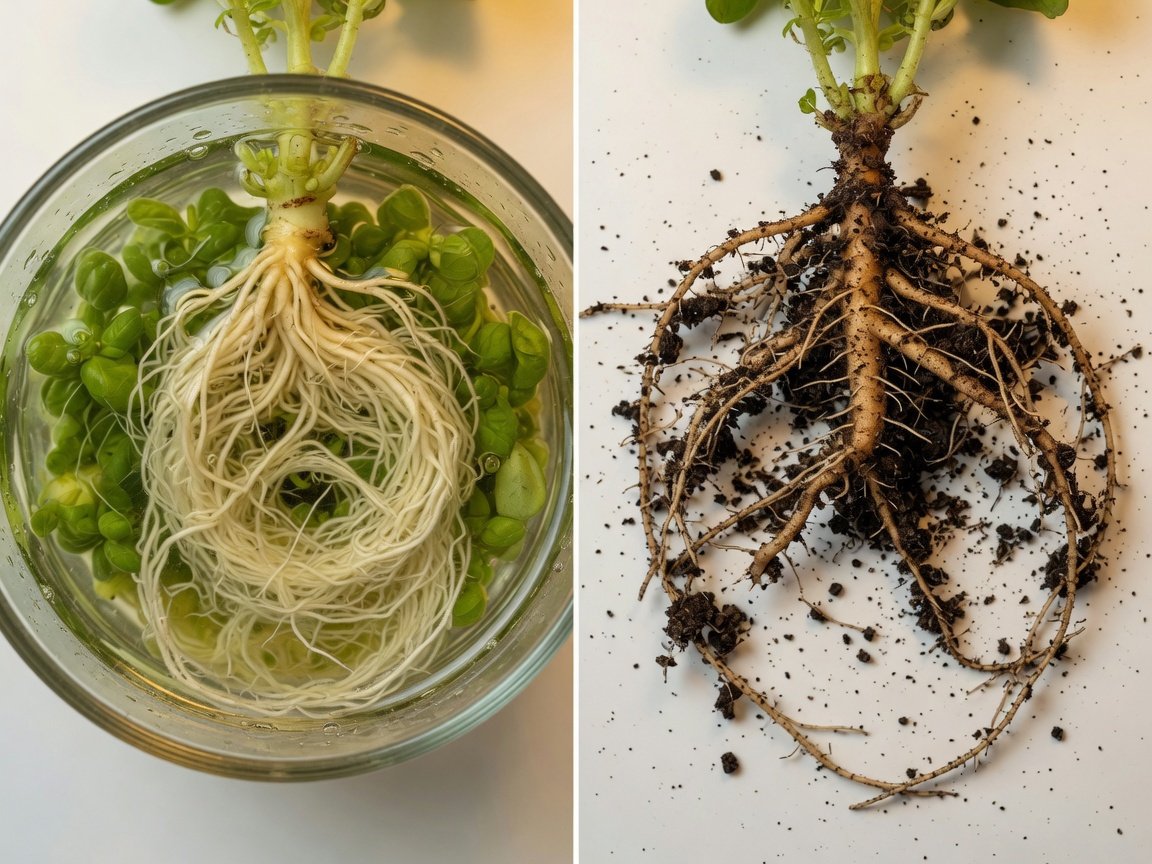
The difference comes down to how plant roots receive their nutrition. In soil growing, nutrients are locked into organic matter and slowly released as billions of microorganisms break it down. A single teaspoon of healthy garden soil contains more microorganisms than there are people on earth — bacteria, fungi, nematodes, and a host of other life forms that interact with plant roots in complex, mutually beneficial ways. Plants respond by growing extensive root systems to seek out water and food across a wide area. It’s a self-regulating system that has sustained agriculture for millennia.
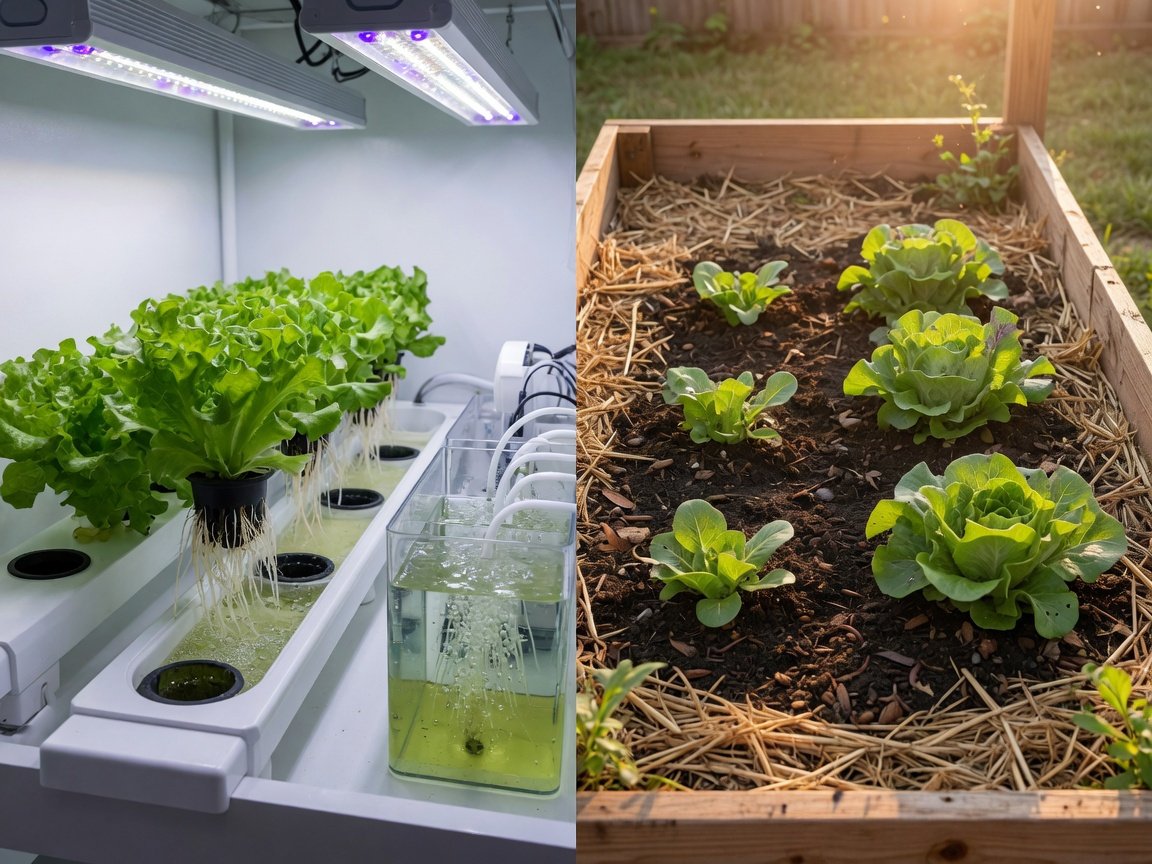
Hydroponics removes soil from the equation entirely. Plant roots sit directly in a nutrient-rich water solution — or in an inert growing medium like perlite, clay pebbles, or rockwool — and receive precisely measured nutrition on demand. Because the plant doesn’t need to search for food, it redirects that energy into vegetative growth and fruit production instead. That single redirection is what drives the dramatic performance differences people associate with soilless growing.
The commercial growing world has clearly noticed. The global hydroponics market was valued at over $9 billion in 2023, according to industry market analysts, and is growing steadily as more operators recognise the efficiency advantages of soilless cultivation. Controlled environment agriculture — the broader category that includes hydroponics, aquaponics, and vertical farming — is now one of the fastest-growing segments in food production worldwide.
Soil, however, brings something that no nutrient solution has fully replicated: biological complexity. That living ecosystem provides natural disease buffering, mineral cycling, and flavour compounds that experienced gardeners value highly — and that are genuinely difficult to reproduce in a synthetic growing environment. Understanding both systems clearly is what makes the choice meaningful rather than arbitrary.
How Much Faster Do Hydroponic Plants Actually Grow?
The growth speed advantage of hydroponics is one of the most consistently documented differences between the two methods. Research from controlled environment agriculture institutions, combined with data from commercial producers, places the hydroponic growth rate advantage at 30–50% faster than equivalent soil-grown plants — and for some crops and system types, the difference is even more pronounced.
Lettuce is the clearest illustration. In soil, a standard head of lettuce takes 60 to 70 days from transplant to harvest. In a well-managed deep water culture or nutrient film technique hydroponic system, the same variety is typically ready in 30 to 35 days. That’s roughly double the number of harvest cycles per year from the same growing space — a significant commercial advantage and a genuinely useful benefit for home growers who want continuous harvests through the season.
Tomatoes, cucumbers, peppers, and basil all show similar acceleration in hydroponic environments. NASA’s Controlled Ecological Life Support System programme — developed to explore food production for long-duration space missions — has consistently demonstrated that hydroponics can sustain fast, reliable plant growth without any soil at all. Research from that programme helped establish many of the nutrient formulations and system designs that commercial hydroponic growers use today.
The faster growth cycle also creates a shorter feedback loop. If a nutrient deficiency develops, you’ll see the symptoms and be able to correct them within days rather than weeks. That speed of response makes it easier to refine your technique and produce consistent results over time.
Which Method Conserves More Water?
Water efficiency is where hydroponics has its most decisive advantage over soil growing. In conventional soil gardening and farming, water is lost in multiple directions simultaneously — evaporation from the soil surface, runoff from heavy watering, and deep percolation beyond the root zone into ground the roots will never reach. Research estimates that as little as 40–60% of water applied to soil actually reaches the plant in many growing conditions.
Hydroponic systems are largely closed-loop. Water that isn’t absorbed by plant roots is captured, filtered, and recirculated back through the system. Losses occur mainly through direct plant uptake and minor surface evaporation from the reservoir. Industry figures consistently place hydroponic water consumption at 70–90% less than equivalent soil-based cultivation for the same crop output. That’s not a marginal improvement — it represents a fundamental shift in how efficiently a growing system uses one of its primary inputs.
For home growers in areas with water restrictions, or anyone on a meter and watching usage costs, this efficiency gain translates into real savings over a full growing season. A small hydroponic herb system might consume just 3–5 litres per week to sustain what a soil container garden would require significantly more to keep healthy, especially in warm weather when evaporation losses from soil surface accelerate.
Soil can be improved with amendments like compost, coco coir, and mulching to reduce evaporation and improve moisture retention. But even a well-managed, mulched soil bed will always lose more water to the environment than a properly designed hydroponic recirculating system. On pure water efficiency, the result is clear.
How Do the Startup Costs Compare Between the Two Methods?
This is where soil gardening holds its strongest advantage. The barrier to entry for soil growing is almost zero. You need a container or a patch of ground, some compost or potting mix, and seeds or seedlings. A complete beginner can put together a productive kitchen herb garden for under £20 and start harvesting within a few weeks. For a raised bed growing a range of vegetables, you’re looking at £30–£80 for materials, depending on size.
Hydroponics requires more upfront investment. At minimum, you need a reservoir, a growing medium, pH testing equipment, and a purpose-formulated nutrient solution. A passive Kratky-method system for growing lettuce — arguably the simplest hydroponic approach, requiring no pump or electricity — can be assembled for £40–£80. A proper deep water culture or flood-and-drain system capable of handling a range of crops typically costs £150–£500 before factoring in grow lighting for indoor setups, which can add another £80–£300 or more depending on the size and quality of the fixture.
Running costs differ too. Hydroponics requires electricity for pumps, timers, and often lighting. Soil growing outdoors has almost no ongoing energy cost. On the other hand, soil growing requires ongoing purchases of compost, fertiliser, and soil amendments to maintain productivity over multiple seasons — costs that hydroponics largely avoids once a good nutrient solution routine is established.
| Factor | Hydroponics | Soil Growing |
|---|---|---|
| Startup Cost | £40–£500+ depending on system type | Under £20 to get started |
| Water Use | Up to 90% less than soil | Higher — losses to evaporation and runoff |
| Growth Speed | 30–50% faster on average | Standard pace, subject to seasonal variation |
| Yield per m² | Significantly higher, especially with vertical growing | Lower plant density; roots need lateral space |
| Ongoing Maintenance | Daily pH and nutrient level monitoring | Periodic watering, feeding, and weeding |
| Learning Curve | Moderate to steep — precision required | Gentle — very beginner-friendly |
| Best For | Fast crops, limited space, water-conscious growing | Low-budget starts, outdoor growing, heritage varieties |
Which Method Produces Better Yields?
When measured per square metre of growing space, hydroponics almost always outperforms soil — and the gap widens significantly when vertical growing is factored in. Commercial hydroponic lettuce operations can produce 10 times more lettuce per square metre per year than equivalent field-grown production, according to figures published by controlled environment agriculture researchers. That yield multiplier is what makes hydroponics so attractive to urban farms operating in expensive, space-constrained environments.
The yield advantage compounds from several factors working together. Faster growth cycles mean more harvests per year from the same infrastructure. Precise nutrient delivery means plants rarely experience deficiency-driven growth slowdowns. And because soilless systems can be stacked vertically — with growing channels mounted in towers or shelving units — the effective growing area within a given floor footprint can be multiplied several times over. Soil cannot be stacked in the same way without becoming structurally impractical.
For home growers with a balcony or small indoor space, this stacking potential changes the equation entirely. A vertical hydroponic tower positioned in front of a south-facing window or under grow lights can produce more salad greens in a season than a comparably sized raised bed planted in soil. If maximising output from a limited footprint is the primary goal, hydroponics is the clear winner.
Soil can match or exceed hydroponics for certain large crops — established fruit trees, sprawling squash plants, or deep-rooted brassicas — where roots genuinely benefit from the structure and microbial ecosystem of a rich, well-managed growing medium. For those crops, the infrastructure cost of hydroponics rarely justifies the return over a well-maintained raised bed.
Does Growing Method Change Food Quality or Flavour?
This is one of the most genuinely contested debates in growing — and the honest answer is more nuanced than the advocates on either side typically admit. Nutritionally, hydroponic produce can be just as dense as soil-grown produce when the nutrient solution is properly balanced and monitored. Some studies have found higher vitamin C concentrations in hydroponically grown tomatoes and leafy greens; others have found the results comparable or slightly lower. The key variable in almost every case is technique, not the growing medium itself.
Flavour is where the disagreement sharpens most. Many experienced gardeners insist that soil-grown tomatoes, strawberries, and root vegetables have a complexity and depth that hydroponics struggles to replicate consistently. This may relate to the vast range of trace minerals, secondary metabolites, and biological compounds that a rich, living soil transfers to plants over a full growing season — compounds that even a carefully formulated nutrient solution may not fully replicate. Heirloom tomato growers and heritage vegetable enthusiasts tend to be particularly emphatic on this point.
Hydroponic growers counter — often convincingly — that freshness is the dominant variable in perceived flavour. Produce harvested in the morning and eaten by lunchtime simply tastes better than anything that has spent three days in a distribution chain. Since hydroponic systems can be placed at the point of consumption, the freshness advantage is real and measurable. Supermarket soil-grown produce may have been travelling for 48–72 hours before reaching a plate, losing aromatic volatile compounds throughout that journey.
The practical conclusion: for nutritional density and freshness, both methods can excel when managed with care. For nuanced flavour profiles in fruit crops and root vegetables, soil often has an edge. For fast-growing greens and herbs, hydroponics frequently wins purely because the product reaches the plate faster.
Which Is Easier for Beginners to Get Right?
Soil is more forgiving — and that forgiveness matters enormously when you’re still learning. If you forget to water for a couple of days, a well-structured soil will buffer the moisture stress and your plants will likely recover without serious damage. If your pH is a point off in a soil garden, the natural biological buffering capacity of a healthy growing medium will often compensate before visible symptoms appear. Soil absorbs a lot of beginner mistakes without turning them into failures.
Hydroponics is less forgiving by its nature. pH swings in a nutrient solution can lock out critical minerals within hours of the shift occurring. A pump failure in a recirculating system can stress or kill plants overnight, particularly during warm weather when roots dry out quickly. Nutrient imbalances that would be buffered naturally in soil show up fast in a hydroponic reservoir — often within 24 to 48 hours. These aren’t reasons to avoid hydroponics, but they do mean that developing good monitoring habits early is genuinely important, not optional.
Modern hydroponic starter kits have reduced the technical barrier significantly compared to even five years ago. Pre-mixed, pH-stable nutrient solutions are widely available from reputable suppliers. Inexpensive digital pH meters (typically £15–£30) and EC meters for measuring nutrient concentration take most of the guesswork out of water management. Many beginners find that once they get past the initial setup phase, a simple passive or deep water culture system feels manageable day-to-day — sometimes less work than a thirsty soil container garden in summer.
A sensible approach for many people is to start with soil, learn what healthy plants look and behave like, then transition to a simple hydroponic system once you have a confident baseline. That progression builds real competence without exposing you to the most common pitfalls right at the beginning.
Can You Blend Soil and Water-Based Growing?
Yes — and the results can be genuinely compelling. Hybrid approaches that combine some of the natural richness of soil with the water efficiency of hydroponic-style delivery have been gaining ground among small-scale and backyard growers over the past several years. The most established example is the wicking bed, which has seen strong adoption in water-scarce regions and urban growing setups worldwide.
A wicking bed places a layer of soil or compost above a sealed water reservoir. Plants draw moisture upward through capillary action — wicking — rather than relying on water applied from above. This keeps the root zone consistently moist without waterlogging, eliminates most surface evaporation losses, and significantly reduces how often you need to water. It’s a practical middle ground that delivers some of the water efficiency of hydroponics while retaining the biological richness of a soil-based root environment. For growers who want the benefits of both systems without the technical complexity of a full hydroponic setup, it’s worth serious consideration.
If you’re interested in how this hybrid approach works in practice — particularly within a fish-based growing system — the detailed guide on utilizing wicking beds in aquaponics systems covers exactly how soil and water can be combined effectively, including setup considerations and what crops benefit most.
Another popular hybrid is coco coir — a coconut fibre growing substrate that behaves somewhat like soil in terms of texture and water retention, but is technically an inert medium used with liquid nutrients in the same way as hydroponics. Many experienced growers describe coco coir as the ideal transitional medium for gardeners moving from soil to full hydroponics, because it combines familiar physical characteristics with the precise nutrient control of soilless growing.
How Does Aquaponics Fit Into the Soil vs. Hydroponics Picture?
Aquaponics deserves a mention here because it represents a third path that often gets overlooked when growers frame the debate purely as soil versus hydroponics. In an aquaponic system, fish and plants grow together in a closed-loop ecosystem. Fish produce waste that beneficial bacteria convert into plant-available nutrients. Plants absorb those nutrients and filter the water, which cycles back clean to the fish. It’s a self-sustaining biological system that eliminates the need for synthetic nutrient inputs once the biological cycle is established. If you’re curious about how the core mechanics differ from conventional hydroponics, the detailed guide on the key differences between aquaponics and hydroponics covers the fundamentals clearly.
Aquaponics shares most of the water efficiency benefits of hydroponics — systems are largely recirculating, with losses mainly due to direct plant uptake and surface evaporation. Growth rates are generally faster than soil, though typically not quite as fast as a highly optimised nutrient film technique hydroponic system operating on precision-mixed synthetic nutrients. The tradeoff is a more forgiving biological system that adjusts to minor imbalances naturally, and the added reward of producing fish protein alongside vegetables.
If you’re genuinely weighing up all three options and want a structured comparison — including setup complexity, cost, and which crops suit each approach best — the full breakdown at Aquaponics vs Hydroponics: Choosing the Right Soilless System is worth reading before committing to any single direction. The choice between these systems depends significantly on whether you want a fish component, how much biological complexity you’re comfortable managing, and what your primary crop goals are.
How Do You Choose the Right Growing Method for Your Situation?
The choice between hydroponics and soil doesn’t need to be permanent or mutually exclusive. Many experienced growers run both in parallel — soil for perennial crops, fruit trees, and flavour-sensitive varieties; hydroponics for fast-cycling greens, herbs, and off-season production. That pragmatic combination is often the smartest approach once you have experience with each method. But when starting out, a clear decision framework helps.
- Define your primary priority. If speed and yield are what matter most, lean toward hydroponics. If cost and simplicity are the deciding factors, start with soil. Be honest about what you actually want from the system, not what sounds most impressive.
- Assess your growing space. Working indoors or on a small balcony? Hydroponics — especially vertical systems — extracts significantly more output per square metre. Have a large outdoor garden? Soil is likely more practical and cost-effective at that scale.
- Check your water situation. In a water-restricted area, or paying high utility rates? Hydroponics’ 70–90% water reduction becomes a real financial and environmental benefit over a full season. In a wetter climate with free rainwater collection, the advantage narrows.
- Be realistic about your available time. Hydroponics rewards daily attention — checking pH, monitoring nutrient levels, inspecting equipment for leaks or pump failures. If you travel regularly or prefer a lower-maintenance setup, a well-amended soil bed is more forgiving of inconsistent attention.
- Match the method to your crops. Leafy greens, herbs, cucumbers, tomatoes, peppers, and strawberries thrive in hydroponics. Root vegetables, fruit trees, and many heritage varieties perform better in soil. Don’t choose a system and then force the wrong crops into it.
- Start smaller than you think you need to. Whether you choose hydroponics or soil, begin with one manageable system, observe it carefully, and expand once you understand its rhythms. Over-scaling a first system is the most common reason new growers abandon both methods and conclude that they “just don’t have a green thumb.”
Set a realistic goal: your first harvest within 6–8 weeks of setup. That’s achievable with both methods when you start with fast-cycling crops — lettuce, radishes, spinach, or basil. That early success builds the confidence and enthusiasm to develop your system further over the following months, rather than losing momentum waiting for results that take longer to materialise.
Frequently Asked Questions About Hydroponics vs Soil
Is hydroponically grown food as nutritious as soil-grown food?
Yes, when the nutrient solution is properly balanced and managed. Hydroponic produce can deliver comparable or superior nutritional profiles to soil-grown equivalents — some studies have found higher concentrations of vitamin C and certain antioxidants in hydroponic leafy greens and tomatoes. The quality of any produce depends primarily on how well the growing system is managed. A poorly maintained hydroponic system will produce nutritionally thin food; so will a depleted, over-farmed soil. Technique matters more than the medium.
How long does it take to set up a basic hydroponic system?
A simple passive system — like a Kratky lettuce setup in a lidded container — can be assembled, filled with nutrient solution, and planted within a couple of hours. A more complete recirculating system with a reservoir, pump, timer, growing channels, and growing medium typically takes a weekend to set up properly. Allow at least 24–48 hours after filling for the system temperature to stabilise and for pH to settle before transplanting seedlings. Budget a week from system assembly to first planting for best results.
Can I grow any plant using hydroponics?
Technically yes — almost any plant can be grown hydroponically with the right system design. In practice, some crops are far better suited than others. Leafy greens, herbs, tomatoes, cucumbers, peppers, and strawberries are consistently successful hydroponic crops with well-established nutrient and system recommendations. Large root vegetables like carrots, parsnips, and beetroot are difficult to grow hydroponically because they need deep, structured growing space that most systems don’t accommodate well. Fruit trees and shrubs are rarely practical in home hydroponic setups. Start with the proven crops and expand from there as your confidence grows.
Is hydroponic farming considered organic?
This is genuinely contested territory, and the answer varies by country and certifying body. In many jurisdictions — including the UK — certified organic hydroponic production is permitted provided the nutrient inputs are sourced from organically approved materials. In others, particularly in parts of the EU, the definition of organic farming explicitly requires interaction with living soil, which disqualifies hydroponics by definition. The debate among certification bodies is ongoing and has not reached a global consensus. If organic certification matters to your production goals, check the current rules for your specific jurisdiction before building a hydroponic system with that intention.
What is the most common mistake beginners make when starting with hydroponics?
Neglecting pH management is consistently the most common beginner error — and the one that causes the most frustration. Plant roots in a hydroponic system can only absorb specific nutrients within a relatively narrow pH window, typically 5.5 to 6.5 depending on the crop. When pH drifts outside that range, nutrient lockout occurs: the plant shows deficiency symptoms even though the nutrients are physically present in the solution. Many beginners respond by adding more nutrients, which compounds the problem. The actual fix is almost always a pH adjustment. Invest in a reliable digital pH meter from the start and make checking it part of your daily routine — it takes about 30 seconds and prevents hours of troubleshooting.
Does hydroponic produce taste different from soil-grown produce?
For fast-growing crops like lettuce, spinach, and soft herbs, freshness is by far the dominant flavour factor — and hydroponics often wins this comparison because the produce can be harvested and eaten within the same day. For fruit crops like tomatoes and strawberries, many experienced growers find that soil-grown varieties develop greater flavour complexity, particularly when grown in a rich, biodiverse soil over a full season. That said, the differences between a freshly harvested hydroponic tomato and a freshly harvested soil-grown tomato of the same variety are far smaller than the difference between either of those and a tomato that spent three days in a supermarket distribution chain. Freshness almost always beats growing method as the primary taste variable.
The Bottom Line
The hydroponics vs soil debate doesn’t resolve into a single right answer — it resolves into the right answer for your situation. Hydroponics excels at speed, water efficiency, and yield density within limited spaces. Soil excels at low-cost entry, biological complexity, and flavour depth for certain crops. Both methods produce outstanding results in the right hands, and both can be adapted and refined over time as your knowledge and confidence grow.
The most important step is simply to start. Pick one system, choose fast-cycling beginner crops, and learn from real plants in real time. The theory in any comparison article — including this one — only takes you so far. The actual education happens the moment roots hit water or soil and you start paying close attention to what the plants are telling you.
Once you’ve genuinely mastered one approach, the other becomes much easier to understand and integrate. The most productive growers aren’t loyal to one method — they’re fluent in both, and they use each one where it naturally excels. That fluency is worth working toward: not a choice between two systems, but the practical knowledge to run either one well.
—