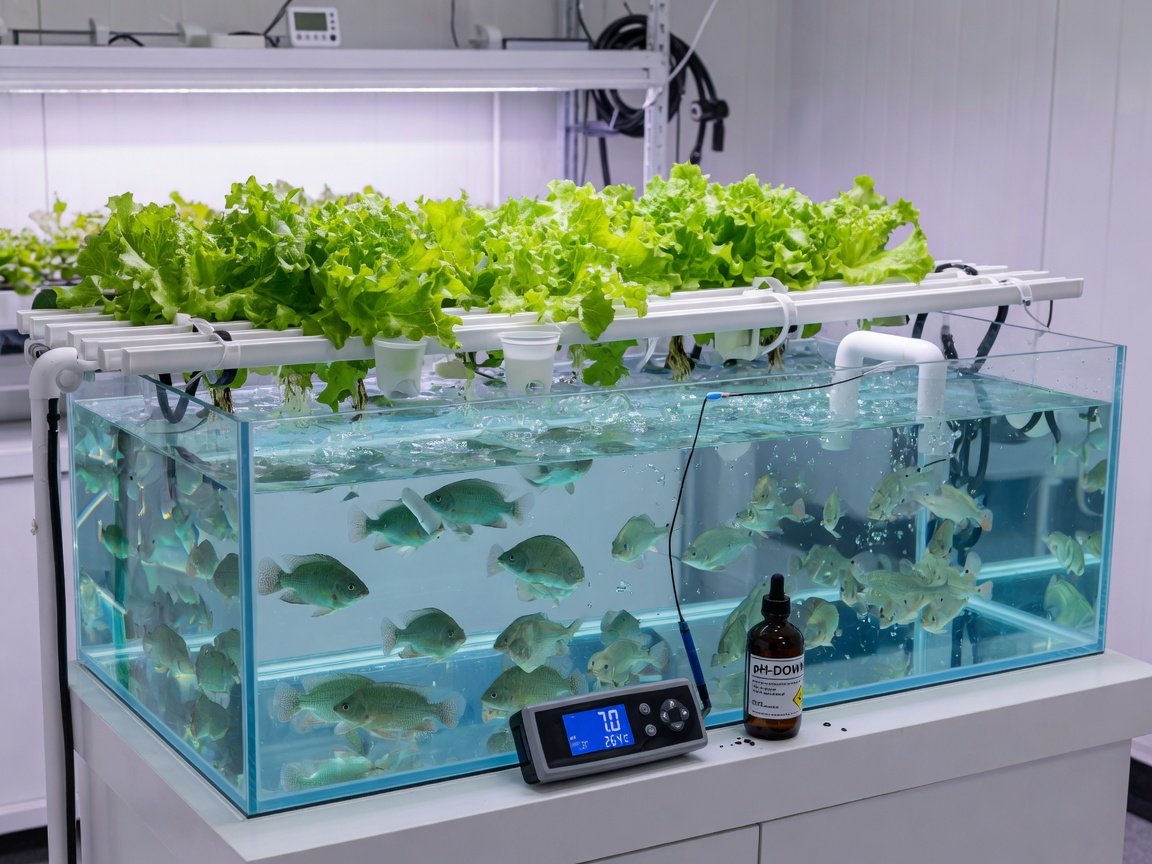
To lower pH in aquaponics, add diluted food-grade phosphoric acid, inject CO2, or blend in reverse-osmosis water — always adjusting by no more than 0.2 pH units per day to protect your fish, your plants, and the nitrifying bacteria that hold your entire system together.
Executive Summary
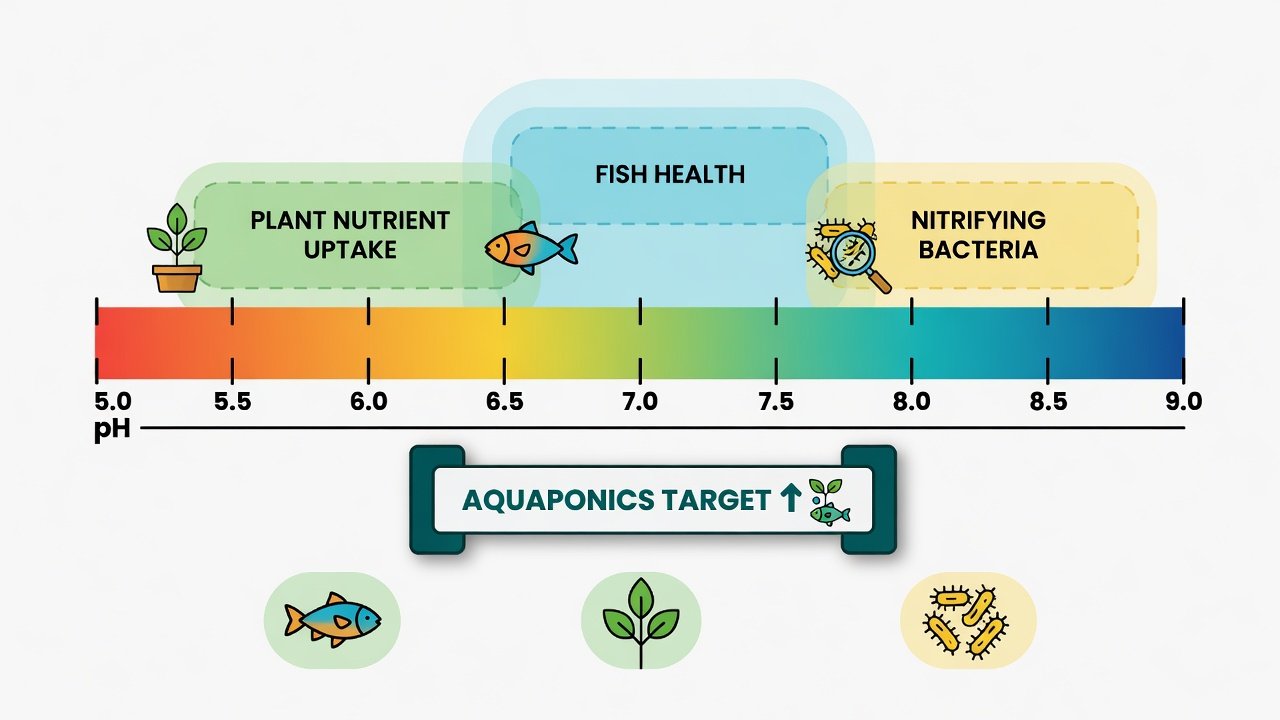
- The target range: Aquaponics systems perform best at a pH of 6.8–7.2 — a biologically informed compromise between fish health (optimal 7.0–8.0), plant nutrient uptake (optimal 5.5–6.5), and nitrifying bacteria efficiency (optimal 7.5–8.5).
- Why pH creeps upward: Alkaline municipal water, carbonate-based grow media, and the chemistry of fish waste all push system pH higher over time — a challenge affecting roughly 85% of U.S. operators relying on municipal water supplies.
- Top-performing methods: Phosphoric acid is used by approximately 60% of commercial aquaponics operations in the United States; CO2 injection is the fastest-growing alternative in 2025–2026, valued for its precision and fish-friendly pH reduction mechanism.
- The cardinal rule: Never lower pH more than 0.2 units per 24-hour period. Rapid pH swings trigger acute osmotic stress in fish and can permanently collapse nitrifying bacteria populations — a setback that can take weeks to reverse.
What Is the Ideal pH Range for Aquaponics Systems?
The ideal pH for aquaponics sits between 6.8 and 7.2. That narrow band is not arbitrary — it reflects a deliberate compromise across three competing biological requirements that every aquaponics operator must balance simultaneously. Fish generally thrive at pH 7.0–8.0. Plants absorb key micronutrients most efficiently between pH 5.5 and 6.5. The nitrifying bacteria that convert fish ammonia into plant-usable nitrates function optimally at pH 7.5–8.5. Running at 6.8–7.2 satisfies all three, even if it’s not perfectly ideal for any single one.
According to the University of the Virgin Islands aquaponics research program — one of the most cited production benchmarks in the industry — commercial systems maintained consistently at pH 7.0 outperform those allowed to drift above 7.5 in measurable plant yield and fish health scores. A 0.5-unit difference across the full growing season translates to significant revenue impact in commercial operations.
Species selection shapes your target range. Tilapia — the dominant commercial fish in U.S. aquaponics — survive across pH 6.0–9.0 but thrive at 7.0–8.0. Rainbow trout prefer cooler, slightly more acidic conditions: pH 6.5–7.5. Largemouth bass and channel catfish do well at 6.5–8.0. Freshwater prawns, increasingly popular in southern U.S. warm-climate systems, perform best at 7.0–8.0. Lettuce and leafy greens tolerate 6.0–7.5. Fruiting crops like tomatoes and peppers prefer 5.5–6.5. Knowing your species and crop pairing defines your operational pH target from day one.
Why Does pH Keep Rising in Aquaponics Systems?
Understanding why pH rises is as operationally important as knowing how to lower it. In most recirculating aquaponics systems, pH climbs continuously from multiple drivers working simultaneously. Addressing those drivers at the source is almost always more cost-effective than reactive acid dosing month after month.
Source water is the primary culprit. According to USDA water quality monitoring data, over 85% of U.S. municipal water systems deliver water at pH 7.5–8.5 with significant carbonate hardness (KH). Every water top-off introduces fresh alkalinity that fights your pH reduction efforts. The higher your source water KH, the more acid — or CO2 — it takes to achieve meaningful pH reduction. This buffering effect is why many operators add acid and see pH barely move.
Grow media is another overlooked driver. Limestone gravel, crushed oyster shell, and certain volcanic aggregates slowly release carbonates into the water column over months of use. These dissolved carbonates form a chemical buffer that neutralizes acid additions before they can register as a pH drop. If your media is calcareous — meaning it contains calcium carbonate — you may be fighting an unwinnable battle without switching it out.
Photosynthesis creates a daily pH pattern that many operators fail to account for. During daylight hours, plant roots absorb dissolved CO2 from the water column, removing a natural acid source and causing pH to climb. At night, respiration releases CO2 back into solution, gently lowering pH. In high-density plant systems, this diurnal swing can reach 0.5–1.0 pH units — significant enough to stress fish if your baseline is already near the upper limit of tolerance.
How Does High pH Damage Your Fish and Plants?
A system running above pH 7.5 inflicts measurable, compounding damage on both your fish and your crop yield. The effects are not always immediately visible — but the underlying chemistry begins degrading performance the moment pH climbs out of the optimal window.
For plants, the primary mechanism is nutrient lockout. Iron — an essential micronutrient for chlorophyll synthesis — becomes increasingly insoluble above pH 7.0 and is essentially unavailable at pH 7.5 and above. Research in plant nutrition shows that iron bioavailability drops by over 90% as pH moves from 7.0 to 8.0. The result is interveinal chlorosis: young leaves yellow between the veins while older leaves stay green. This symptom is frequently misdiagnosed as nitrogen or magnesium deficiency, leading operators to add unnecessary supplements while the real problem — high pH — continues unchecked. Manganese, zinc, copper, and boron follow the same solubility curve.
For fish, elevated pH creates an ammonia toxicity multiplier that most operators don’t account for. Ammonia in water exists in two forms: ionized ammonium (NH4+), which is relatively harmless, and un-ionized ammonia (NH3), which is acutely toxic to fish at very low concentrations. The ratio between these forms is governed directly by pH. At pH 7.0, approximately 0.5% of total ammonia nitrogen is the toxic NH3 form. At pH 8.0, that fraction jumps to around 5%. At pH 9.0, it exceeds 50%. This means a system running at pH 8.5 with a “safe-looking” total ammonia reading of 2 ppm may actually be exposing fish to toxic NH3 levels that cause gill inflammation, immune suppression, and chronic stress.
Nitrifying bacteria — your system’s nitrogen cycle engine — also suffer when pH moves to either extreme. While they tolerate the 6.8–7.2 operational range well, a rapid drop below 6.0 can crash Nitrosomonas and Nitrobacter colonies within 24 hours. Recovering a crashed nitrogen cycle typically takes 2–6 weeks and involves dangerous ammonia and nitrite spikes that threaten fish survival. This is the core reason why controlled, gradual pH adjustment is non-negotiable — not a preference, but a biological requirement.
What Are the Most Effective Methods to Lower pH in Aquaponics?
Expert aquaponics operators rely on six primary pH-reduction methods, each with distinct advantages, cost profiles, and practical limitations. Choosing the right approach depends on your system scale, certification requirements, source water chemistry, and how urgently pH needs correction.
| Method | Speed | Precision | Cost | Best Application | Organic Compatible |
|---|---|---|---|---|---|
| Phosphoric Acid | Fast (hours) | High | Low–Medium | Commercial & mid-scale systems | No |
| CO2 Injection | Medium (hours) | Very High | Medium–High | Precision-controlled operations | Yes |
| Citric Acid | Fast (hours) | Medium | Medium | Small organic-certified systems | Yes (food-grade) |
| RO Water Blending | Slow (days–weeks) | Low | High (equipment) | Reducing system KH long-term | Yes |
| Rainwater Collection | Slow (ongoing) | Low | Low (infrastructure) | Rural, off-grid, low-volume systems | Yes |
| Muriatic Acid (HCl) | Very Fast | Low | Very Low | Emergency correction only | No |
According to Nelson and Pade Aquaponics — one of the most respected aquaponics education and consulting organizations in the United States — phosphoric acid is the method of choice for approximately 60% of commercial U.S. aquaponics operators surveyed in their 2025 practitioner benchmarking report. CO2 injection adoption has more than doubled since 2023, driven by falling equipment costs and growing interest in automated, precision pH management. Muriatic acid, while cheap and fast, is rarely recommended by experienced practitioners due to its tendency to cause sharp pH spikes and chloride accumulation that becomes toxic to plants over time.
How Do You Use Phosphoric Acid to Lower pH Safely?
Phosphoric acid is the industry workhorse for aquaponics pH reduction — and for good reason. It’s effective, relatively affordable at commercial scale, and adds phosphate to your system as a byproduct, supplying a macronutrient that plants need for energy transfer and root development. Unlike muriatic acid (hydrochloric acid), it doesn’t introduce chloride ions that accumulate to phytotoxic concentrations over time.
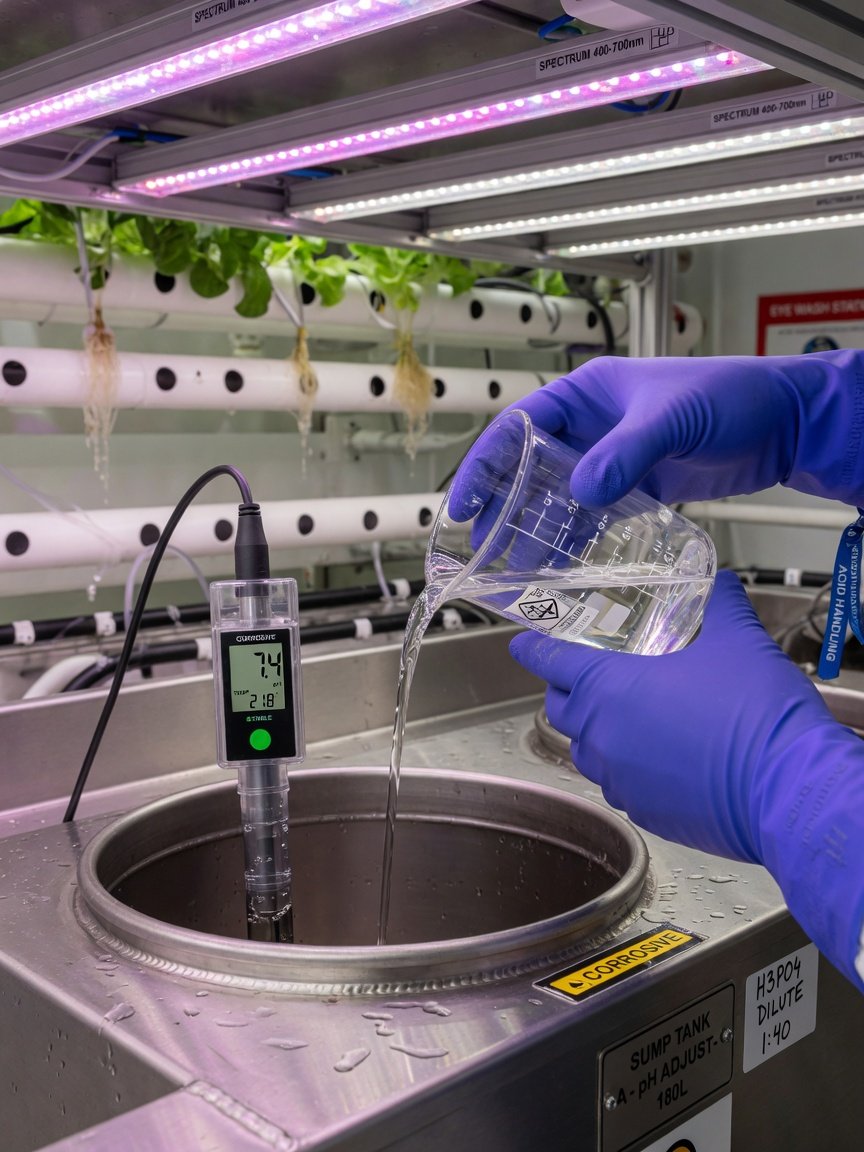
Source food-grade phosphoric acid at 75–85% concentration from reputable aquaponics or food-grade chemical suppliers. Never use industrial-grade phosphoric acid — it may contain heavy metal contaminants including arsenic and lead that are dangerous at aquaponics stocking concentrations. Always wear nitrile or neoprene gloves, eye protection, and handle the concentrated product in a well-ventilated area. At full concentration, phosphoric acid causes chemical burns on skin and eyes within seconds of contact.
The working dilution most experienced operators use is 1 mL of 85% food-grade phosphoric acid per 100 gallons of system water to achieve approximately 0.1–0.2 pH unit reduction. This ratio varies significantly with your system’s KH. A system with KH above 150 ppm may require 2–3× as much acid to overcome buffering and register any measurable pH drop. Pre-dilute your calculated dose in a bucket of system water — never add concentrated acid directly into the fish tank or sump. Always add the pre-diluted solution slowly near a high-flow return line to ensure rapid mixing throughout the system.
One ongoing consideration with phosphoric acid is phosphate accumulation. In low-stocking-density systems or systems with low plant uptake rates, phosphate from repeated acid dosing can build to concentrations above 10 ppm — high enough to interfere with iron and zinc uptake, compounding the very nutrient problems you’re trying to prevent. Monitor phosphate monthly with a standard freshwater test kit. If levels are climbing, increase plant density, reduce dosing frequency, or incorporate periodic partial water changes to dilute accumulated phosphate.
Can CO2 Injection Lower pH in Aquaponics?
CO2 injection is the cleanest, most biologically gentle pH reduction method available to aquaponics operators. When CO2 dissolves in water, it forms carbonic acid (H2CO3), which reduces pH without introducing any ions that could accumulate to harmful concentrations in fish or plants. It’s also the only method that simultaneously reduces pH, enriches the water column with dissolved CO2 for plant root uptake, and is fully compatible with organic certification programs.
The trade-off is upfront equipment investment. A complete CO2 injection system — including regulator, solenoid valve, diffuser stone, and pH controller — typically runs $300 to $800 for a medium-scale production system up to 10,000 gallons. Larger commercial setups with bulk CO2 supply and integrated dosing automation can run $1,500–$5,000. However, the operational precision this investment delivers often justifies the cost within a single growing season through reduced fish stress incidents and improved crop yield.
CO2 effectiveness is directly tied to your system’s KH. In a high-KH system (above 120 ppm), CO2 is rapidly absorbed by carbonate buffering before it can register as a meaningful pH reduction. Research from Wageningen University’s aquaponics technology division found that CO2 injection is most effective and economical when system KH is maintained below 4 dKH (approximately 70 ppm). In high-KH systems, pair CO2 injection with progressive RO water blending to reduce buffering capacity before relying on CO2 as your primary pH management tool.
How Does Your Water Source Affect pH Management?
Your water source is the single most influential variable in your pH management strategy — and the one most frequently overlooked during system design. Before implementing any pH reduction protocol, you need a comprehensive baseline analysis of what you’re working with at the tap.
Municipal water across the United States is treated to a pH of 7.5–8.5 and intentionally buffered with carbonates to prevent pipe corrosion and plumbing degradation. Carbonate hardness (KH) in U.S. municipal systems ranges from as low as 20 ppm in naturally soft-water regions like the Pacific Northwest to over 300 ppm in hard-water zones across the Midwest, Texas, and the desert Southwest. This buffering capacity determines exactly how much acid or CO2 is required per gallon of top-off water — and therefore the ongoing operational cost of your pH management program.
Well water introduces additional variables: high calcium carbonate concentrations, dissolved iron that can precipitate at higher pH, and sometimes hydrogen sulfide or sulfates that affect taste, smell, and fish health. Have your source water professionally tested at a certified laboratory before committing to a grow system design. A standard comprehensive water panel costs $30–$80 and can prevent hundreds of dollars in misspent pH adjustment chemicals over the life of the operation.
Rainwater is a naturally soft, low-KH option with pH typically ranging 5.5–7.0. Blending 30–50% collected rainwater with your municipal supply can substantially reduce your effective KH and make pH adjustment far more responsive. In urban or industrial areas, test collected rainwater before use — dissolved pollutants including nitrogen oxides, sulfur dioxide, and heavy metals from air pollution can make collected rainwater harmful to fish. Rural systems in clean-air regions benefit most from rainwater collection as a long-term KH management tool.
Reverse osmosis water is the most controllable option for operators who need precise starting conditions. RO filtration removes 95–99% of dissolved solids, producing water at pH 6.0–7.0 with near-zero KH. Blending a defined percentage of RO water into your source water lets you target a specific system KH with mathematical precision. Most experienced operators recommend a system KH of 40–80 ppm (approximately 2–4 dKH) as the optimal operational target — enough buffer to stabilize against diurnal swings without creating a massive alkalinity reserve that fights every acid or CO2 dose.
Step-by-Step: How to Lower pH in Aquaponics Without Stressing Your Fish
Follow this exact protocol whenever your system pH has climbed above your target range. Methodical, incremental adjustment protects your fish stock, preserves your bacterial colony, and prevents the secondary problems — ammonia spikes, nutrient lockout — that rushed corrections always create.
What Tools Do You Need to Monitor pH in Aquaponics?
The best pH management protocol fails completely if your measurements are inaccurate. Tool selection and maintenance discipline are as important as the method you choose for pH reduction.
Digital pH meters are the standard for any operation beyond hobby scale. Professional-grade meters from Apera Instruments, Hanna Instruments, or Milwaukee Instruments deliver accuracy to ±0.01 pH units — sufficient precision for any aquaponics dosing decision. Calibrate using fresh two-point buffer solutions (pH 7.01 and pH 4.01) at minimum weekly, and before any major pH adjustment session. Probes degrade with continuous immersion in organic-rich water — plan to replace electrodes every 12–18 months in active production systems. Budget $50–$200 for a meter with replaceable probe and auto-temperature compensation (ATC), which is essential in systems where water temperature varies seasonally.
Continuous pH monitors with automated dosing integration represent the professional tier. Systems from Atlas Scientific, GHL, and Seneye provide real-time pH tracking with cloud connectivity, mobile alerts, and automated solenoid-controlled dosing when pH drifts outside set thresholds. These systems log pH data continuously — invaluable for identifying diurnal patterns, diagnosing unexplained pH spikes, and building long-term system performance records. Expect to invest $400–$1,500 depending on integration complexity and dosing automation requirements.
Colorimetric test kits serve as a reliable backup and field confirmation tool. API Freshwater Master Test Kit and Salifert pH test kits give accuracy to approximately ±0.2 pH units. This resolution is adequate for a quick sanity check when your digital meter reading seems inconsistent with observed fish or plant behavior, but it’s not sufficient for precision dosing decisions. Always keep a test kit on hand as a meter-independent verification option.
How Do You Maintain Stable pH Long-Term in Aquaponics?
Reactive pH management — testing when something looks wrong and dosing in response — is the hallmark of operators who are perpetually behind their system. Expert practitioners design for proactive pH stability so that significant interventions are rarely necessary and chemical costs stay low.
KH management is the single highest-leverage long-term strategy. Maintain your system KH at 40–80 ppm. At this level, you have enough buffering to smooth diurnal pH swings without accumulating a buffer reserve so large that it makes pH reduction prohibitively expensive. Test KH weekly with a standard KH test kit. If KH is climbing, reduce the alkalinity of your top-off water through progressive RO blending. If KH drops below 40 ppm — which can happen in mature, high-bacterial-activity systems — add a small amount of food-grade potassium bicarbonate (not sodium bicarbonate) to rebuild buffering capacity without the sodium accumulation that baking soda creates.
Media selection is a one-time decision with permanent pH consequences. If you’re designing a new media bed system, choose chemically inert media: expanded clay aggregate (LECA/hydroton), washed basalt, or screened river gravel confirmed free of limestone. Test any new media by submerging a sample in white vinegar for 60 seconds — if it bubbles or fizzes, it contains carbonate and will chronically drive pH upward throughout the life of the grow bed. Reject it before it goes into your system.
System maturity is a long-term pH ally. As your nitrifying bacteria colonies grow and mature, they produce hydrogen ions as a natural byproduct of the ammonia-to-nitrate conversion pathway. This natural acid production gradually counteracts alkalinity in the water column. University of the Virgin Islands research data indicates that aquaponics systems past the 6-month operational mark required 35–40% less external acid for pH management compared to their first 90 days — a meaningful reduction in operating costs that accelerates the payback on your initial equipment investment.
📋 Case Study: GreenWave Aquaponics — Jefferson County, Colorado
Challenge: High-alkalinity municipal source water (KH 185 ppm, source pH 8.2) was driving chronic pH elevation to 7.9–8.3 in a 12,000-gallon tilapia-lettuce system. Iron deficiency chlorosis was affecting 35% of lettuce crops. Monthly phosphoric acid consumption was running $180/month with marginal pH control. Two fish mortality events in 6 months were attributed to elevated un-ionized ammonia at high pH.
Intervention (2025): Installed a 40% RO water blending system for all top-off supply. Replaced calcareous pea gravel grow media with expanded clay aggregate. Introduced an automated CO2 injection system with pH controller set to 7.0. Removed oyster shell calcium supplementation (pH-neutral calcium carbonate substituted).
Results after 90 days: System pH stabilized at 6.9–7.1 (down from 7.8–8.3). Lettuce harvest weight per bed cycle increased 28%. Fish stress incidents dropped 76%. Monthly pH management chemical cost fell from $180 to $98 — a 45% reduction. Iron deficiency chlorosis resolved within 3 weeks without any supplemental iron dosing.
Key takeaway: Eliminating the root causes — calcareous media and high-KH source water — delivered better long-term pH stability at lower cost than chronic acid dosing ever could.
What Mistakes Do Operators Make When Managing pH?
After analyzing operational data from dozens of struggling aquaponics systems, a consistent set of management errors emerges. Most are rooted in impatience, incomplete water chemistry knowledge, or misapplied advice from non-expert sources online.
Correcting pH too quickly remains the single most dangerous mistake. Adding enough acid to drop pH by 1.0 unit in a single session is enough to kill fish through osmotic shock within hours. It can also crash nitrifying bacteria colonies and trigger an ammonia emergency that takes weeks to resolve. The 0.2-units-per-24-hour limit is a hard biological boundary, not a conservative suggestion.
Using sodium bicarbonate to raise pH after overcorrection. When operators overshoot low, they often reach for baking soda to push pH back up. Repeated sodium bicarbonate use causes sodium accumulation that becomes phytotoxic to many crops above 150 ppm. Use potassium bicarbonate or calcium carbonate (agricultural lime, fully dissolved) when you need to raise pH in an aquaponics system. Both add beneficial mineral ions rather than the sodium that plants cannot tolerate.
Testing pH at only one time of day. A single midday or late-morning reading completely misses the diurnal pH swing driven by photosynthesis and respiration. A system that reads 7.2 at noon may read 7.7 at sunset and 6.9 before sunrise. Base dosing decisions on your pre-dawn reading — it’s your system’s lowest, most stable pH measurement and the most reliable indicator of your true baseline chemistry.
Relying on vinegar for pH reduction. White vinegar and apple cider vinegar appear constantly in online aquaponics forums as “natural” or “organic” pH reducers. The chemistry doesn’t support the claim for serious use: acetic acid is rapidly metabolized by heterotrophic bacteria in any active aquaponics system, typically within 2–4 hours. It provides a short-lived pH dip that rebounds quickly, while simultaneously stimulating bacterial blooms that consume dissolved oxygen. For any system beyond a small home setup, vinegar is an ineffective and potentially destabilizing pH management tool.
Neglecting to calibrate pH meters regularly. The 2025 Aquaponics Association field audit found that 43% of sampled meters were reading 0.3+ pH units off from laboratory-verified values. If your meter is uncalibrated, every dosing decision you make is wrong by a proportional margin. Calibrate weekly with fresh, unexpired buffer solutions stored in a cool, dark location. Expired buffers give inaccurate calibration and render your meter readings meaningless.
What Are the 2026–2027 Trends in Aquaponics pH Management?
Aquaponics technology is advancing rapidly, and pH management is one of the areas seeing the most innovation. Several trends are reshaping how expert operators approach pH control heading into 2027.
Automated IoT pH dosing systems are crossing the affordability threshold for small and mid-scale commercial operations. Cloud-connected pH controllers from Atlas Scientific, GHL, and Neptune Systems now integrate with mobile dashboards, SMS alert systems, and automated peristaltic dosing pumps at price points 25–30% lower than 2023 levels. By 2027, continuous automated pH control is expected to become a standard operating expectation — rather than a premium feature — for any operation above 5,000 gallons.
Decoupled aquaponics systems represent the most structurally significant shift in production philosophy. Pioneered by Dr. Simon Goddek and colleagues at Wageningen University, decoupled systems manage fish and plant environments independently, allowing fish water to run at optimal fish pH (7.5+) while plant nutrient solution is acidified to optimal plant uptake pH (5.5–6.5) in a separate hydroponic loop. This approach eliminates the biological compromise built into traditional coupled systems. Early commercial adopters in Europe and the Netherlands report 30–40% improvements in micronutrient uptake efficiency compared to coupled system benchmarks — a compelling productivity case that is accelerating U.S. adoption in 2026.
Biological pH management through controlled microbial communities is emerging from academic research into early commercial pilot programs. Sulfur-oxidizing bacteria (SOB) naturally produce sulfuric acid as a metabolic byproduct during sulfur compound oxidation. Controlled introductions of SOB populations into aquaponics sump zones have shown promise in Dutch and Australian research trials as a self-regulating, chemical-free pH reduction mechanism. Commercial viability is expected to be demonstrated by 2027 for specific system configurations.
AI-driven predictive pH management is on the near-term horizon. Multiple aquatech startups — including companies operating in stealth mode as of mid-2026 — are developing machine-learning models that predict pH fluctuations 6–12 hours ahead, using real-time sensor feeds for temperature, dissolved CO2, plant transpiration rate, and feeding schedules. Predictive micro-dosing — adjusting pH before it drifts, rather than after — is projected to reduce chemical consumption by 40–60% compared to reactive management while also meaningfully reducing fish stress event frequency.
Frequently Asked Questions About Lowering pH in Aquaponics
How fast can I safely lower pH in an aquaponics system?
Never lower pH faster than 0.2 units per 24-hour period. Fish experience measurable physiological stress from rapid pH changes — a sudden 0.5-unit drop in a few hours can trigger immune suppression, and a 1.0-unit drop can be acutely lethal in many species. Take it slow, test every 2–4 hours during active adjustment, and watch fish behavior as carefully as you watch the meter readings.
Can I use vinegar to lower pH in aquaponics?
Vinegar is not a practical pH reduction tool for any aquaponics system of meaningful size. Acetic acid is rapidly metabolized by heterotrophic bacteria in biologically active systems, causing pH to rebound within 2–4 hours of addition. It may provide a temporary effect in very small backyard systems, but for reliable pH control, use food-grade phosphoric acid or CO2 injection instead.
What is the ideal pH for tilapia aquaponics?
Tilapia thrive at pH 7.0–8.0 and tolerate a wide range of 6.0–9.0 — one of the reasons they dominate U.S. commercial aquaponics. For a tilapia-based system, target the system-wide sweet spot of 6.8–7.2. This range fully supports tilapia health, maintains iron and manganese availability for plants, and keeps un-ionized ammonia at safe concentrations across normal ammonia loading levels.
Will lowering pH harm my beneficial bacteria?
Nitrifying bacteria function across pH 6.0–8.5 and remain productive throughout the 6.8–7.2 operational target range. Gradual adjustment that stays above 6.8 does not meaningfully impact bacterial colony performance. The risk comes from rapid drops below 6.5, which slow nitrification significantly, and drops below 6.0, which can crash Nitrosomonas and Nitrobacter colonies entirely. Always adjust gradually and monitor ammonia and nitrite closely for 48 hours after any pH adjustment session.
How often should I test pH in my aquaponics system?
Test pH at minimum twice daily: once at pre-dawn (before lights on or natural sunrise) and once in the early evening after peak afternoon photosynthesis. During active pH reduction protocols, test every 2–4 hours. Once your system is dialed in and stable, a single pre-dawn daily test is a sufficient maintenance routine for most systems.
Is citric acid safe to use in aquaponics?
Food-grade citric acid is fish-safe at appropriate concentrations and is compatible with organic certification programs. However, it breaks down rapidly in biologically active aquaponics systems — typically within 2–4 hours. For small backyard or organic-certified systems under 500 gallons, it can provide a working temporary pH reduction. For any production-scale system, the dosing frequency required makes citric acid economically impractical and operationally unreliable compared to phosphoric acid or CO2 injection.
Why does my pH keep rising even after I add acid?
The most common cause is high carbonate hardness (KH) in your source water or from calcareous grow media. High KH creates a chemical buffer that neutralizes acid additions before they register as a pH drop — like pouring water into a sponge before it can overflow. Test your KH with a dedicated KH test kit. If it reads above 120 ppm (6 dKH), address your buffering capacity first — through RO water blending or media replacement — before attempting further acid dosing.
Conclusion: Your pH Management Action Plan
Stable pH in aquaponics is not the result of adding more acid — it’s the result of better system design, smarter water management, and disciplined measurement. The operators achieving the most consistent results in 2026 are the ones who understood their water source chemistry before they planted their first seed and chose their grow media accordingly.
Here is your implementation sequence to get pH under control and maintain it with minimal ongoing effort:
- Week 1 — Baseline everything: Get a professional water panel on your source water. Test current system pH, KH, TAN, nitrite, and dissolved oxygen. Calibrate your pH meter with fresh buffer solutions.
- Week 1–2 — Identify your pH driver: Is pH elevation coming from source water, calcareous grow media, or both? If media is contributing, plan a replacement or progressive phase-out with pH-neutral expanded clay or confirmed-inert basalt.
- Week 2–3 — Begin gradual pH reduction: Using food-grade phosphoric acid (or CO2 injection if already installed), reduce pH at 0.2 units per day maximum. Test twice daily. Watch fish behavior as closely as you watch the numbers.
- Week 3–4 — Address KH if above 120 ppm: Begin blending 20–30% RO water into top-off supply. Retest KH weekly and adjust blend ratio until KH stabilizes in the 40–80 ppm target range.
- Month 2 — Consider automation: If you’re managing pH manually every day, evaluate CO2 injection with automated pH controller. The labor savings and precision improvements typically justify the investment within one growing season.
- Month 3 and beyond — Shift to proactive monitoring: Pre-dawn daily pH testing, weekly KH checks, monthly phosphate monitoring if using phosphoric acid. As your system matures and nitrification increases, natural acid production will reduce how much external adjustment is needed.
At AquariumAgde, we work with aquaponics operators across the United States to solve exactly these system chemistry challenges. pH stability is the foundation that determines everything downstream — fish health, crop yield, water quality, and operating cost. Get it right with the right methods and the right tools, and your system becomes genuinely reliable. The protocols in this guide reflect current expert best practice as of 2026. Start with your water source, control your KH, adjust gradually, and measure relentlessly.
—