Choosing the right size for your aquaponics system is one of the most important decisions you’ll make as a grower — and getting it right from the start saves you time, money, and a lot of frustration. The short answer? Your ideal system size depends on your available space, your food production goals, and whether you’re growing purely for fun or building toward something bigger.
Key takeaways:
- A functional beginner system can start with as little as a 50-gallon fish tank and a single grow bed.
- The universal stocking rule — 1 inch of fish per gallon of water — applies at every scale.
- Research from the University of the Virgin Islands found that 60–100 grams of fish food consumed per day will support approximately 1 square metre of plants in a raft-based system.
- Your goals (hobby, family food supply, or commercial production) should dictate your size — not the other way around.
- Always design with future expansion in mind, even when you’re starting small.
Why Does Aquaponics System Size Matter So Much?
Aquaponics works because of balance. Fish produce waste, bacteria convert that waste into plant nutrients, and plants clean the water before it cycles back to the fish. It’s an elegant loop — but a surprisingly delicate one. The size of your system sets the outer limits for every variable inside it: how many fish you can keep, how many plants you can grow, how much food you can produce, and how quickly your system recovers when something goes wrong.
Too many fish in too little water causes ammonia to spike, stressing and killing your stock. Too few fish and your plants won’t get enough nutrients, no matter how well everything else is managed. Unlike a soil garden where you can throw down extra compost if your plants look pale, aquaponics demands that your fish load, water volume, and plant area stay in proportion at all times. Industry practitioners consistently note that poorly calibrated system size is the leading cause of failure among new aquaponic growers.
There’s a stability argument for larger systems too. Bigger water volumes buffer against temperature swings, pH fluctuations, and the occasional missed feeding far better than small ones do. A 500-gallon system is significantly more forgiving than a 50-gallon setup when life gets busy. That said, bigger isn’t always better — especially before you’ve learned to read your system’s signals.
How Do Your Goals Shape the Size of Your System?
Before you measure a single square foot of floor space, ask yourself one honest question: what do you actually want from this system? That answer alone will drive most of your sizing decisions.
There are three broad categories most aquaponic growers fall into, and each points toward a different scale:
- Hobby growers — You want to learn the craft, grow a handful of herbs and salad greens, and enjoy the process. A small setup with a 50–100 gallon tank and one or two grow beds is more than enough. The goal is experience, not yield.
- Home food producers — You want to meaningfully supplement your grocery bill and put fresh fish or vegetables on the table regularly. A medium-scale system — somewhere in the 200–500 gallon range with multiple grow beds — is your target.
- Commercial growers — You want to sell produce, fish, or both at market scale. This means systems with several thousand gallons of fish tank capacity, greenhouse integration, and the kind of infrastructure that warrants a proper business plan before you build.
Being honest about which category you’re in prevents the two most common sizing errors: building a system too small to meet your actual needs, or building one so large it becomes overwhelming before you’ve mastered the basics. Most experienced practitioners recommend starting one size tier smaller than you think you need — then scaling up from a position of knowledge and confidence.
How Much Space Do You Actually Need?
Space is usually the first hard constraint you’ll hit, and that’s a useful anchor. Aquaponics is genuinely space-efficient compared to conventional growing — research consistently shows aquaponic production can use up to 90% less water than traditional soil-based agriculture, and a well-designed home system can yield a meaningful harvest from just a few square metres. But the footprint you need is more than just the floor area your tanks and beds occupy.
When you’re measuring up your space, think through all of these:
- Headroom — Taller crops like tomatoes, beans, or cucumbers need vertical clearance, especially if you’re working in a garage or shed with a low ceiling.
- Walkways — You need comfortable access to every part of your grow beds for planting, harvesting, and maintenance. Narrow passages become frustrating quickly.
- Equipment clearance — Pumps, aeration, plumbing, and filters all need room. They also need to be accessible when something needs attention at 10pm.
- Expansion room — Leave space to add another grow bed or a larger tank without tearing everything out and starting again.
A garage or spare room works well for small systems, but medium and larger setups almost always benefit from purpose-built or converted greenhouse space — giving you control over temperature, light, and humidity year-round.
What Is the Right Fish-to-Water Ratio?
The most widely used stocking rule in aquaponics is simple: 1 inch of fish per gallon of water. A 100-gallon tank can comfortably support 100 inches of fish — that might be 20 fish at 5 inches each, or 10 fish at 10 inches each. This guideline exists because fish continuously produce ammonia through respiration and waste, and your biological filtration can only handle so much of it before water quality deteriorates.
Overstocking is one of the fastest ways to crash a system. Crowded fish become stressed, stressed fish get sick, and once disease takes hold in a densely stocked tank it spreads quickly. Understocking is a subtler problem — your plants won’t receive sufficient nutrients and will grow slowly or show deficiency symptoms despite perfect conditions everywhere else.
Species selection matters significantly here too. A 100-gallon tank that comfortably holds 15 goldfish might only suit 5–7 tilapia at adult size, because tilapia grow large and produce considerably more waste per fish. When selecting the right fish for your aquaponics setup, always plan for the mature size of your species — not the size they arrive at.
How Do You Use Feed Rate to Calculate Grow Bed Size?
This is where the design maths comes together — and it’s more straightforward than it sounds. The key insight is that the amount of fish food you add to your system each day directly determines how much plant-growing area you need to process the resulting nutrients.
Research conducted at the University of the Virgin Islands — one of the world’s foremost aquaponics research institutions — established that approximately 60–100 grams of fish food consumed per day will effectively sustain around 1 square metre of plants in a raft-based aquaponics system. This relationship holds reasonably well for media bed configurations too, though exact figures vary with plant type, system design, and local conditions.
Working through the numbers: if you’re feeding your fish 300 grams per day, you need approximately 3–5 square metres of grow bed to absorb that nutrient load. Feed too little relative to your plant area and your plants go hungry. Feed too much and nutrients accumulate to toxic levels in the water. This feed rate-to-grow-bed ratio is one of the most practical design tools available to aquaponic growers at any scale.
What Are the Standard Aquaponics System Size Categories?
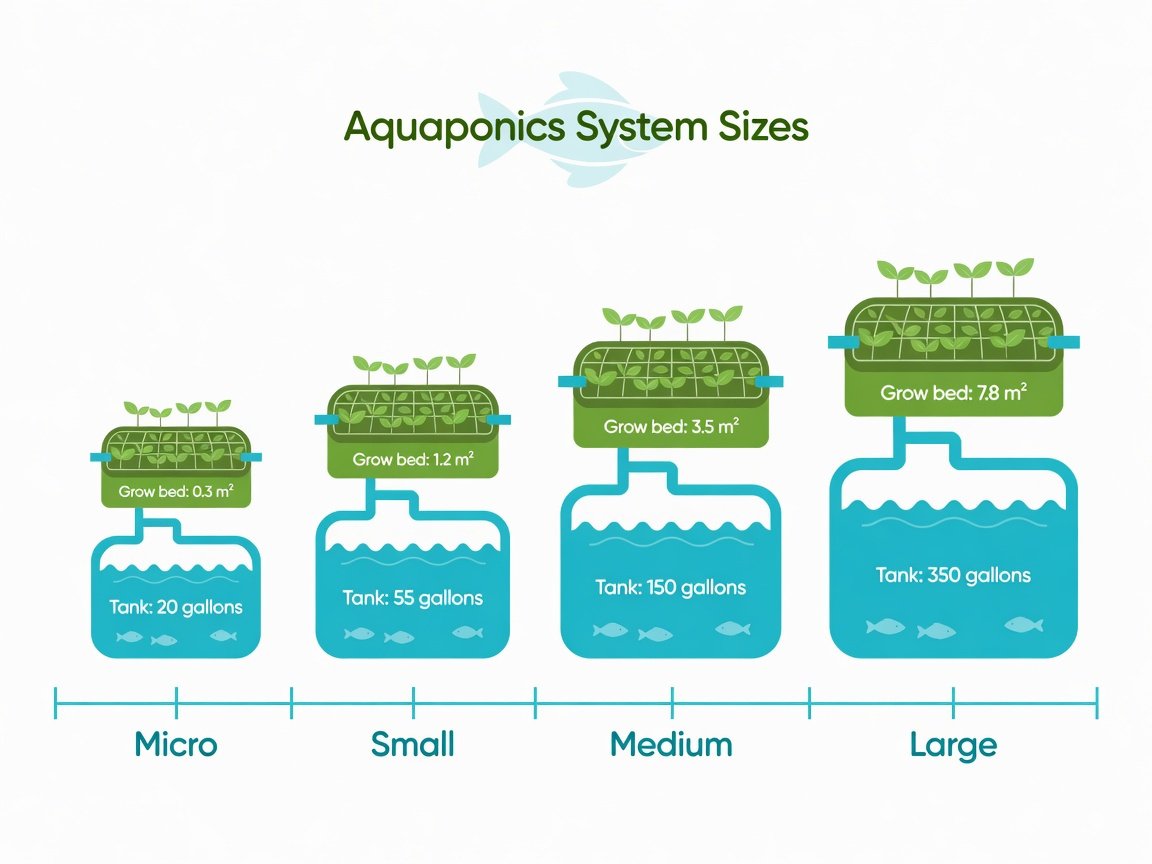
While there are no official industry-wide size classifications, most experienced practitioners use a four-tier framework that helps set realistic expectations for yield, complexity, and cost. Knowing which tier you’re aiming for makes the rest of the planning process considerably cleaner.
| System Tier | Fish Tank Volume | Grow Bed Area | Typical Yield | Best For |
|---|---|---|---|---|
| Micro / Desktop | 10–30 gallons | 0.25–0.5 m² | Herbs and microgreens | Indoor learning, decoration |
| Small / Home | 50–200 gallons | 1–3 m² | Salad greens, herbs, modest fish harvest | Hobby growers, beginners |
| Medium / Family | 200–1,000 gallons | 3–10 m² | Full vegetable variety plus regular fish harvest | Home food production |
| Large / Commercial | 1,000+ gallons | 10 m²+ | Market-scale produce and fish | Selling produce, full-scale business |
For most beginners, the Small / Home tier is the ideal entry point. It’s large enough to grow a meaningful variety of plants and produce a modest fish harvest, yet manageable enough that you can learn your system’s rhythms before adding complexity. If you want serious growing capacity without a serious price tag, building an IBC tote aquaponics system for under $200 is one of the most popular routes into the medium tier — it punches well above its cost.
How Does System Size Affect Your Budget?
System size and cost are directly linked — but not always in the way you’d expect. Larger systems cost more to build, but the cost per unit of food produced often falls as you scale up. A well-designed 500-gallon system can produce dramatically more food per dollar spent than five separate 100-gallon systems, because you’re sharing pumps, filtration, aeration, and infrastructure across a much greater growing capacity.
For a detailed picture of what each size tier costs to set up and run, this breakdown of aquaponics system costs covers everything from basic hobby setups to full commercial installations. As a general guide:
- Micro systems — $50–$300, mostly DIY or repurposed materials.
- Small home systems — $200–$1,500, depending on tank choice and grow media.
- Medium family systems — $1,000–$5,000, often including a purpose-built structure.
- Commercial systems — $10,000 and up, with greenhouse, filtration, and automation factored in.
Running costs also scale with system size — primarily electricity for pumps and grow lighting, fish feed, and consumables like pH adjustment solutions. Budget for ongoing operating costs from the start, not just your initial build. A system that’s cheap to build but expensive to run can erode the economics of home food production faster than you’d expect.
How Do You Choose the Right Fish Tank for a Small System?
For hobby and small home systems, the fish tank is usually the anchor around which everything else is designed. Your tank volume determines how many fish you can stock, which determines how much feed you add per day, which determines how large your grow beds need to be. Everything flows from the tank capacity you commit to.
Common options for small systems include standard aquariums, agricultural stock tanks, food-grade plastic barrels, and purpose-built aquaponic tanks. Each has genuine trade-offs in cost, visibility, durability, and ease of plumbing. Picking the right fish tank for a small aquaponics system means weighing material safety (always use food-grade containers), available surface area, depth, and whether you want to observe your fish comfortably.
Rectangular tanks tend to be more efficient than circular ones for space utilisation, but circular tanks offer better natural water circulation and fewer dead spots. For most beginners, a sturdy stock tank or a repurposed food-grade tote in the 50–150 gallon range hits the sweet spot between cost and practicality — without overcomplicating the plumbing.
Can You Scale Up Your Aquaponics System Later?
Yes — but you need to design for it from the beginning. This is one of the most consistent regrets you’ll hear from experienced aquaponic growers: they set up in a tight corner without thinking about expansion, and when they were ready to grow the system, there was nowhere to go without dismantling everything they’d built.
Scaling an aquaponics system isn’t just about adding a bigger tank. You also need to consider whether your pump has enough head pressure for a higher flow rate, whether your plumbing layout can accommodate additional grow beds, whether your structure can bear the extra weight of water and media, and whether your space gets enough light to support an expanded plant area.
Many growers find that the jump from a small home system to a medium family-scale setup is more efficiently done as a planned rebuild than as a piecemeal extension — especially when the original system was built into a constrained space. If you ever envision going to commercial scale, investing in the right aquaponics greenhouse from the outset can save you from a full relocation and rebuild as your ambitions grow.
What Are the Most Common Sizing Mistakes Beginners Make?
Sizing mistakes are almost universal among first-time growers — and almost entirely avoidable with a little upfront planning. Here are the ones that show up most often:
- Overstocking the fish tank — Enthusiasm is usually the culprit. Always calculate stocking density based on adult fish size, not the size they arrive at as juveniles.
- Undersizing the grow beds — If your plant area can’t absorb the nutrients your fish produce, ammonia and nitrite will spike fast. The feed rate-to-grow-bed ratio keeps this in check.
- Ignoring water volume buffers — Small systems with minimal water volume crash faster and harder when something goes wrong. More water means more stability.
- Building in a space that can’t expand — Setting up with walls on three sides leaves nowhere to add a second grow bed when you’re ready to scale.
- Starting too large too soon — A huge system with no operating experience is just as risky as a tiny one. You will make mistakes while learning — far better to make them on a smaller, less costly setup.
For a comprehensive checklist covering both sizing and the broader decisions you’ll face as a new grower, the guide to key considerations for setting up a successful aquaponics system is an excellent complement to the size planning process.
Frequently Asked Questions About Aquaponics System Size
What is the minimum size for a working aquaponics system?
A functional aquaponics system can technically run on as little as a 10-gallon aquarium with a small grow tray above it. However, very small systems are far less stable and significantly harder to manage than medium-sized ones — parameters shift quickly and there’s very little margin for error. For a genuinely productive setup that yields a useful amount of food, most practitioners recommend starting with at least a 50-gallon fish tank paired with a grow bed of around 1 square metre.
How many fish do I need per square metre of grow bed?
Rather than thinking in fish per square metre, think in terms of daily feed rate. Around 60–100 grams of fish food consumed per day will support approximately 1 square metre of plants in a raft-based system. Work backwards from how much grow bed area you have to determine how many fish you should stock and how much you should be feeding them each day.
Is a 100-gallon aquaponics system big enough to feed a family?
A 100-gallon system is an excellent beginner setup, but it’s unlikely to fully supply a family’s vegetable needs on its own. You can expect a meaningful supplement — regular salad greens, herbs, and a modest fish harvest — but not a complete food supply. To make a genuine dent in a family of four’s weekly grocery shop, most practitioners suggest looking at 300–500 gallons of fish tank capacity with corresponding grow bed area.
How long does it take to cycle a new aquaponics system?
The nitrogen cycle — the bacterial process that converts fish ammonia into plant-usable nitrates — typically takes 4–6 weeks to establish in a new system. Larger systems don’t cycle faster, but they do tend to be more stable once established. You can speed up the cycling process by seeding with beneficial bacteria from a mature aquaponics or aquarium system, or by using an ammonia source during the fishless cycling period before your stock arrives.
Do I need a greenhouse for a large aquaponics system?
Not necessarily — many large systems operate outdoors in warm, stable climates. But for year-round production in temperate regions, a greenhouse is almost always the better option. It extends your growing season, stabilises temperatures for fish and plants alike, and protects your system from weather extremes. As your system grows beyond hobby scale, greenhouse integration tends to shift from a nice-to-have to a practical necessity.
What grow media works best for different system sizes?
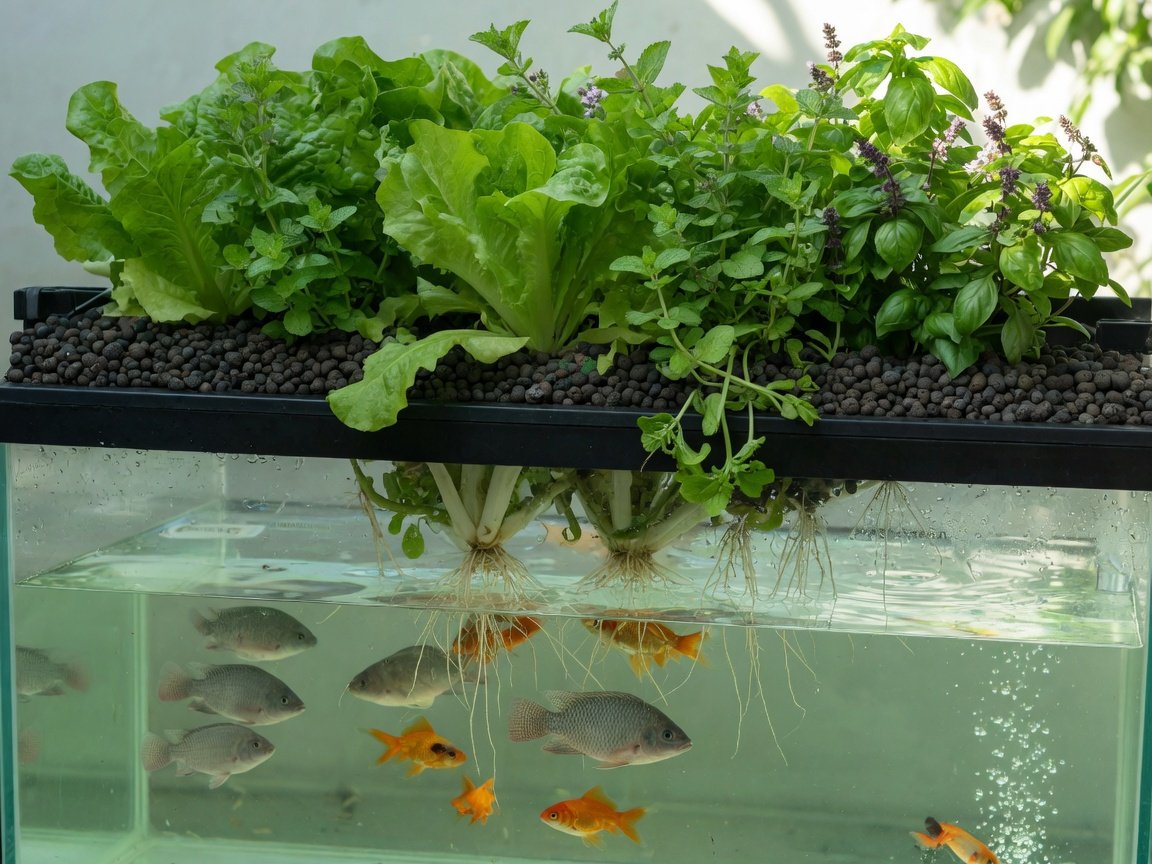
For small and medium systems, expanded clay pebbles (hydroton) and washed gravel are the most popular media bed choices — they’re widely available, pH-neutral, and easy to work with. Larger systems often move to raft (deep water culture) or nutrient film technique (NFT) configurations instead of media beds, as these are easier to manage at scale, allow higher plant densities, and require less labour per unit of food produced.
The Bottom Line: Size Your System Around Your Goals
The right size for your aquaponics system isn’t the biggest one you can build — it’s the one that fits your goals, your space, your budget, and your current level of experience. Start with what you can manage confidently, learn your system inside and out, then expand from a foundation of knowledge rather than guesswork.
The fundamentals stay the same whether you’re running a 50-gallon desktop setup or a 5,000-gallon commercial installation: keep your fish load, feed rate, and grow bed area in balance, and give your beneficial bacteria a stable environment to do their work. Get those three things right, and size becomes much less of a worry.
Your six-step sizing action plan:
- Week 1 — Define your goals clearly: hobby, family food supply, or commercial production.
- Week 2 — Measure your available space and identify your hard constraints (ceiling height, floor load, light access).
- Week 3 — Research the fish species you want to keep and calculate your stocking density based on adult size.
- Week 4 — Work out your target daily feed rate and use the 60–100 g/m² rule to calculate the grow bed area you need.
- Month 2 — Source your materials, build or purchase your system, and begin the cycling process.
- Month 3–4 — Add your first fish once the system has fully cycled and water parameters are consistently stable.