Setting up an aquaponics farm costs anywhere from $200 for a simple DIY backyard system to $500,000 or more for a full commercial greenhouse operation — and knowing where you land on that range before you spend a cent makes every planning decision cleaner and faster. The number isn’t mysterious once you break it down by scale and component.
Key findings at a glance:
- A DIY system built around a recycled IBC tote can come in under $500 all-in
- Small market-garden aquaponics setups typically run $5,000–$20,000
- Commercial aquaponics farms commonly require $50,000–$300,000 in startup capital
- Ongoing operating costs average 20–35% of annual revenue once a system is established
- Electricity and labor are the two costs most new growers consistently underestimate
What Does It Cost to Set Up an Aquaponics Farm?
Aquaponics farms don’t have a single price tag — they have a range, and that range is genuinely wide. A hobbyist building from salvaged parts and a used tote can be running fish and growing greens for under $500. A family aiming to produce most of their own food in a dedicated backyard system typically spends $2,000–$8,000. An entrepreneur planning to supply local restaurants or a farmers’ market stall should budget at least $15,000–$50,000 for a system capable of generating meaningful revenue.
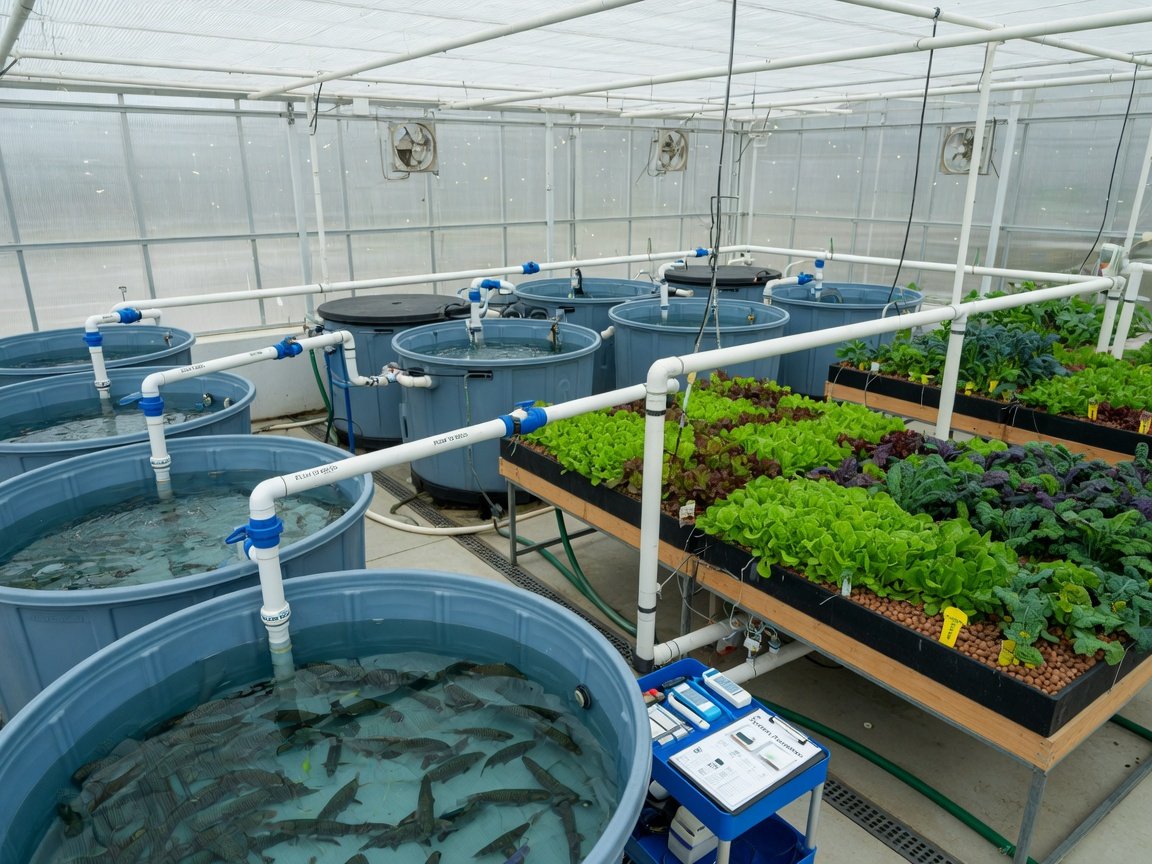
At the commercial end, costs climb steeply. A greenhouse-based operation with 1,000–5,000 square feet of growing space — producing enough fish and vegetables to sell at wholesale — typically runs $80,000–$250,000 once you account for infrastructure, equipment, and the working capital to survive until the system reaches full production. Larger industrial operations can top $500,000 easily.
Three variables move the number most dramatically: system size, whether you’re building indoors or outdoors, and how much of the construction you’re doing yourself. A hands-on grower with basic carpentry and plumbing skills can typically build for 40–60% less than one who contracts every stage. If you want a practical picture of what a complete home setup looks like before committing a budget, the ultimate guide to backyard aquaponics covers everything from site selection to first harvest in real-world detail.
What Are the Main Cost Components of an Aquaponics Farm?
Every aquaponics system — regardless of scale — shares the same fundamental building blocks. Understanding what each component actually costs makes the total figure far less daunting.
Fish Tanks
Fish tanks are usually the single largest hardware line item. A used, food-grade IBC tote for a backyard system costs $50–$150. For commercial operations, round polyethylene or fiberglass tanks run $800–$3,000 each — and most commercial setups need several. Larger round tanks in the 3,000–5,000 gallon range, used in intensive systems, cost $4,000–$8,000 per unit.
Grow Beds or Channels
Media-bed grow beds made from repurposed food-grade containers cost $50–$200 each on the DIY end. Purpose-built NFT (nutrient film technique) channels or DWC (deep water culture) troughs run $300–$1,500 per unit before installation. Commercial systems using dedicated grow channels typically spend $5,000–$20,000 on grow infrastructure alone, depending on total growing area.
Pumps and Aeration
A reliable submersible pump for a backyard system costs $40–$150. Commercial setups need higher-capacity pumps ($200–$800 each) plus backup units — pump failure means dead fish, so redundancy isn’t optional at any commercial scale. Air pumps and diffusers for dissolved oxygen management add $50–$300 for small systems, scaling up to $500–$2,000 for commercial operations.
Plumbing and Filtration
PVC fittings, pipes, bell siphons, and unions add up to $100–$500 for a small system. A well-designed aquaponics plumbing layout is worth planning thoroughly upfront — retrofitting a poor design costs significantly more than doing it right the first time. Solids-removal filtration — a radial flow separator or drum filter — adds $150–$800 for small systems and $2,000–$10,000 for commercial-scale water treatment.
Grow Media or Rafts
Expanded clay pebbles (LECA/hydroton) run $40–$80 per cubic foot. A 200-gallon media bed typically needs 3–4 cubic feet, adding $120–$320 per bed. DWC systems use cut styrofoam rafts at $10–$30 per sheet. Perlite and washed gravel are cheaper alternatives at $5–$15 per cubic foot, though clay pebbles outperform them for most aquaponics applications in terms of drainage and root aeration.
Greenhouse or Shelter Structure
A basic hoop house covering 500 square feet runs $2,000–$5,000. A climate-controlled commercial greenhouse with shade cloth, ventilation, and heating costs $15–$35 per square foot to build — meaning $75,000–$175,000 for a 5,000 sq ft structure. For growers in warm, frost-free climates, outdoor systems with simple shade structures can eliminate this cost almost entirely.
Electrical and Lighting
Outdoor and greenhouse systems often need little supplemental lighting. Indoor systems are a different story. Quality LED grow fixtures run $100–$500 per unit, and a commercial indoor setup may need dozens. Budget $2,000–$30,000 for lighting in a dedicated indoor operation. This cost alone is why most commercial growers opt for greenhouse production over warehouse farming when site options allow.
Small-Scale vs. Commercial Aquaponics: The Real Cost Comparison
Putting the numbers side by side makes the scaling picture immediately clear. Here’s how setup cost, monthly operating cost, and best use case break down across the main system sizes you’re likely to consider.
| System Type | Typical Setup Cost | Monthly Operating Cost | Best For |
|---|---|---|---|
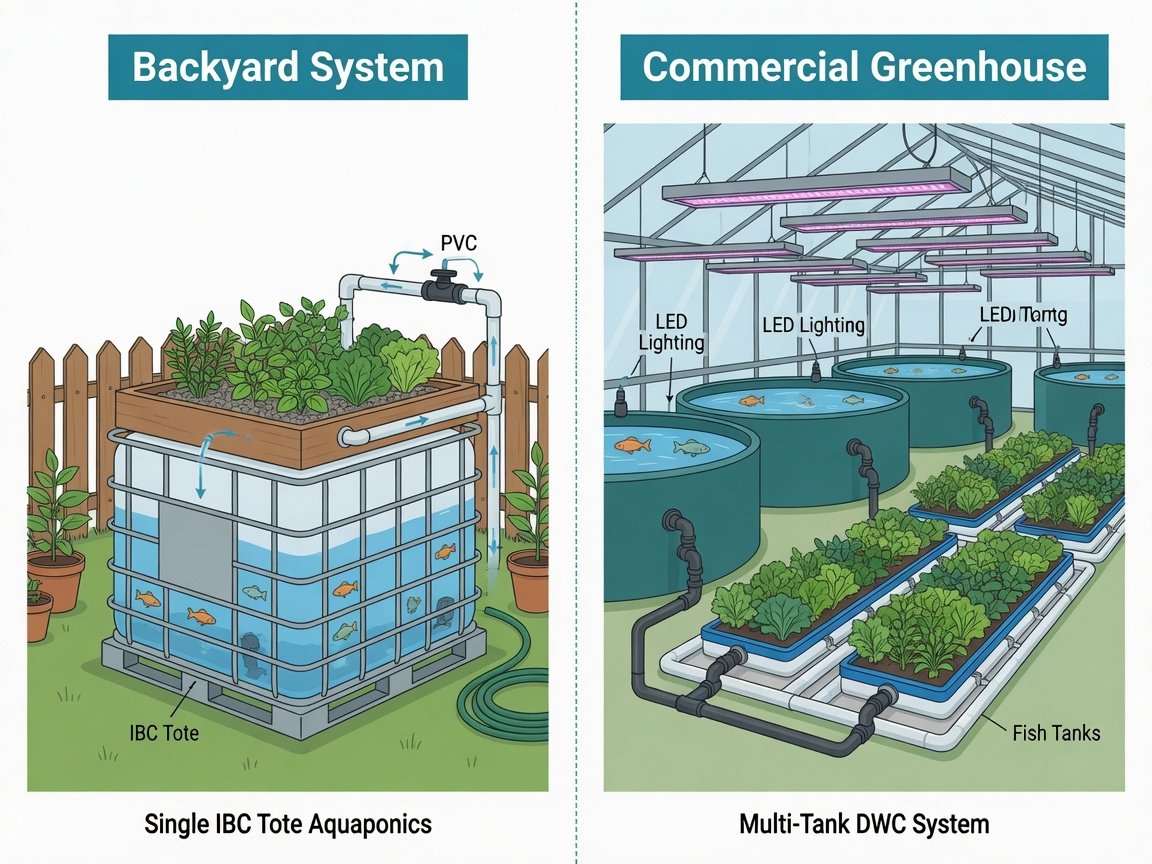
| Beginner/Hobby (IBC tote) | $200–$800 | $20–$60 | Learning the system, household food supplementation |
| Backyard Market Garden | $3,000–$15,000 | $100–$400 | Part-time income, CSA boxes, farmers’ markets |
| Small Commercial Greenhouse | $20,000–$80,000 | $1,500–$5,000 | Full-time income, restaurant supply, local wholesale |
| Medium Commercial | $80,000–$250,000 | $5,000–$20,000 | Regional distribution, grocery supply |
| Large Commercial | $250,000–$1M+ | $20,000–$80,000 | Wholesale, export, institutional food supply |
Notice how the operating-cost-to-setup-cost ratio stays fairly consistent across scales. Whether you’re spending $800 or $800,000, you’re typically looking at monthly operating costs equivalent to roughly 1–5% of your total setup investment. The commercial advantage isn’t dramatically lower relative costs — it’s a much higher revenue ceiling per dollar of infrastructure.
If you’re seriously evaluating whether a commercial setup makes financial sense for your situation, it’s worth digging into what’s involved in starting a commercial aquaponics farm before locking in a budget — the planning and market considerations go well beyond equipment costs alone.
What Hidden Costs Catch First-Time Aquaponics Farmers Off Guard?
Most first-time growers budget accurately for hardware and completely miss the costs that arrive during and after the build. These are the ones that consistently blow initial budgets and stress out new operators in their first year.
Six to Eight Weeks of Zero Revenue During Cycling
A new aquaponics system needs time for beneficial bacteria to colonize the biofilter before it can support fish at proper stocking density. This nitrogen cycle typically takes 4–8 weeks. During that period, you’re paying operating costs — electricity, feed, water — without selling anything. Budget at least two months of operating expenses as a cash reserve before you start, or your first cycle will feel far more stressful than it needs to be.
First-Cycle Fish Mortality
Even experienced operators expect some fish mortality during the first few months. A 10–20% loss rate in the first production cycle isn’t unusual, and it represents real replacement cost. If you’re stocking 200 tilapia fingerlings at $1.50 each, a 15% loss costs $45. At commercial scale with premium species running $4–$8 per fingerling, first-cycle losses hit considerably harder and deserve a specific line in your startup budget.
Water Testing Equipment and Chemistry Supplies
Ammonia, nitrite, nitrate, and pH testing are non-negotiable. A quality liquid test kit runs $30–$40 and lasts several months of regular use. Digital pH and dissolved oxygen meters cost $50–$200 each. At commercial scale, continuous monitoring systems — which send real-time alerts when parameters drift outside safe ranges — cost $500–$3,000. Skimping on water testing is a false economy; a single undetected ammonia spike can wipe out an entire fish stock overnight.
Equipment Failures and Contingency
Pumps fail. Bell siphons clog. Heaters malfunction. Build a 5–10% equipment contingency into your startup budget and keep a spare pump on the shelf from day one. A $60 backup pump sitting unused for two years is far cheaper than losing a fish stock because your only pump failed at midnight and the nearest hardware store doesn’t open until 9 a.m.
Startup Fish and Fingerling Costs
You need healthy stock to start, and that cost is easy to overlook during the excitement of building. Tilapia fingerlings run $0.50–$2.00 each in small quantities. Higher-value species cost more: barramundi fingerlings run $2–$5 each, trout $1–$3, and specialty coldwater species considerably more. Stocking 100–200 fish for a small system means $50–$400 just in initial fish cost, before any other startup expense.
What Are the Monthly Operating Costs of an Aquaponics Farm?
Setup costs get all the attention, but operating costs are what determine whether an aquaponics farm is financially viable long-term. Here’s what to expect on a monthly basis once your system is established and running at stocking density.
Fish Feed
Feed is the largest recurring variable cost for most operations. High-quality aquaponic fish pellets — typically 32–40% protein — run $1.00–$2.50 per pound. A small system with 50–100 fish consumes roughly 5–10 lbs per month ($5–$25). A commercial system stocking 2,000 fish can burn through 200–400 lbs per month ($200–$1,000). Feed conversion ratio — how many pounds of feed it takes to produce one pound of fish — is a key efficiency metric; better feeding practices and genetics can cut this significantly over time.
Electricity
This is typically the dominant fixed operating cost. Pumps and blowers run continuously, 24 hours a day. Water heaters in cooler climates add significantly to the bill. Grow lights in indoor operations can double or triple total electrical draw. Expect $50–$150/month for backyard systems, $500–$2,000/month for small greenhouse operations, and $3,000–$10,000/month for larger commercial facilities.
Switching to solar is the single most impactful way to reduce this cost permanently. A well-sized solar array with battery backup can cover most or all of an aquaponics system’s power needs — the detailed guide to going off-grid with a solar-powered aquaponics setup walks through how to size and implement this for systems of different scales.
Labor
For commercial operations, labor often eclipses every other cost combined. Daily monitoring, feeding, harvesting, plant transplanting, and system maintenance add up fast. Even at minimum wage, 4 hours of daily work across a moderate-sized system runs $1,500–$2,500/month. Most commercial operators find that a single dedicated full-time employee is the minimum viable staffing level for any system of real commercial scale.
Consumables
pH adjustment solutions, supplemental minerals (iron chelate is a common deficiency in mature systems), net pots, packaging for sales, and cleaning supplies all contribute to a monthly consumables budget. Plan for $30–$100/month for small systems and $200–$600/month for commercial operations. These costs are individually small but consistent, and they’re frequently omitted from first-draft budgets entirely.
Six Ways to Cut Your Aquaponics Farm Setup Cost Without Cutting Corners
You don’t need top-of-the-line equipment to build a system that works reliably and produces well. These six strategies consistently help growers reduce setup costs without compromising on what actually matters to long-term performance.
- Start with an IBC tote system. A single 275-gallon IBC tote converted into a combined fish tank and grow bed costs under $200 to set up. This lets you learn how the nitrogen cycle actually behaves, make your inevitable early mistakes on a small scale, and refine your approach before committing thousands of dollars to a larger build. It’s no coincidence that many of the most experienced aquaponics operators still point to their first IBC system as the most valuable thing they ever built. A complete walkthrough of building a full IBC tote aquaponics system for under $200 proves just how accessible this entry point really is.
- Buy used equipment. Food-grade IBC totes, water storage tanks, submersible pumps, and PVC fittings appear regularly on Craigslist, Facebook Marketplace, and agricultural equipment auctions at 20–50% of new prices. Always verify food-grade rating before use and clean thoroughly. The only components worth buying new are critical circulation pumps (where reliability is paramount) and anything in direct contact with food at harvest.
- Go solar for power. Electricity is the single largest ongoing operating cost in most aquaponics systems. A properly sized solar array with battery backup can eliminate it almost entirely after an upfront investment of $2,000–$8,000. Most solar setups pay back in 2–4 years of electricity savings — after which your biggest recurring cost essentially disappears.
- Match your grow method to your scale. Media beds are the most forgiving and the cheapest to build — ideal for beginners and small backyard systems. DWC scales better for larger leafy green operations. NFT channels suit high-value herbs. Choosing the wrong method for your scale means paying for an expensive retrofit six months into production.
- Build a hoop house before a permanent greenhouse. A basic hoop house costs $3–$8 per square foot versus $15–$35 for a permanent climate-controlled structure. Many successful small commercial farms begin in hoop houses and reinvest profits into better infrastructure over time. Starting cheap forces sound operational discipline and reduces the financial risk if your market turns out to be smaller than projected.
- Source fingerlings locally. Shipping live fish is expensive, stressful for the fish, and significantly increases mortality risk on arrival. Sourcing fingerlings from a local hatchery or fish farmer cuts per-fish acquisition cost and reduces arrival losses. Building a reliable relationship with a local supplier also gives you flexibility on restock timing as your production cycles mature.
How Long Does It Take an Aquaponics Farm to Pay for Itself?
Return on investment in aquaponics depends on your scale, your market access, and how efficiently the system runs. Here are realistic payback timelines based on what operators at different scale tiers consistently report.
Hobby and Backyard Systems
These are rarely built with strict financial ROI in mind — the value is in fresh clean food, education, and the satisfaction of running a closed-loop food system. A $2,000 system growing tilapia, tomatoes, and leafy greens for a household of four can displace $100–$200/month in grocery spending. On that basis, payback lands in the 10–20 month range. Most backyard growers think of it as a lifestyle investment with fresh food as the return rather than a pure financial calculation.
Small Commercial Systems ($10,000–$50,000)
With a well-connected grower selling directly to restaurants, farmers’ markets, or via a CSA subscription scheme, annual gross revenue of $20,000–$60,000 is achievable from a well-run small operation. After operating costs, a 2–4 year payback is realistic for operators who lock in their market before completing the build. Operators who build first and figure out sales second typically take 5–7 years — if the operation survives that long.
Commercial Greenhouse Operations ($80,000–$300,000)
These require serious financial modeling before the first shovel goes in the ground. Most successful commercial aquaponics operators targeting payback within 3–5 years focus heavily on premium crops — basil, watercress, microgreens, specialty herbs — alongside high-value fish. Operators who try to compete on price with conventional agriculture rarely survive their first three years. The competitive advantage of aquaponics is freshness, locality, and clean production credentials — not commodity pricing.
The farms that make the numbers work fastest share two characteristics: a confirmed market before they build, and a product mix weighted toward high-value crops and fish species.
Which Fish and Crops Offer the Best Return on Your Setup Investment?
Your fish and plant selection directly affects how quickly a system pays for itself. Here’s how the most popular aquaponics combinations compare on financial terms.
Tilapia + Leafy Greens
The classic combination — and popular for good reason. Tilapia are hardy, fast-growing, and remarkably tolerant of variable water quality, making them an ideal starting species. Paired with fast-cycling leafy greens like lettuce, kale, and Swiss chard, you get plant harvests within 4–6 weeks of transplant. The downside is market saturation in many areas — lettuce is essentially a commodity, and you’ll compete on freshness and local identity rather than price. Margins are thinner than with premium species and crops.
Murray Cod or Barramundi + High-Value Herbs
High-value fish paired with premium herbs is the combination most associated with commercially viable small aquaponics farms. Barramundi and Murray cod fetch $15–$30/lb at retail and restaurant supply. Specialty herbs — coriander, Thai basil, lemon thyme, chives — sell for $8–$20/lb wholesale and grow prolifically in aquaponics conditions. The tradeoff is that these species are more demanding on water quality and require tighter parameter management than tilapia. If you’re considering Murray cod in particular, the comprehensive guide to raising Murray cod in aquaponics covers the water quality targets, stocking densities, and harvest timing specific to this rewarding but exacting species.
Trout + Watercress or Premium Herbs
Cold-water systems running trout and watercress or premium herbs can be highly profitable in the right market and climate. Trout fetches $8–$15/lb wholesale. Watercress commands premium prices in restaurant and specialty retail channels. The operational constraint is temperature — these systems require consistent cold water (55–65°F), which means meaningful climate control investment in warm regions. In naturally cold climates, this combination is genuinely compelling.
What Permits, Insurance, and Legal Costs Do You Need to Budget For?
Regulatory costs are the section most aquaponics setup guides skip — which is exactly why they catch so many first-time operators off guard. Here’s what to look into before you spend anything on equipment.
Zoning and Land Use
Before purchasing a single component, verify your property is zoned for agricultural or aquaculture activity. Some suburban and peri-urban properties have zoning restrictions that prohibit commercial food production or structures above a certain footprint. A 20-minute call to your local planning authority takes almost no time and can save you from buying equipment you can’t legally use.
Business Licenses and Food Handler Permits
If you’re selling produce or fish — even at a local farmers’ market stall — you’ll likely need a business license and possibly a food handler permit or food safety certification, depending on your jurisdiction. These typically cost $50–$500 per year and may require a short food safety training course as a prerequisite to licensing.
Aquaculture Licenses
Many states and countries require a specific aquaculture license to raise fish for commercial sale, even at small scale. Annual fees vary widely — from $25 in some jurisdictions to several hundred dollars in others. Some locations also require regular water quality testing, production record-keeping, and periodic reporting to fish and wildlife authorities.
Commercial Liability Insurance
If customers visit your property, or if you’re supplying food commercially, liability insurance isn’t optional. Annual premiums for small farm operations run $500–$2,000 depending on coverage level, location, and the insurer’s assessment of aquaponics risk. Note that some standard farm insurance policies don’t cover aquaponics operations by default — confirm coverage explicitly with your broker before signing.
Permit and legal cost summary:
- Backyard hobby system: $0–$100 in most cases
- Small commercial farm: $500–$3,000 upfront; $300–$1,500/year ongoing
- Medium commercial operation: $2,000–$8,000 upfront; $1,000–$5,000/year ongoing
Is an Aquaponics Farm Worth the Investment in 2026?
The honest answer is: it depends on what you’re trying to achieve.
If you’re building a backyard system to grow clean food for your family, reduce grocery bills, and engage with a genuinely rewarding hobby, aquaponics is an excellent investment at almost any budget level. The entry point is accessible, the learning curve is real but manageable, and the satisfaction of eating fish and vegetables you raised in your own closed-loop system is hard to put a dollar value on.
If you’re targeting a commercial operation, the picture is more nuanced — but no less compelling for the right operator. Aquaponics uses roughly 90% less water than conventional soil farming, requires no synthetic pesticides, and can be sited far closer to urban markets than most traditional agriculture. The consumer appetite for locally grown, transparently produced food has strengthened every year, and premium buyers increasingly want to know exactly where their produce comes from and how it was raised.
The operations that struggle are almost always the ones that underestimate operating costs, overestimate first-year yields, or build without a confirmed route to market. The ones that thrive start smaller than they think they need to, secure their local buyers before scaling up, and keep a genuine cash reserve for the learning curve every new system goes through in its first 12 months.
Aquaponics rewards patient, observant operators more than it rewards well-funded ones. That’s both its challenge and its appeal — and it’s why the operators who take the time to understand their system deeply almost always outperform those who simply outspend the problem.
Frequently Asked Questions About Aquaponics Farm Setup Cost
How much does a small aquaponics farm setup cost?
A small aquaponics farm setup typically costs between $3,000 and $20,000, depending on whether you build outdoors or in a greenhouse, which grow method you choose (media bed, NFT, or DWC), and how much labor you contribute yourself. A market-garden system capable of supplying a farmers’ market stall or small CSA scheme typically lands around $5,000–$12,000 for a hands-on builder who sources some equipment secondhand.
What is the cheapest way to start an aquaponics system?
The cheapest functional entry point is an IBC tote build. A single 275-gallon food-grade IBC tote, sourced used, can be converted into a complete fish tank and grow bed combination for $200–$500 all-in, including pump, plumbing, and grow media. It’s not a commercial system, but it’s enough to learn how aquaponics actually behaves in practice — which is the most valuable thing you can know before spending more.
How profitable is an aquaponics farm?
Commercial aquaponics farms can be genuinely profitable, but payback typically takes 2–5 years depending on scale and market. Farms focused on high-value products — premium herbs, specialty fish, microgreens — reach profitability faster than those competing on commodity produce. Low operating costs achieved through solar power, efficient feeding, and direct market relationships significantly accelerate the timeline. Operators who enter with realistic cost projections and a confirmed buyer base consistently outperform those who build first and find markets afterward.
What are the biggest ongoing costs in aquaponics?
Electricity is the largest fixed ongoing cost for most systems — pumps and aeration run 24/7, and heating or lighting adds significant draw in many climates. Fish feed is the largest variable cost. At commercial scale, labor often eclipses both electricity and feed combined, particularly at harvest time. Water treatment consumables and packaging round out the monthly cost picture at a lower but consistent level.
Do I need permits to run an aquaponics farm?
Permit requirements depend entirely on your location and scale. Backyard hobby systems in agricultural or rural zones rarely require any permits. Small commercial farms selling food typically need a business license, food handler certification, and in most jurisdictions an aquaculture license. Always check local zoning regulations before purchasing equipment — it’s the one step that costs nothing and can save you from a very expensive mistake.
How long does it take to recoup aquaponics startup costs?
Hobby and backyard systems typically recoup their cost in grocery savings within 10–24 months. Small commercial farms with strong direct market access commonly achieve payback in 2–4 years. Larger commercial greenhouse operations generally plan for a 3–7 year payback period. Operators with confirmed markets, high-value product mixes, and realistic operating budgets consistently hit the shorter end of that range.
Can I build an aquaponics system indoors on a modest budget?
Yes — a compact indoor setup is very achievable on a limited budget, particularly for leafy greens and herbs under LED grow lights. The main added cost versus outdoor systems is lighting, with quality LED fixtures running $100–$500 per unit. The benefit is year-round production regardless of outdoor climate, which is genuinely valuable for growers in cold regions or without accessible outdoor growing space. A detailed guide to small indoor aquaponics covers the setup considerations, space requirements, and species choices that work best in an interior environment.
How does aquaponics farm setup cost compare to conventional farming startup costs?
Aquaponics generally has a higher per-square-foot setup cost than open-field conventional farming but a significantly lower land requirement, lower water usage (roughly 90% less), and no synthetic input costs. Compared to hydroponic greenhouse operations at similar scale, aquaponics costs are often comparable — with the advantage of producing both fish protein and vegetables from the same infrastructure. The economics favor aquaponics most strongly in contexts where land is expensive, water is scarce, or premium local produce commands meaningful price premiums.
Build a Realistic Budget Before You Build Anything Else
Whatever scale you’re targeting, the same discipline applies: build a complete cost picture before you spend a dollar on equipment, secure your market before you start construction, and treat your first six months of operating costs as capital investment rather than expected revenue.
Start with an honest assessment of your goals. Are you feeding your family? Supplementing your income with a weekend farmers’ market operation? Building a full-time business? The answer changes every downstream decision — how much to spend, what to grow, which fish to raise, and how to structure the whole operation from day one.
The good news is that aquaponics carries genuine advantages that only grow more valuable over time: dramatically lower water consumption, zero synthetic pesticide inputs, proximity to urban markets, and a compelling food provenance story that resonates strongly with consumers in 2026. For growers who go in with realistic expectations and a clear route to market, the investment case is genuinely strong — at almost any scale.
—
One Reply to “What are the Setup Costs for an Aquaponics Farm?”