You can grow sweet potato in your aquarium right now — today — using nothing more than an organic tuber, three toothpicks, and the fish water already in your tank. The roots dangle into the water and feed from it directly. The vines trail above the surface. And the whole setup quietly strips nitrates from your water column without a single extra water change.
Here’s what you need to know before you start:
- Root growth appears in 7–14 days using the basic toothpick suspension method — no special equipment required
- Nitrate reduction is measurable within 3–4 weeks as the vine hits its stride and begins feeding aggressively from the water column
- Sweet potato roots are non-toxic to freshwater fish and are actively beneficial to shrimp, which graze on the biofilm that develops on the root surface
- The leaves and young vine tips are edible — a genuinely useful bonus harvest that most hobbyists never think to mention
What Does Growing Sweet Potato in an Aquarium Actually Mean?
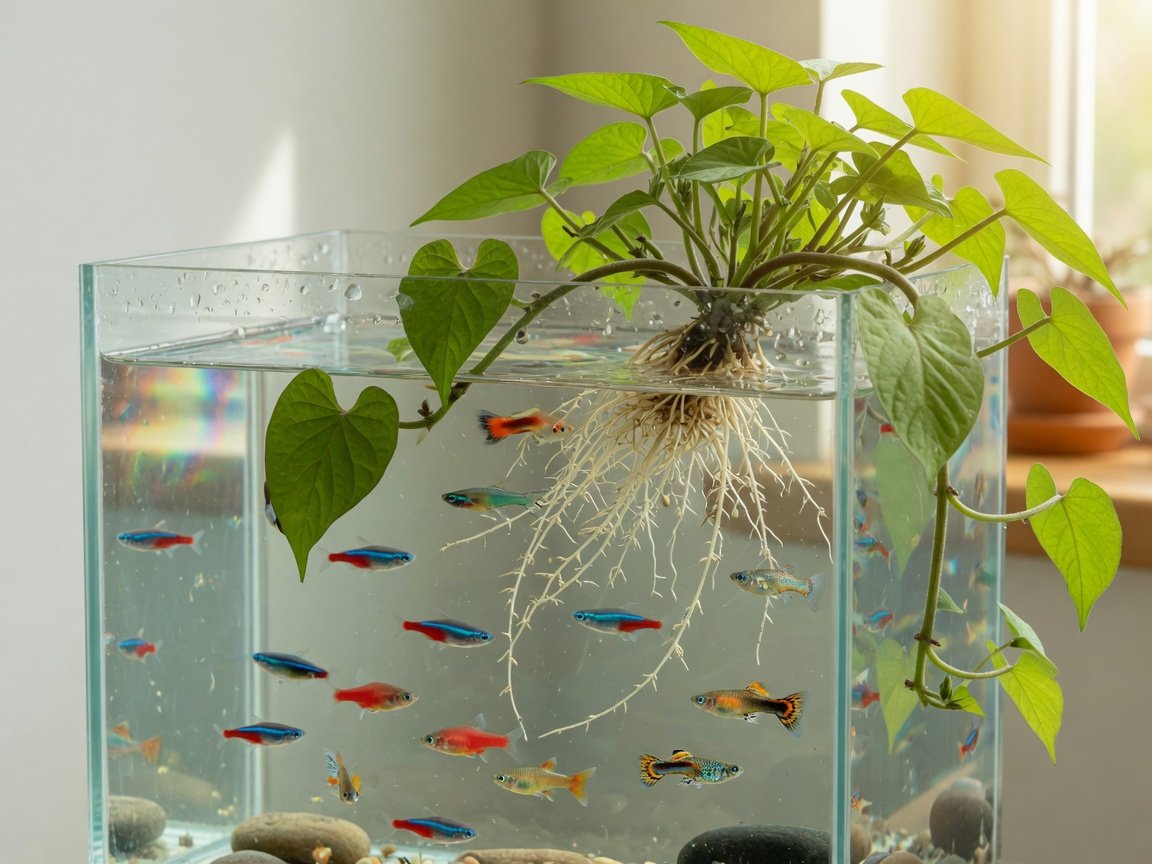
Let’s clear up the most common misconception right away. Growing sweet potato in an aquarium does not mean planting a tuber in the substrate like a sword plant or a Java fern. Sweet potato (Ipomoea batatas) functions as an emergent plant in this setup — the roots live in the water while the vines and leaves grow above the waterline in open air.
Think of the classic school science project: a potato balanced on a jar with toothpicks, its bottom half in water, shooting roots downward and green vines upward. This is exactly that — except your jar is a living aquarium, your water is rich with fish-produced nutrients, and the plant earns its place by actively cleaning the water your fish depend on.
Experienced aquaponics growers have long recognised sweet potato as one of the most effective crops for pulling nitrogen compounds out of fish water. Its vigorous root system and fast above-ground growth give it a nutrient uptake rate that few beginner-friendly plants can match. The aquarium method brings that same biology to a small home tank with almost zero setup complexity. For anyone curious about scaling this concept into a full growing environment, the detailed walkthrough on growing sweet potatoes in a complete aquaponics system covers nutrient cycling, system design, and harvest timing in much greater depth.
For now, the aquarium method is the perfect low-effort starting point. Fifteen minutes of setup. Then the plant does the rest.
Why Will Your Aquarium Fish Love It?
The headline benefit is nitrate control. Every freshwater aquarium accumulates nitrates over time — fish waste breaks down to ammonia, ammonia converts to nitrite, and nitrite converts to nitrate through the natural nitrogen cycle. Nitrates are less immediately toxic than ammonia or nitrite, but at concentrations above 40 ppm they can suppress immune function, cause chronic stress, and reduce breeding success in sensitive species.
Water changes are the standard fix — but they’re time-consuming and only treat the symptom. A thriving sweet potato vine addresses the cause, consuming nitrates directly as a nitrogen source for its explosive leaf and root growth. Hobbyists running heavily stocked tanks regularly report dropping nitrates from 60–80 ppm to under 20 ppm within four to five weeks of adding a well-rooted vine, without changing their water change schedule at all.
Sweet potato vines consume nitrates at a rate few other beginner-friendly plants can match — feeding directly from the water column with no substrate needed.
Beyond water chemistry, there are several other practical gains worth knowing about:
- Biofilm habitat — the root system becomes a grazing surface for shrimp, snails, and small fry, providing supplementary nutrition and natural cover
- Gentle shading — trailing vines reduce light intensity in corners and along the back of the tank, which many fish — especially shy or nocturnal species — genuinely appreciate
- No CO₂ competition — emergent plants use atmospheric CO₂ rather than dissolved CO₂ from the water, so sweet potato won’t compete with your submerged plants for carbon
- Aesthetics — sweet potato vines come in green, purple, and variegated leaf forms, all of which trail beautifully over the sides and back of a tank
What Will You Need to Get Started?
The total cost of this project is typically under £5 / $6, and you likely already have most of what you need.
- An organic sweet potato — organic is essential here. Many conventionally grown sweet potatoes are treated with a sprout inhibitor called chlorpropham during storage, which prevents the eyes from producing shoots. Organic tubers don’t go through this treatment and begin sprouting within days in warm, bright conditions.
- Toothpicks or a small net cup — standard wooden toothpicks are all you need to suspend the potato at the waterline. A 2-inch net cup (the kind used in hydroponics) gives a tidier, more secure result if you want a neater presentation.
- A freshwater aquarium — 10 gallons or larger is ideal. Smaller tanks can work, but the root mass will fill them surprisingly quickly once the vine is established and actively growing.
- A bright light source above the tank — this is the element most hobbyists underestimate. Your aquarium LED is designed to illuminate downward through the water column, not to support vigorous above-water leafy growth. A basic clip-on grow bulb positioned above the tank opening makes a significant, visible difference in vine health and speed.
- Optional: a hang-on bracket or foam float — useful for tanks without an obvious rim ledge, or if you want the setup to look intentional rather than improvised.
Lighting consistently separates sluggish, yellow vines from fast, lush ones. Sweet potato is a sun-loving crop that wants 12–16 hours of bright light every day — far more than typical aquarium plants. If you’re setting this up in a room without reliable natural light, it’s worth reading up on choosing the right grow lights for an indoor aquaponics setup — the same principles apply directly to aquarium-based plant growing and will save you time troubleshooting.
How Do You Prepare Your Sweet Potato for the Aquarium?
You have two solid approaches depending on what you have available: a whole tuber or a stem cutting. Both work well — they just suit different situations.
Option A: Whole Tuber Method
This is the beginner’s choice and closely mirrors the classic science-experiment setup. Push 3–4 wooden toothpicks horizontally into the widest part of your sweet potato, spacing them evenly around the circumference. They act as a shelf, letting the potato rest on the tank rim with its lower third submerged. The pointed end — or whichever end shows the earliest eye development — should face downward into the water.
Within 7–14 days, fine root threads emerge from the submerged section. Vine growth above the waterline typically begins around weeks three to four, then accelerates noticeably once the root system has a firm foothold. In warm water above 78°F with strong light, some growers see vine tips extending 2–3 inches per day during peak growth.
Option B: Stem Cutting Method
If you have access to an existing sweet potato vine — from a garden, a plant shop, or a fellow fish keeper — stem cuttings are faster and often more reliable. Take a 6–10 inch cutting from a healthy stem. Strip the leaves from the bottom 3–4 nodes, leaving the top leaves intact. Place the bare nodes in aquarium water — let it float, clip it to the side, or hang it from the rim — and roots will emerge from the nodes within 5–10 days.
Cuttings are particularly practical in smaller tanks because you control the initial root mass from day one. They’re also the natural next step once your main vine is established, since every trim you make produces a ready-to-root cutting.
How to Set Up Your Sweet Potato in the Tank: Step by Step
- Choose and rinse your potato. Select an organic tuber showing early signs of eye development. Rinse under cold water to remove surface residue — don’t scrub the skin off, since the sprouting eyes are on the skin surface.
- Insert your toothpicks. Push 3–4 toothpicks horizontally into the widest part of the potato, spaced evenly. Make sure they’re firm enough to support the potato’s weight without flexing when rested on the tank rim.
- Position it at the waterline. Rest the toothpicks on the tank rim so the lower third of the potato sits in the water. The pointed or eye-heavy end faces down.
- Set up your light. Position a grow light above the tank opening on a 14-hour daily timer, or place the tank near a south-facing window.
- Monitor daily for the first two weeks. Look for fine white root threads emerging from the submerged section. Nothing by day 14 almost always means a sprout-inhibited tuber — swap it for an organic one.
- Watch for vine shoots at weeks 3–4. Small leafy shoots push up from the eyes above the waterline. Growth accelerates quickly once started.
- Trim roots when needed. Once the root mass grows substantial, cut it back to 4–6 inches from the base using clean scissors. The plant regrows from the cut within 1–2 weeks.

What Are the Best Tank Conditions for Sweet Potato Growth?
Sweet potato is forgiving, but matching these parameters closely will mean the difference between a vine that crawls and one that races across your tank lid within a month.
| Parameter | Ideal Range | Notes |
|---|---|---|
| Water temperature | 70–85°F (21–29°C) | Aligns perfectly with most tropical freshwater community tanks |
| pH | 5.5–7.0 | Tolerates up to 7.5; slightly acidic conditions are preferred |
| Nitrate level | 20–80 ppm | Higher nitrates actually accelerate vine growth initially |
| Light above tank | 12–16 hours/day | Direct sun or a dedicated grow light; aquarium LEDs alone are usually insufficient |
| Water hardness | Soft to moderately hard | Very hard water can slow root development slightly but rarely stops it |
| Water flow near roots | Gentle to moderate | Some surface movement helps oxygenate roots and prevents rot at the waterline |
Temperature compatibility is one of sweet potato’s biggest practical strengths in this context. At 75–82°F it overlaps precisely with the requirements of most tropical community fish. You make no compromise between what the plant needs and what the fish need — both thrive in the same range without any adjustment.
Which Fish Work Best With Sweet Potato Vines?
Almost any freshwater fish will coexist happily with sweet potato. The roots are non-toxic, the plant doesn’t alter water chemistry in any harmful way, and the shading effect is mild enough that most species either ignore it or benefit from it. That said, some setups pair particularly well.
Goldfish tanks are arguably the single best home for sweet potato vines. Goldfish are famously messy, produce enormous quantities of nitrate, and are typically kept in cooler water — sweet potato handles the lower end of its temperature range (around 65–70°F) well enough to function in coldwater setups. Many goldfish keepers report dramatically reducing water change frequency after adding a vigorous vine to their tank.
Cichlid tanks — both African and South American — are another excellent fit. Cichlids are heavy feeders that push nitrates upward fast. The vine’s aggressive uptake keeps levels manageable between scheduled maintenance sessions.
Tropical community tanks with tetras, rasboras, livebearers, guppies, and corydoras run perfectly at the 75–82°F range where sweet potato thrives. If you’re still deciding between a freshwater or saltwater setup for your next tank, this comparison of tropical fish in freshwater versus saltwater aquariums is worth reading — the nitrate management approach differs significantly between the two ecosystems, and sweet potato is strictly a freshwater tool.
One caution: large, boisterous fish such as Oscars or territorial cichlids may investigate and tear at the root mass. A loose piece of plastic mesh around the roots solves this without restricting water flow.
What Are the Most Common Problems and How Do You Fix Them?
Most sweet potato vine problems trace back to four causes. Here’s how to diagnose and fix each one quickly.
The Potato Isn’t Sprouting After Two Weeks
Cause: Sprout inhibitor. Chlorpropham is applied to many conventionally grown sweet potatoes during storage to prevent premature sprouting. It works well for grocers and very poorly for fish keepers. Organic sweet potatoes skip this treatment entirely.
Fix: Replace the potato with an organic one from a health food shop, farmers’ market, or organic grocery. In warm water above 75°F with good overhead light, an untreated tuber will show root activity within a week.
Roots Are Growing But the Leaves Are Yellow
Cause: Insufficient light. Yellowing leaves on an otherwise active vine almost always indicate the plant cannot photosynthesise efficiently. Standard aquarium LEDs illuminate downward through the water column — they simply don’t provide the quality or direction of light that above-water vines need.
Fix: Add a grow bulb in a clip lamp positioned above the tank opening, running 12–16 hours daily. A basic LED grow bulb costing less than £15 / $20 is sufficient for most home aquariums. Visible improvement in leaf colour typically follows within 7–10 days.
The Root Mass Is Blocking the Filter Intake
Cause: Success. A dense root mass reaching the filter intake is a sign of a well-established, actively growing vine.
Fix: Trim roots back to 4–6 inches from the base using clean scissors. Try to trim above the waterline to minimise debris entering the tank. Roots regrow to a similar density within 2–3 weeks, so this becomes a routine maintenance task rather than a one-off fix.
The Tuber Is Rotting at the Waterline
Cause: Too much tuber submerged, or insufficient water movement near the potato. Rot almost always starts at the wet-dry interface — where the tuber transitions from submerged to exposed — when that zone is stagnant and continuously damp.
Fix: Lift the potato so only the bottom quarter touches the water. Make sure your filter output is creating gentle surface movement near the potato’s position. If rot has already set in, cut the affected area away cleanly with a sterile knife, let the cut surface dry for an hour, then reposition.
How Do You Harvest, Trim, and Maintain Your Vine Long-Term?
Once your vine is established — typically 6–8 weeks after initial setup — the maintenance routine is minimal. The three main tasks are trimming, harvesting, and eventual tuber replacement.
Trimming the vines: When vines outgrow your space, cut them back to whatever length you prefer. Sweet potato branches from cut points, so regular trimming produces a denser, bushier plant rather than a single long runner. Every trim gives you potential new cuttings to root in water, share with fellow hobbyists, or simply compost.
Harvesting the leaves: Sweet potato leaves are fully edible and nutritious. In many parts of Southeast Asia and West Africa they’re a staple cooking vegetable — used in stir-fries, soups, and salads. If your tank water is free of medications and chemical treatments, the leaves and young shoot tips from your aquarium vine are safe to harvest and eat. Pick the newest growth at the vine tips for the most tender texture.
Replacing the tuber: Over 6–12 months the original tuber becomes progressively hollowed out as the vine draws from it. When it looks significantly shrunken or develops persistent soft spots, take a 6–10 inch cutting from your established vine, strip the lower nodes, place it in the tank water, and within a week you have a rooted replacement. The cycle begins again. If the idea of fish and plants working together as a system has you curious about what else is possible, this look at everything you can grow with aquaponics is genuinely eye-opening — sweet potato is just the beginning of what fish-fertilised water can produce.
Monitoring water parameters: Test nitrates weekly for the first four to six weeks and keep a simple log of the readings. Most hobbyists see a clear downward trend within a month, and tracking it is satisfying in a way that’s hard to explain until you see it yourself.
Frequently Asked Questions
Can I grow a whole sweet potato directly in my aquarium?
Yes — but only the lower third should touch the water. Toothpicks, a net cup, or a foam float hold it at the correct depth. Fully submerging the tuber causes rapid rot. Keep the majority of the potato above the waterline and let only the bottom section make contact.
How long does it take for sweet potato roots to appear in aquarium water?
Fine root threads typically appear within 7–14 days with an organic, untreated tuber in warm water above 75°F and bright overhead light. No activity at all after two weeks almost always means a sprout-inhibited potato. Replace it with an organic one and try again.
Will sweet potato roots harm my fish?
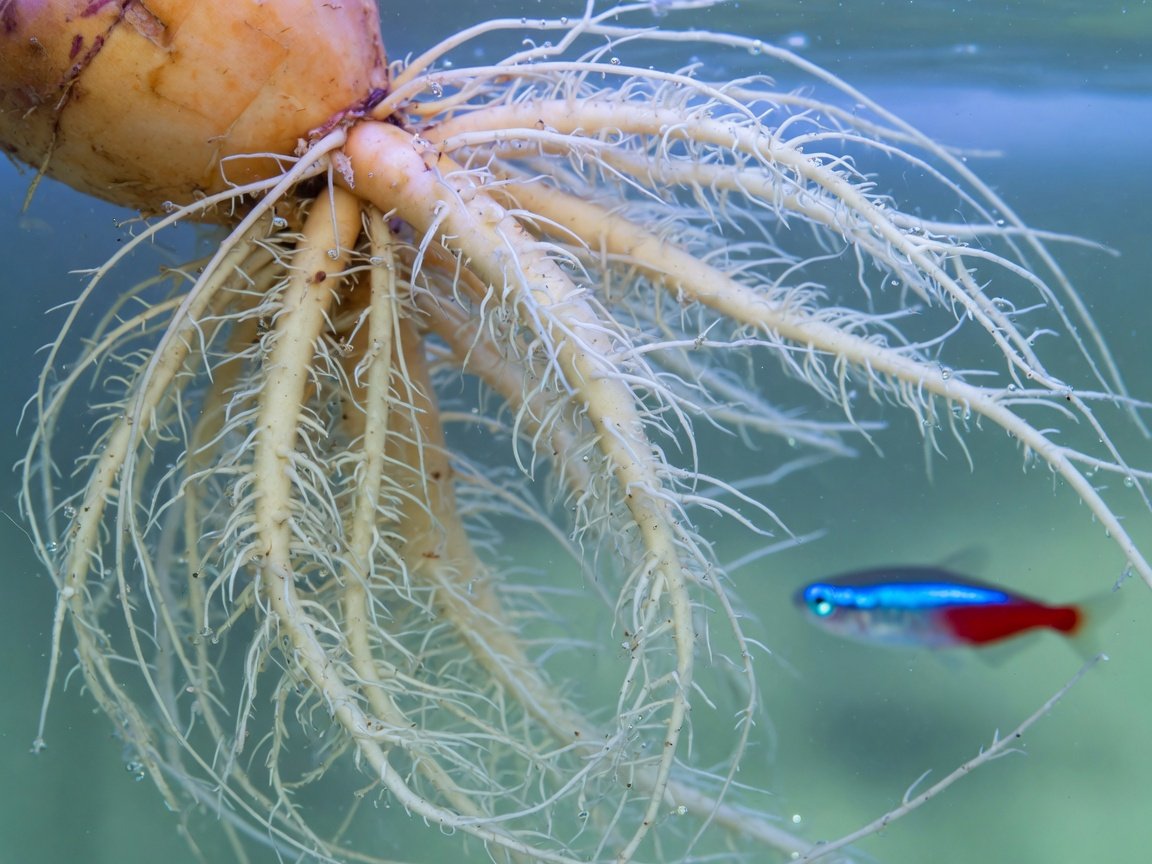
No. Sweet potato roots are non-toxic to freshwater fish. In many tanks, shrimp, snails, and small fry actively graze on the biofilm that develops on the root surface, making the root mass a supplementary food source rather than a hazard. There is no evidence that sweet potato roots alter water chemistry in any way harmful to aquatic life.
Do I need special lighting to grow sweet potato in my aquarium?
Almost certainly yes, unless your tank sits in direct window sunlight for most of the day. Standard aquarium LEDs illuminate the inside of the tank — they don’t provide the direction, intensity, or duration of light that above-water vines need. A basic clip-on grow bulb running on a 14-hour timer above the tank opening is enough to produce strong, healthy growth.
Can I eat the sweet potato after it’s been growing in my fish tank?
The vine’s leaves and young shoot tips are the best harvest — nutritious, tender, and perfectly safe to eat if your tank is medication-free. The tuber itself typically becomes depleted and soft after months of supporting vine growth. Most hobbyists find it unappetising by the time it needs replacing. Harvest the leaves; replace the tuber.
Does this method work in saltwater aquariums?
No. Ipomoea batatas is a strictly freshwater plant. Its roots die quickly in marine or brackish conditions. If you have a saltwater tank and want natural nutrient export, macroalgae refugiums — growing chaetomorpha or caulerpa in a sump — are the established equivalent approach.
How often should I trim the sweet potato vines?
Every 2–4 weeks once the vine is established is a typical rhythm. More frequent trimming encourages bushier, more compact growth and produces a continuous supply of cuttings you can root, share, or compost. Nothing in this process needs to go to waste.
Ready to Try It? Your Action Plan
Growing sweet potato in your aquarium is one of the most satisfying low-effort things you can add to your fish-keeping routine. Fifteen minutes of setup. A cost measured in loose change. And a plant that starts improving your water quality within weeks while trailing genuine greenery over the top of your tank.
- Today: Buy an organic sweet potato. Insert toothpicks. Place it at the waterline with the lower third submerged. That’s the whole setup.
- Days 3–5: Position a grow light above the tank opening if you haven’t already. Set it on a timer for 14 hours daily.
- Day 14: Check for root threads. Nothing visible means a sprout-inhibited tuber — swap it for a fresh organic one.
- Week 4: Test nitrates and compare to your pre-sweet-potato baseline. The difference should be measurable by now.
- Month 2: Take your first vine trimmings. Propagate, cook the leaves, or give cuttings to a fellow fish keeper.
- Month 6+: If the fish-and-plants concept has taken hold, the floating raft aquaponics method is one of the most accessible ways to scale from a single aquarium into a proper growing system where fish and plants support each other at scale.
As aquaponics principles move increasingly into mainstream home fish keeping through 2025 and 2026, the hobbyists who already understand how roots and fish water interact will be well ahead of the curve. Start with one tuber. Track your nitrates. See what happens. Your fish will benefit, your water will improve, and you might find yourself genuinely surprised by how much a sweet potato can do for a fish tank.
—