The ideal pH for aquaponics is 6.8 to 7.2. That narrow window is the compromise point where fish stay healthy, plants absorb the nutrients they need, and the beneficial bacteria that power the whole system keep working at full capacity — all at the same time.
Key Takeaways
- The aquaponics pH sweet spot is 6.8–7.2, balancing the competing needs of fish, plants, and nitrifying bacteria.
- pH below 6.0 causes nitrification to stall — ammonia accumulates and can reach toxic levels within days.
- pH above 8.0 shifts ammonia to its toxic un-ionised form, threatening fish rapidly even at low total ammonia concentrations.
- Test pH at least twice a week; daily testing is essential during the cycling phase.
Why pH Is the Most Important Number in Your Aquaponics System
Water chemistry can feel overwhelming when you’re starting out, but pH is the one number that ties everything else together. It controls whether your fish can breathe properly, whether your plants can access iron and other trace minerals, and whether the bacteria colony that converts toxic ammonia into plant food is running at full capacity or barely limping along.
Think of pH as the master dial on your system. Spin it too far in either direction and the whole ecosystem starts to unravel, even if every other parameter looks fine on paper. Research from the Food and Agriculture Organisation of the United Nations indicates that aquaponics systems operating outside the 6.5–7.5 range show measurably lower fish growth rates, reduced plant yields, and higher disease incidence across the board.
The complicating factor is that the three main groups of living things in your system — fish, plants, and bacteria — each have slightly different preferences. Fish like it near neutral (around 7.0). Plants prefer it slightly acidic (closer to 6.0–6.5). Nitrifying bacteria are most active around 7.5–8.0. Getting all three to coexist happily is the art and science of aquaponics pH management. If you’re still getting to grips with how the whole ecosystem works together, this primer on mastering aquaponics is an excellent place to build your foundation.
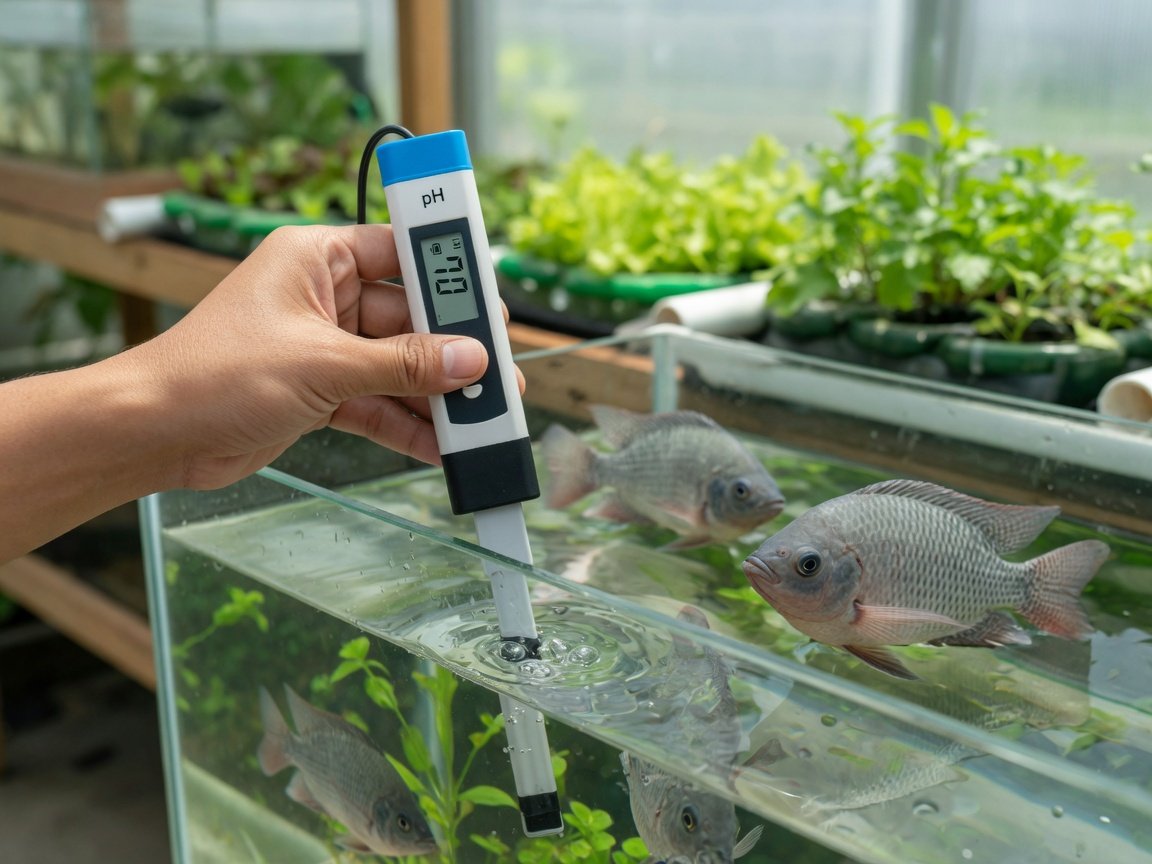
What Is the Ideal pH Range for Aquaponics?
The consensus across aquaponics research and experienced practitioners is 6.8 to 7.2. Some sources widen this slightly to 6.5–7.5, and that range is workable — but tighter is better. Here’s why that specific window serves everyone in the system:
| Stakeholder | Preferred pH Range | Risk Below Range | Risk Above Range |
|---|---|---|---|
| Fish (most species) | 6.5–8.0 | Gill damage, stress | Ammonia toxicity |
| Plants | 5.5–6.5 | Root rot (extreme cases) | Iron & manganese lock-out |
| Nitrifying bacteria | 7.0–8.0 | Nitrification stalls | Activity declines above 9.0 |
| Aquaponics sweet spot | 6.8–7.2 | — | — |
At 6.8–7.2 you’re at the lower end of what bacteria prefer but still firmly within their functional range. You’re slightly above what plants ideally want, but nutrient availability at this level is very good for the majority of crops. And you’re comfortably within the safe zone for every commonly farmed fish species in aquaponics.
Dr. James Rakocy, whose research at the University of the Virgin Islands laid much of the scientific groundwork for modern aquaponics, consistently ran his large-scale systems at 7.0–7.2 and recorded excellent growth rates for both tilapia and leafy greens. That target has since become the industry benchmark, repeated in FAO technical guides and adopted by commercial producers worldwide.
How Does pH Affect Your Fish?
Fish are sensitive to pH, and they’re even more sensitive to rapid changes in pH. A gradual drift from 7.2 down to 6.5 over the course of a week is far less dangerous than a sudden swing of the same magnitude overnight.
When pH drops below 6.0, fish show visible signs of acute stress: laboured breathing, erratic swimming, loss of appetite, and increased mucus production on their gills and skin. At 5.5, most common aquaponics species — tilapia, trout, catfish, goldfish — begin to die. Below 5.0 is almost universally fatal within hours.
High pH creates a different but equally dangerous threat. Ammonia exists in two forms in water: ionised ammonium (NH₄⁺), which is relatively harmless to fish, and un-ionised ammonia (NH₃), which is acutely toxic even at very low concentrations. As pH rises above 7.5, the balance shifts progressively toward the toxic form. At pH 8.5, studies show that approximately 9–12% of total ammonia nitrogen is present as un-ionised NH₃ — enough to cause serious gill damage at ammonia levels that would be perfectly safe at a neutral pH.
This is why keeping pH below 8.0 is non-negotiable if you’re carrying any meaningful fish load. An unchecked upward pH creep is one of the most common triggers for fish disease outbreaks in aquaponics systems — fish under chronic ammonia stress have compromised immune responses and become far more vulnerable to opportunistic pathogens.
How Does pH Affect Plant Nutrient Uptake?
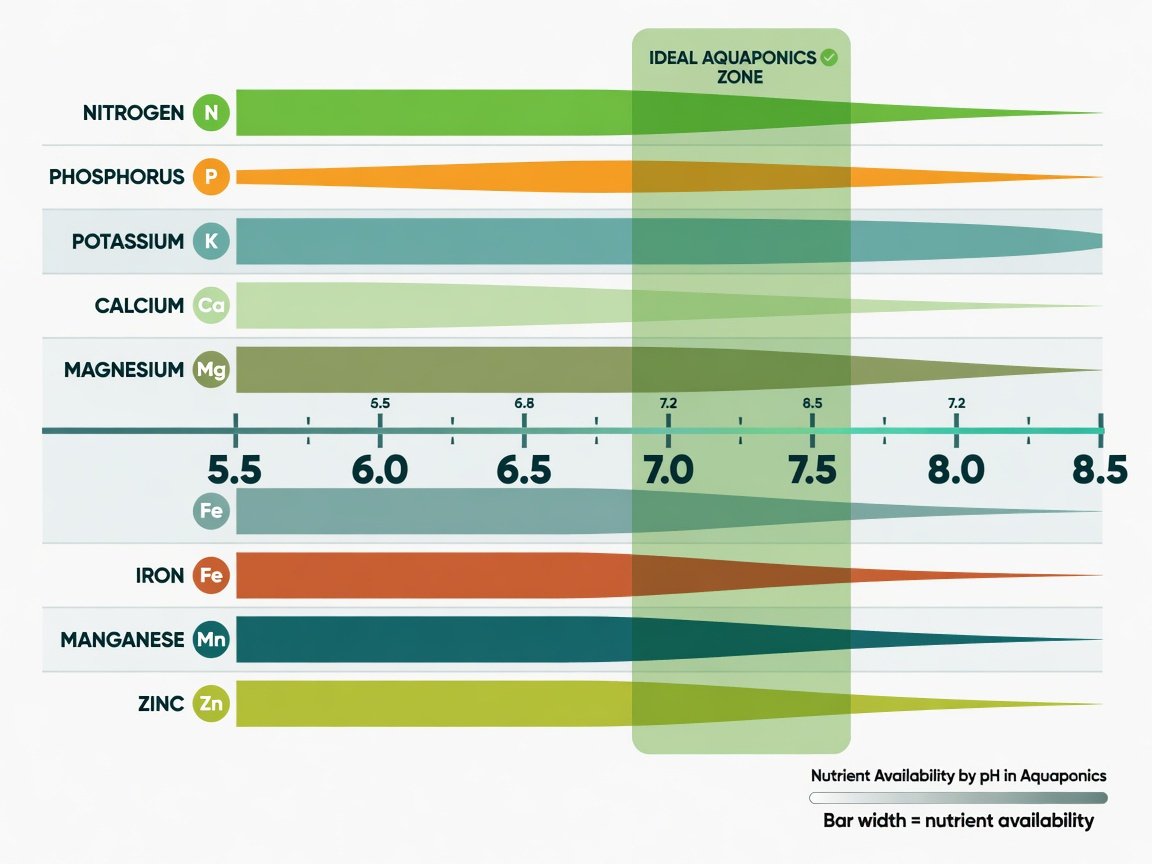
Plants don’t absorb pH directly — but pH controls whether the nutrients already in your water are in a chemical form that plant roots can actually take up. This is called nutrient availability, and it shifts dramatically across the pH scale.
Iron is the classic example. At pH 7.5 and above, iron becomes largely insoluble and precipitates out of the water column as iron hydroxide. Plants can’t access it, even if there’s plenty present in the system. The result is iron deficiency chlorosis — new leaves turn yellow while the veins stay green. It looks exactly like a nutrient shortage, but the real problem is pH.
Manganese, zinc, and copper follow a similar pattern. The lower the pH (within reason), the more soluble and available these micronutrients become. Calcium, magnesium, and phosphorus, on the other hand, are most available between 6.5 and 7.5 — which lines up neatly with the aquaponics sweet spot. According to plant nutrition research, over 90% of essential plant nutrients are optimally available between pH 6.0 and 7.5, making the 6.8–7.2 target an exceptionally efficient range for crop production.
If you’re growing leafy greens like lettuce, spinach, or basil, you’ll find they thrive at 6.8–7.2 because their micronutrient demands are relatively modest. Fruiting plants and root vegetables are more demanding and may show early deficiency symptoms at the higher end of the range. When planning which crops to grow alongside your fish, reading up on the best plants for aquaponics helps you choose varieties that perform best in the neutral zone.
How Does pH Affect Nitrifying Bacteria?
The nitrifying bacteria in your biofilter are the engine of your entire system. Without them, ammonia from fish waste would accumulate to lethal levels within days. These bacteria — primarily Nitrosomonas and Nitrospira species — convert ammonia to nitrite and then nitrite to nitrate, which plants absorb as fertiliser. The whole loop depends on them.
Their activity is strongly pH-dependent. Research shows that nitrification rates drop by roughly 50% when pH falls from 7.5 to 6.5, and can decline by as much as 90% at pH 6.0 compared to optimal conditions. Below 6.0, the process can effectively stall. That means ammonia and nitrite build up fast — even in a previously stable, well-cycled system.
The bacteria technically prefer slightly alkaline conditions. pH 7.5–8.0 is their sweet spot. This is the main reason you should resist the temptation to run your system at a lower pH just because your plants would prefer it. A small sacrifice in plant-optimal conditions is worth it to keep the biological engine running efficiently.
As the FAO’s technical guide on small-scale aquaponics notes: “The nitrification process is the cornerstone of any aquaponics system, and maintaining water pH above 6.0 at all times is a non-negotiable baseline for system stability.” Practically, this means that any time you see pH drifting toward 6.5, your first concern should be testing ammonia and nitrite — not just fish comfort.
What Causes pH to Rise in an Aquaponics System?
Knowing what pushes pH upward helps you get ahead of problems before they become emergencies. Several common factors drive pH higher in aquaponics systems:
- Tap water alkalinity. Most municipal water has a pH of 7.5–8.5 and significant carbonate hardness (KH). Every top-up adds alkalinity, which buffers pH upward over time.
- Calcium carbonate in growing media. Crushed limestone, coral gravel, or oyster shell media dissolves slowly and releases calcium carbonate into the water. This is one of the most common causes of persistently high pH in new builds.
- Photosynthesis. During daylight hours, plants and algae consume dissolved CO₂. Less CO₂ means less carbonic acid, which pushes pH up. In heavily planted systems, pH can swing 0.5–1.0 units between morning and evening.
- Insufficient fish bioload. Fish waste produces acids. In a significantly under-stocked system, there’s not enough acid production to counteract the alkalinity arriving with water top-ups.
- New concrete or untreated wood. Both leach alkaline compounds into the water column, particularly in new builds that haven’t been cured properly.
A persistent upward pH drift is extremely common in new aquaponics systems, especially during the cycling phase before fish waste production is fully established. If you’re fighting pH that simply won’t come down, the detailed strategies in this expert guide to lowering pH in aquaponics walk through every tested method in depth.
What Causes pH to Drop in an Aquaponics System?
pH crashes — rapid downward swings — are less common than gradual rises but considerably more dangerous, because they can catch you off-guard and harm fish before your next scheduled test.
- Fish waste and respiration. Fish produce CO₂ and ammonia metabolites that acidify the water over time. In an overstocked system, this effect accelerates significantly.
- Nitrification itself. The conversion of ammonia to nitrate is an acid-generating process. As your bacterial colony matures and throughput increases, the system naturally acidifies — this is normal, but it needs managing.
- Low alkalinity (KH). If your water has very low carbonate hardness, there’s nothing to buffer against pH swings. Small acid inputs produce large pH drops. This is sometimes called a “pH crash” and is the most dangerous single scenario in aquaponics management.
- Overfeeding and decaying organic matter. Uneaten food decomposes and releases organic acids that steadily lower pH.
- High plant density and root respiration. Plant roots release CO₂ and organic acids, gradually acidifying the water in densely planted systems over weeks and months.
Monitoring KH (carbonate hardness) alongside pH is the most effective way to catch a crash before it happens. If KH drops below 50 ppm, your system has very little buffering capacity and a pH crash can occur within 24–48 hours. Keep KH above 80 ppm as a safety margin — this gives you time to respond to an acid spike before it harms your fish.
How Do You Test pH in an Aquaponics System?
You can’t manage what you can’t measure. Accurate, consistent testing is the foundation of stable water chemistry — and it’s where most beginners let things slip.
You have three main options:
- Liquid test kits. The most widely trusted method for aquaponics. They use a colour-change reagent and are accurate to within 0.2 pH units. Liquid kits are affordable, the reagents last 1–2 years, and they don’t require calibration. The API Freshwater Master Test Kit is a popular and reliable choice among both hobbyists and small commercial producers.
- Digital pH meters. Fast, precise (±0.01 pH units on quality models), and easy to read. They need regular calibration with two-point buffer solution — monthly at minimum — and the probes degrade over time and require replacement. Worth the investment if you’re testing daily or running a larger system where precision matters.
- pH test strips. Cheap and convenient but the least accurate option, with potential errors of 0.5–1.0 pH units or more. Fine for a very rough check but not reliable enough for critical management decisions.
How often should you test? During initial cycling, test every day — ideally at the same time each morning to account for the natural diurnal pH fluctuation driven by photosynthesis. Once the system is fully established and stable, twice a week is a reasonable minimum for a healthy, balanced system. Always return to daily testing for at least one week following any significant change: new fish added, changed feeding rate, media swap, or new plant beds brought online.
In larger systems, test in multiple locations — at the fish tank, at the biofilter outflow, and at the plant bed return line. pH can vary meaningfully between zones in complex layouts.
How Do You Adjust pH in an Aquaponics System?
Once you’ve confirmed pH is outside the 6.8–7.2 target range, here’s how to bring it back. The golden rule: never adjust by more than 0.2 pH units per 24 hours. Even a change in the right direction stresses fish if it happens too fast.
To Raise pH
- Potassium hydroxide (KOH) or calcium hydroxide (Ca(OH)₂): The two most widely used pH-up compounds in aquaponics. Both are fish-safe when dosed correctly. Calcium hydroxide also contributes calcium, which benefits plant growth. Always dissolve in water before adding, and introduce the solution slowly near a high-flow area so it dilutes before reaching the fish tank.
- Crushed oyster shell or calcium carbonate in a mesh bag: A gentler, slower-release approach that buffers pH upward over days or weeks. Excellent for long-term stabilisation rather than emergency correction.
- Potassium bicarbonate: Raises both pH and KH simultaneously, improving buffering capacity. A preferred choice when you need to raise pH and also want to prevent future crashes.
To Lower pH
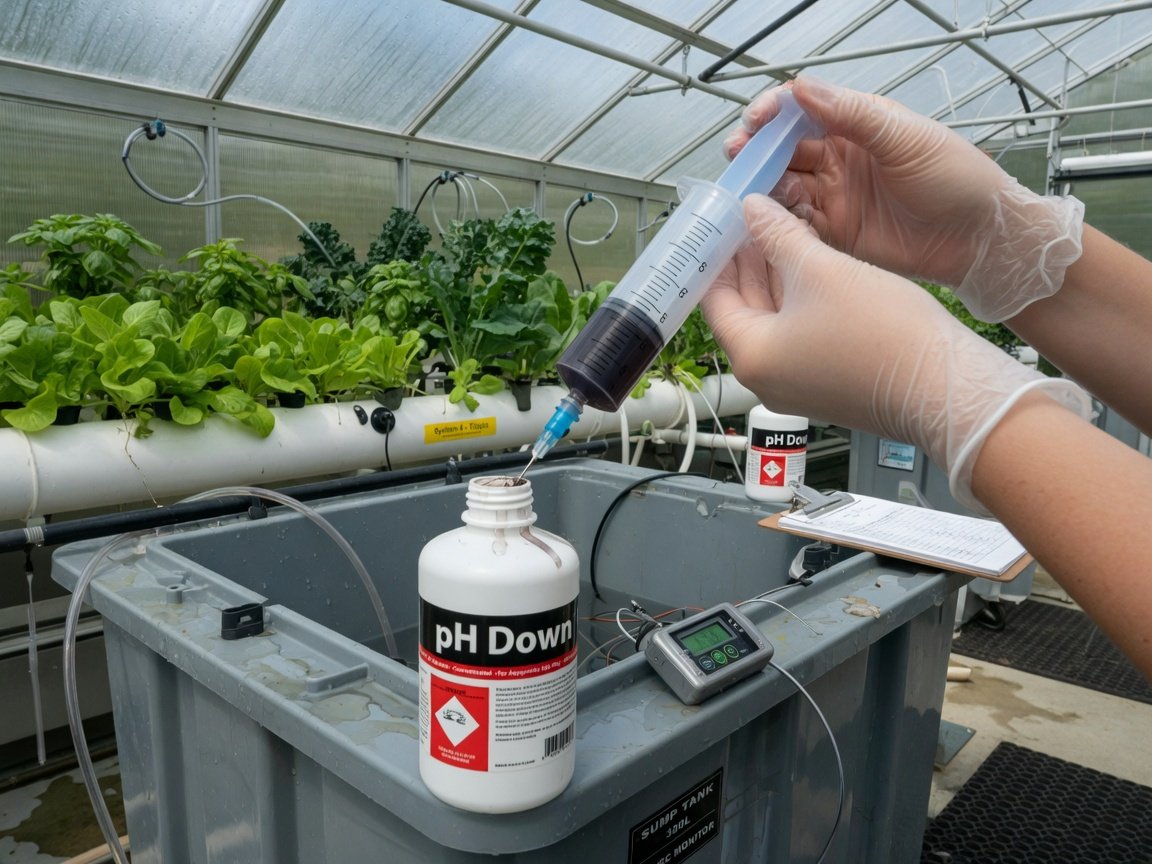
- Phosphoric acid: The preferred choice in aquaponics because residual phosphate is a beneficial plant nutrient. Safe for fish at correct doses. Always dilute before adding and introduce slowly.
- Citric acid: Works quickly but is consumed by bacteria and can temporarily disturb biofilm stability if overdosed. Best reserved for minor adjustments of 0.1–0.2 units.
- CO₂ injection: Dissolves into carbonic acid, gently and controllably lowering pH. Common in commercial-scale systems and in builds that already run CO₂ equipment. Very precise, no chemical residue.
- Replace carbonate-leaching media: If your growing media contains carbonates, swapping it for an inert alternative often solves a chronic high-pH problem at its source rather than treating the symptom.
Always dose in small increments, retest after 2–4 hours, and repeat if needed. Never add acid or base directly to a fish tank — always dose into the sump or a high-flow section where the chemical fully dilutes before it reaches your fish.
How Do You Keep pH Stable Long-Term?
Chasing pH with corrections every few days is exhausting and stressful for your system. Stability is the real goal — and stability comes from building the right foundations in the first place, not from reactive management.
- Know your source water before you start. Test your tap water’s pH and KH. If KH is above 200 ppm, it will constantly push pH up. If it’s below 50 ppm, you’ll need to buffer it with potassium bicarbonate. Rainwater can be blended with tap water during top-ups to bring alkalinity down without adding chemicals.
- Choose inert growing media. Expanded clay (LECA), pumice, and acid-washed gravel won’t alter pH. A simple test: drop a piece in a glass of white vinegar — if it fizzes, it contains carbonates and will drive pH up for months. For a thorough comparison of media types and their effects on system chemistry, the guide to choosing the right aquaponics grow media is an invaluable resource.
- Match your fish stock to your system volume. Overstocking drives pH down through acid overload; understocking allows it to drift up. A balanced bioload keeps acid inputs and alkalinity roughly in equilibrium, reducing the frequency of corrections needed.
- Keep KH above 80 ppm. Carbonate hardness is your pH buffer. Without it, even small acid inputs cause large swings. If your source water is soft, add potassium bicarbonate or calcium bicarbonate to bring KH up to a safe baseline.
- Remove solid waste consistently. Decomposing uneaten food and fish waste is a constant acid source. A well-maintained solids removal setup — settling chambers, filter socks, or dedicated clarifiers — significantly reduces the acid load on your water chemistry.
- Record readings and watch for trends. A simple notebook or spreadsheet tracking pH and KH twice a week will show you gradual drifts days before they become crises. The pattern matters as much as the individual reading.
A system designed with stable water chemistry in mind can hold 6.8–7.2 for weeks at a time with only minor, occasional interventions. The hallmarks of a successful aquaponics system — consistent parameters, matched biology, and proactive management — all trace back, in one way or another, to getting pH right.
pH for Specific Fish Species: Quick Reference
While 6.8–7.2 is the universal sweet spot for a combined system, some species tolerate or even prefer slight deviations from this range. Here’s a quick reference guide:
| Fish Species | Comfortable pH Range | Notes |
|---|---|---|
| Tilapia | 6.5–8.5 | Most pH-tolerant common species; ideal at 7.0–8.0. Best beginner fish. |
| Rainbow Trout | 6.5–7.5 | Prefers cooler, slightly acidic water. Sensitive to high pH and ammonia. |
| Catfish | 6.5–8.5 | Hardy and forgiving; tolerates a wide range well. |
| Goldfish / Koi | 7.0–8.5 | Prefer slightly alkaline conditions. Popular ornamental choice. |
| Barramundi | 7.0–8.0 | Commercial favourite in warmer climates; relatively tolerant. |
| Carp | 6.5–8.5 | Very hardy. Common in traditional polyculture systems globally. |
Tilapia’s unusually wide pH tolerance is one of the main reasons it dominates aquaponics worldwide — it gives you significantly more room for variation without immediate consequences, which is invaluable while you’re learning how your specific system behaves. Trout, by contrast, are less forgiving and best suited to experienced growers who are confident in maintaining tighter, more stable parameters.
The pH–Temperature Connection You Can’t Ignore
One factor that catches many growers off-guard: water temperature directly influences both pH dynamics and ammonia toxicity. As temperature rises, the same total ammonia concentration becomes more toxic, because warmer water shifts the balance further toward the un-ionised form.
This means that in summer, or in heated systems running above 25°C (77°F), you need to be more vigilant about keeping pH below 7.5. Studies on ammonia toxicity show that the safe threshold for un-ionised ammonia drops by roughly 30–40% as temperature rises from 20°C to 28°C at the same pH. In practical terms, a pH reading of 7.4 at 20°C is very different from 7.4 at 28°C — the second scenario carries meaningfully higher ammonia risk.
Always read pH alongside temperature and keep both logged. If your temperature climbs in warmer months, tighten your pH target toward the lower end of the 6.8–7.2 range and increase testing frequency. The two numbers together tell you far more than either one in isolation.
Frequently Asked Questions About pH in Aquaponics
What happens if pH is too high in aquaponics?
If pH rises above 8.0, ammonia in the water shifts progressively toward its toxic un-ionised form (NH₃). Even moderate ammonia levels that are entirely safe at neutral pH become genuinely dangerous. Fish show signs of stress — gasping at the surface, lethargy, clamped fins — and plants lose access to iron and manganese, leading to visible yellowing. Bring pH down gradually using diluted phosphoric acid, adding no more than 0.2 pH units per day, and monitor ammonia levels closely throughout the correction process.
What happens if pH is too low in aquaponics?
Below pH 6.5, nitrifying bacteria start to underperform noticeably. Below 6.0, nitrification can stall almost completely, causing ammonia and nitrite to spike to toxic levels within days. Fish show respiratory distress, erratic behaviour, and increased susceptibility to disease. Raise pH slowly using potassium hydroxide or calcium hydroxide dissolved in water, introduced gradually, and monitor ammonia and nitrite levels closely until the system has fully restabilised. Avoid the temptation to correct rapidly — the shock of a fast swing is often worse than the low pH itself.
How often should I test pH in my aquaponics system?
During initial cycling, test every single day — ideally at the same time each morning, before the photosynthesis-driven afternoon rise, to give you a consistent baseline. Once your system is fully established and running stably, twice a week is a sensible minimum for an experienced grower. Any time you make a significant change — adding fish, adjusting feeding rate, swapping media, or bringing new plant beds online — revert to daily testing for at least a week to catch any instability early.
Is 7.5 pH OK for aquaponics?
Yes, 7.5 is workable but sits at the edge of the recommended range. At this level, iron and manganese availability begin to decline, and ammonia toxicity starts to creep upward — particularly at warmer temperatures. Most fish species will be comfortable at 7.5 provided total ammonia is low, but you may see gradual yellowing in plants over time, especially iron-hungry leafy crops. If your system consistently reads 7.5, it’s worth investigating the cause (likely source water alkalinity or carbonate media) and nudging it back toward 7.0–7.2 for the best all-round performance.
Can I use vinegar to lower pH in aquaponics?
Technically yes, but it’s not recommended as a routine tool. Acetic acid (vinegar) is consumed rapidly by bacteria in the biofilm, meaning its pH-lowering effect is short-lived and can cause erratic swings as the biofilm responds. In larger doses, it can temporarily disturb the microbial community you depend on. Phosphoric acid is a far better choice — it lowers pH more predictably and any residual phosphate is a beneficial plant nutrient rather than a waste product.
Why does pH keep rising in my aquaponics system?
The most common culprits are high-KH tap water used for regular top-ups, carbonate-containing growing media such as crushed limestone or untreated pea gravel, and an insufficient fish load to produce enough acid to counteract incoming alkalinity. A quick diagnostic: drop a small piece of your growing media into a glass of white vinegar. If it fizzes, it contains carbonates and will keep releasing alkalinity into your system until it’s fully exhausted or replaced with an inert alternative. New concrete tanks are another frequent offender in purpose-built setups.
What is the ideal pH for tilapia aquaponics specifically?
Tilapia are comfortable across a wide range — 6.5 to 8.5 — but perform best at 7.0–8.0. For a combined tilapia-and-plants system, targeting 7.0–7.2 gives you the best balance: fish well within their comfort zone, bacteria working at high efficiency, and plants able to access the full spectrum of nutrients. Tilapia’s wide tolerance range is one reason they’re such a popular choice for beginners — they give you meaningful room for error while you’re learning how your specific system behaves across seasons and stocking densities.
Final Thoughts: Keep It Simple, Keep It Consistent
pH management in aquaponics comes down to one central principle: 6.8 to 7.2, tested consistently, adjusted slowly. Almost everything else in water chemistry — ammonia toxicity, nutrient availability, bacterial efficiency — connects directly back to that number.
You don’t need elaborate equipment or expensive chemistry to get this right. A reliable liquid test kit, a notebook to log your readings, and a handful of the adjustment compounds described above is everything you need for a system of any size. The most valuable habit is simply testing on a schedule and acting at the first sign of drift — a pH that’s wandering is dramatically easier to correct than one that’s already crashed or spiked.
Build your system with inert materials from the start. Match your fish stock to your system volume. Understand your source water’s alkalinity before you add a single fish. Do those three things and pH stability will come with remarkably little ongoing effort — leaving you free to focus on what aquaponics is really about: growing great food.
—