An aquaponics tower is a vertical PVC growing system that pulls nutrient-rich water from a fish tank up to stacked planting holes. It then lets gravity drag the water back down through plant roots before returning it to the fish — basically a closed loop where fish waste feeds plants and plants clean the water.
You need one because it grows a serious amount of food in almost no footprint. Stick around and I’ll walk you through exactly how to build and run one.
What Is an Aquaponics Tower?
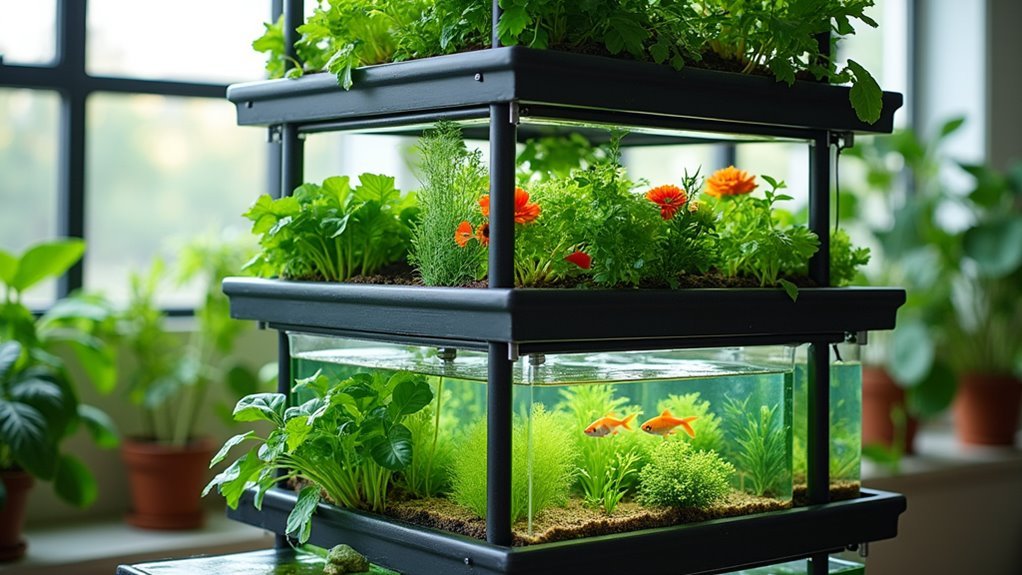
Basically, an aquaponics tower is a vertically stacked growing system where plants live above a fish tank, and the whole thing runs on a closed loop that I’d describe as nature doing your fertilizing for you — which, honestly, is the best kind of farming. Water pumps up to the top grow bed, drips through porous media where bacteria convert fish waste into plant-ready nitrates, then gravity pulls it back down.
Obviously, fish eat, fish produce waste, plants clean the water — everybody wins. Now, aesthetic considerations matter here too, because these towers actually look impressive, not janky. I mean, vertical stacking saves serious space.
There are safety concerns worth addressing — solids clogging roots being the big one — but a simple filtration step handles that cleanly.
How Does an Aquaponics Tower Work?
All right, so here’s the basic loop — and once you see it, you can’t unsee it, kind of like realizing a hot dog is technically a sandwich. Water gets pumped up from your fish tank to the top grow beds, floods through a porous growing media where beneficial bacteria are quietly doing the unglamorous but absolutely critical work of converting fish ammonia into nitrate.
Then, gravity pulls that now nutrient-rich water down through each tray, bathing your plant roots in a continuous, aerated flow before it circles back to the fish. Now, before any of that water ever touches a root, it runs through a mechanical and biological filtration stage that strips out the solid waste. Skip that step and you’ll have a very expensive, very smelly science experiment on your hands, trust me.
I’ve seen guys overlook filtration and act surprised when their plants struggle, which, honestly, fair enough, it’s not the glamorous part, but it’s the part that makes the whole closed-loop system actually work.
Water Flow Explained
How does all this actually work? Honestly, it’s simpler than it sounds — and I say that as someone who once spent three hours confused by a garden hose. A pump (usually around 400 GPH, give or take) pushes nutrient-rich water up from the fish tank to the top grow bed.
Now, gravity takes over from there, cascading water downward through each successive tray. Obviously, beneficial bacteria convert fish ammonia into nitrate along the way, feeding your plants naturally. Each bed alternates flood and drain cycles, which keeps roots oxygenated — think of it like the system taking intentional breaths.
All right, here’s the part people skip: you need a filter first. Without it, solids clog everything, and your whole closed-loop collapses fast.
Biological Filtration Process
So that filter I mentioned? It’s not just a box full of gravel — it’s basically a tiny city of bacteria doing the heavy lifting for you. I call it bacterial colonization, which sounds scary but is actually your best friend.
Here’s the cycle you need to understand:
- Fish produce ammonia waste.
- Bacteria convert ammonia into nitrite, then nitrate.
- Plants absorb that nitrate like it’s premium fertilizer.
Obviously, balanced water chemistry keeps everyone alive — fish, bacteria, plants. The bacteria colonize bio balls, gravel, or your media beds, and honestly, once that colony establishes itself, the system practically runs itself. Water flows through plant roots, nutrients get absorbed, and filtered water returns to your fish. It’s elegant, really.
Nutrient Cycling Mechanics
I’m sure you’ve noticed that without replenishment, systems crash fast — that’s nutrient depletion, and it’s brutal.
But here’s where microbial succession earns its keep: different bacterial communities establish themselves in stages over roughly 4–6 weeks, steadily driving ammonia and nitrite toward zero while keeping nitrate humming around 30–60 ppm. Your fish stay healthy. Your plants stay fed. Everyone wins.
The Benefits of Growing Vertically With Aquaponics
Now, I’ll be honest — the moment I understood what a vertical aquaponics tower actually does for your growing space, I felt a little silly for ever thinking flat was the only option. Stacking your plants upward means you’re multiplying your growing area without multiplying your footprint, and that’s fundamentally a game-changer whether you’re working with a tiny urban balcony or a modest backyard setup you’ve been quietly overcomplicating for years.
The fish water does the heavy lifting nutritionally, cycling up through the tower and feeding every plant level on the way down. So you’re not just saving space — you’re running a surprisingly efficient little ecosystem that produces more food per square foot than most conventional garden beds I’ve seen.
Obviously it’s not magic, but when you combine year-round harvesting potential with the fact that your fish and plants are basically doing each other favors, it starts to feel pretty close.
Space-Saving Vertical Design
Why cram everything onto the ground when you can go *up*? Vertical aquaponics towers let you stack growing space instead of spreading it out, which honestly feels like cheating in the best way possible.
Here’s what makes the design genuinely clever:
- Water pumps up top, then cascades down through every layer by gravity — nutrients delivered, no drama.
- Roots stay compact and vertical, slashing the horizontal footprint dramatically.
- More plants per square foot than almost any horizontal setup you’ll find.
Now, I’ll skip the composting misconceptions and colorimetric testing rabbit holes for now — those deserve their own conversation. The point is, vertical design solves a real problem: limited space. Obviously, not everyone has an acre. This approach works *because* you don’t.
Enhanced Plant Growth Potential
Saving space is great, but here’s the thing — vertical aquaponics doesn’t just *fit* more plants into a smaller footprint, it actually helps those plants *grow better*, and that’s a distinction worth sitting with for a second. Flood-and-drain cycles push oxygen straight to the roots, which is basically like giving your plants a double espresso every few hours.
I’m sure you’ve noticed how waterlogged soil just *kills* things — this system avoids that entirely. Water flows continuously through the root zones, delivering fish-waste nutrients directly.
Obviously, you’ll still want to think about lighting considerations and pest management — neither disappears magically — but vertical stacking actually simplifies both. Fewer hidden corners means pests have fewer places to hide, and you can position lighting more deliberately. Honestly, it’s smarter than it looks.
Efficient Resource Use
All right, here’s why this actually matters beyond just being cool:
- Closed-loop water cycle — water pumps up, gravity pulls it back down through the roots, back to the fish. Nothing wasted.
- Vertical stacking — you’re multiplying your growing area without touching your square footage. Obviously.
- Year-round production — urban resilience isn’t just a buzzword; it’s what happens when your food supply doesn’t depend on weather.
Now, I’ll admit I’m biased toward systems that respect environmental ethics *and* produce dinner simultaneously. This one’s basically pulling double duty like a responsible adult — which, honestly, puts it ahead of me most mornings.
Aquaponics Tower vs. Traditional Grow Beds
So how does an aquaponics tower actually stack up against a traditional grow bed — and is it worth the switch? Honestly, I’m biased — I love towers — but let me give you the real picture.
| Feature | Tower | Traditional Bed |
|---|---|---|
| Space Efficiency | High | Low |
| Tower Maintenance | More demanding | Simpler |
| Nutrient Management | Precise filtration needed | More forgiving |
Obviously, grow beds are easier — less clogging risk, fewer moving parts. But you’re trading floor space for simplicity, and if you’re working with limited room, that trade stings.
Towers let you pack more plants vertically, which is basically the IKEA approach to gardening — same footprint, somehow more storage. Now, towers demand attention, but I’d argue they’re worth it.
Which Plants Grow Best in an Aquaponics Tower?
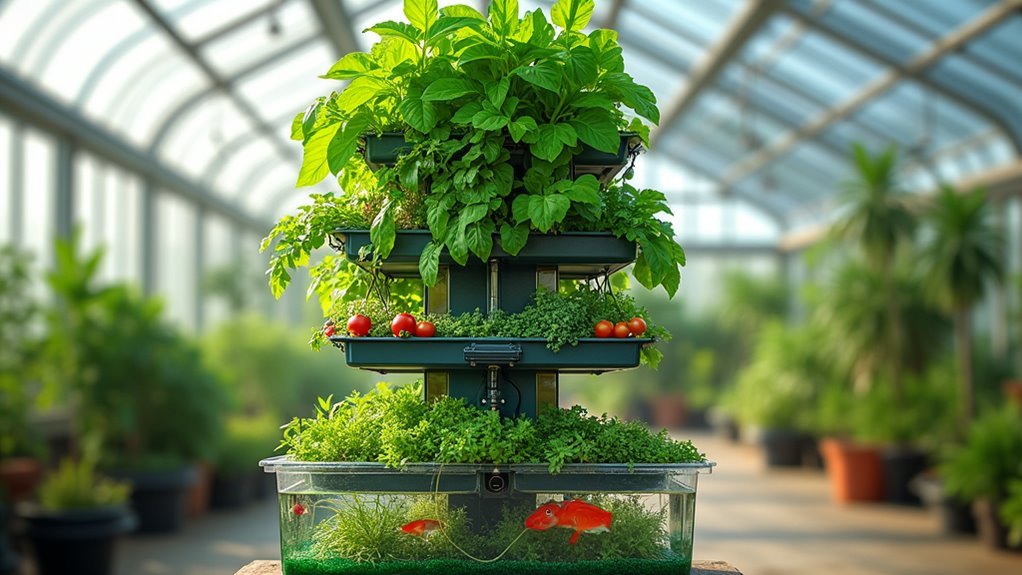
Now, not every plant is going to thrive in a tower, and picking the wrong one is basically setting yourself up to babysit a problem — so let’s talk about what actually works.
Stick to plants that don’t need deep root zones. You’re not growing pumpkins here — obviously those unrelated plant species have zero business in a tower setup.
My top topic ideas for what actually belongs there:
- Leafy greens — lettuce, spinach, kale. Fast growers, shallow roots, basically built for this.
- Herbs — basil, mint, cilantro. They love rapid nutrient uptake like it’s their personality.
- Smaller edibles — strawberries, chard. Compact, manageable, and honestly satisfying to harvest.
I mean, keep it simple and your tower rewards you. Overthink it and, well, good luck.
What Fish Work Well With a Tower System?
Here’s the thing about fish selection — get it wrong and you’re basically running a very expensive, very wet disappointment machine. I’m partial to tilapia, honestly. Hardy, fast-growing, unbothered by minor fluctuations — basically the golden retrievers of aquaponics fish.
Now, bass, goldfish, and koi also work well, though each brings its own drama. Temperature management matters more than most beginners expect — you’re targeting 65–85°F consistently, because swings stress fish fast.
All right, stocking fish is where people get cocky and systems get wrecked. Overload your tank, oxygen crashes, fish suffer, plants suffer, *you* suffer. Keep ammonia and nitrite low, nitrate between 30–60 ppm, and don’t rush density decisions.
Obviously, a solid pump prevents solids from destroying your roots. Trust the numbers.
Materials, Tools, and Equipment for Your Aquaponics Tower
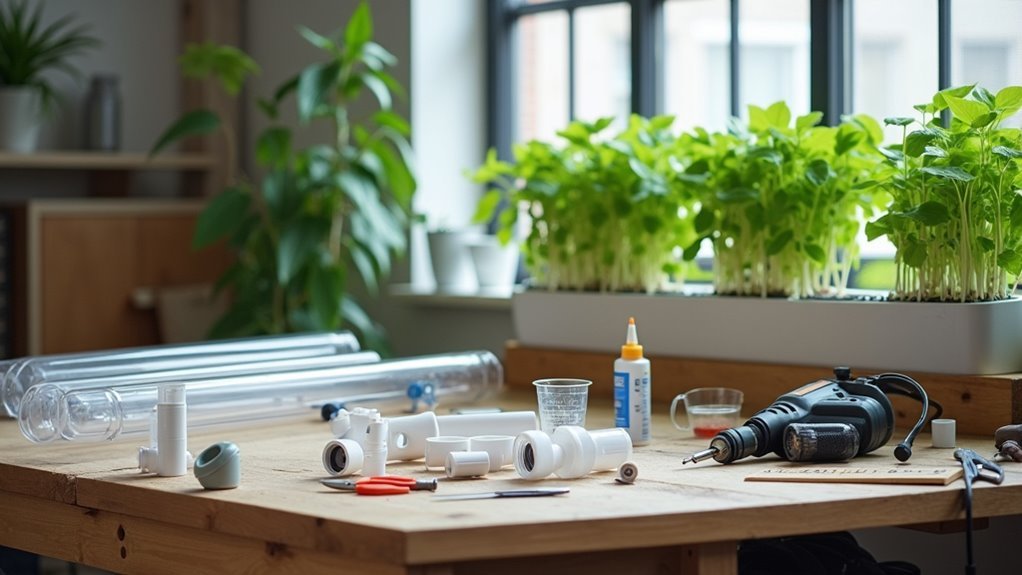
What does a solid aquaponics tower actually require before you even think about planting anything? More than you’d expect, honestly — but less than building a swimming pool. Here’s what you’re actually working with:
- Structure — Four vertical 2–3 foot PVC pipes, eight 1-foot segments with drilled holes, creating 18–25 planting sites per pipe.
- Water system — A 100-gallon fish tank, a 400 GPH pump, aquarium tubing, and a 4-way splitter for even distribution.
- Growing media — Rockwool, pond filter foam, and burlap strips for root attachment and flow control.
Now, the DIY plumbing side might seem intimidating, but it shouldn’t be. Obviously, outdoor pest control means you’ll also need a clamping system — wind doesn’t care about your setup.
Setting Up Your Aquaponics Tower Step by Step
All right, setting up your aquaponics tower isn’t rocket science, but it does have a sequence — and if you skip steps like dechlorinating your water or pressure-testing your joints before you add fish, you’re going to have a bad time, trust me on that one.
I’d say start with your pump setup first: drop a 400 GPH pump in the tank, run tubing up to the towers, and split the flow evenly with a 4-way splitter so you’re not accidentally drowning two columns and starving the other two.
Once water’s moving, cycling the system before you stock fish and plants is the unglamorous but genuinely critical part — kind of like seasoning a cast iron pan, nobody wants to do it, but you’ll regret skipping it.
Choosing Your System Components
Now, before you start buying random pipes and pumps off the internet like I definitely didn’t do my first time around, let me walk you through what you actually need.
Here are your three non-negotiables:
- 4-inch PVC towers with 18–25 drilled planting holes each — obviously not composite materials, which warp unpredictably.
- A 400 GPH aquarium pump — undersizing this is basically volunteering for failure.
- A solid filtration unit — skip this and you’re just clogging pipes for fun.
Also, check local legal considerations around water systems before you build anything permanent. I’m sure you’ve noticed municipalities love surprises.
Mount everything on a sturdy base, use a 4-way splitter for even distribution, and angle your towers slightly so water drains back cleanly.
Cycling and Water Preparation
Before you even think about dropping fish into your new system, you’ve got to cycle it first — and if you skip this step, you’re basically setting up a very expensive fish funeral. I mean, I’ve seen it happen, and it’s not pretty.
Ammonia cycling is your foundation. Fill your system, let it stabilize for a few days, and keep water parameters in check — temperature between 65-85°F, ammonia at 3-5 ppm, nitrite below 1 ppm, nitrate around 30-60 ppm. Add pure ammonia if levels drop too low. Obviously, introduce nitrifying bacteria to speed things along.
Now, expect a nitrite spike early — that’s totally normal, not a sign your system hates you. Wait 4-6 weeks until ammonia and nitrite hit zero before stocking fish.
Stocking Fish and Plants
Once your ammonia and nitrite levels have flatlined to zero and you’ve resisted the urge to rush things — which, honestly, took me longer to learn than I’d like to admit — you’re finally ready to actually build out the fun part.
Now, stocking fish and plants happen together. Here’s my sequence:
- Add fish first — tilapia or goldfish work great for beginners.
- Start plants in net cups — leafy greens establish faster than you’d expect.
- Monitor everything obsessively — pH, ammonia, temperature, all of it.
Obviously, don’t overcrowd your tank immediately. I’m sure you’ve noticed that patience here pays dividends later. Stocking fish gradually lets your system balance naturally, giving plants the growth environment they genuinely need to thrive.
Where to Set Up Your Aquaponics Tower
Where you set up your aquaponics tower matters more than most people think — you need decent light, easy access for feeding and maintenance, and utilities close enough that you’re not running extension cords across the yard like some kind of aquatic disaster waiting to happen.
Obviously, water and electricity need to be nearby. If you’re working inside a Growing Dome, centralize the grow bed and push your tank toward the north wall — trust me, future-you will appreciate that workflow.
Angle your PVC towers slightly so gravity handles the composting water return without drama. Outdoors? Clamp everything down, because wind treats unsecured pipes like a personal challenge.
And leave yourself actual walking paths around the tower — reversed airflow, cramped quarters, and tangled hoses make maintenance miserable fast.
Common Aquaponics Tower Problems and How to Fix Them
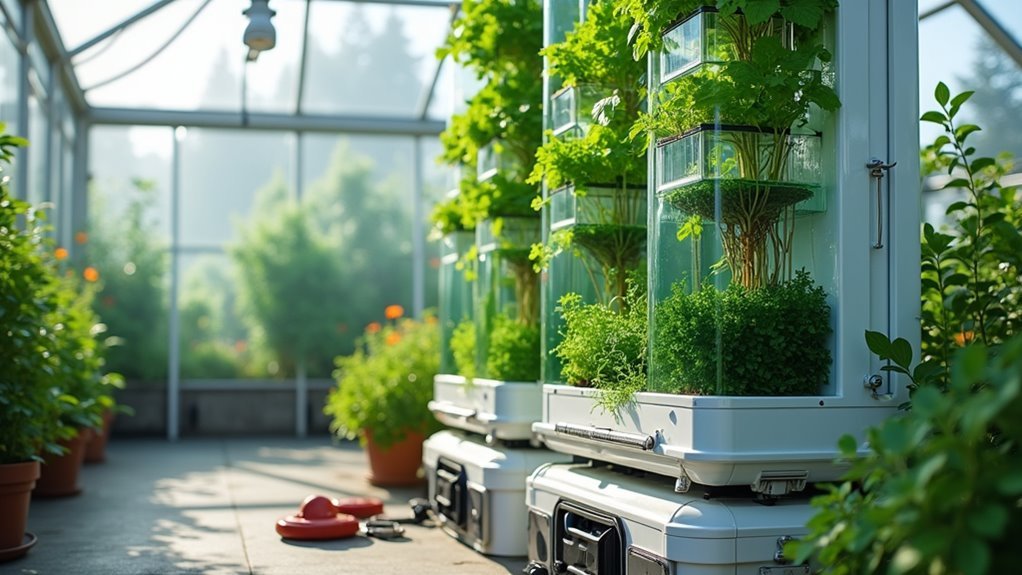
Even the best aquaponics towers throw a tantrum eventually, and honestly, most of the problems you’ll run into fall into a pretty short list — clogging, root chaos, uneven flow, and the occasional wind-induced disaster that makes you question all your life choices. Ignore timeline misconceptions here — these issues hit early, not later.
Even the best aquaponics towers throw a tantrum eventually — and the problems are fewer than you think.
Here’s your short survival guide:
- Clogging at the top — rotate roots, add a dedicated pre-filter, and stop assuming partial filtration is “good enough.”
- Root crowding — secure cups properly using spike holes so roots don’t block everything downstream.
- Slow flow — run a solid 400 GPH pump with properly sized tubing.
Climate implications matter too — outdoor towers need clamping systems because wind doesn’t care about your lettuce.
Frequently Asked Questions
Can You Grow Anything in a Hydroponic Tower?
You can’t grow everything, but I’ll tell you that herbs and leafy greens thrive best.
Plants with compact growing roots and manageable nutrient balance needs, like lettuce and basil, are your ideal choices.
What Does Aquaponics Need?
“An ounce of prevention is worth a pound of cure.” You’ll need a reliable pump, filtration, biological bacteria, and aeration to manage turbulent nutrient flow and fluctuating pH levels.
These components are essential to ensure your fish and plants thrive harmoniously.
What Are the Disadvantages of Hydroponic Towers?
Despite the funny benefits you’ve heard, hydroponic towers have real drawbacks. I’ll debunk common myths: they’re prone to clogging, uneven light exposure, root crowding, and poor water clarity that disrupts nutrient delivery to your plants.
What Is the Lifespan of a Hydroponic Tower?
Like Rome’s enduring aqueducts, your hydroponic tower’s infrastructure durability can span many years. With proper maintenance and energy efficiency in mind, I’d say you’ll enjoy a decade or more of productive growing.