I work a lot with Murray cod in aquaponics, and I think they need big tanks — 300+ gallons if you want healthy adults. They’re obligate carnivores, so high‑protein feeds; temps around 24–25°C seem best, and stocking around 30–40 kg/m³ keeps stress down. Maybe that sounds strict, probably it is; it’s like keeping a border collie in a run, not an apartment. I’ll show you how to…
Biology and Natural Habitat of Murray Cod
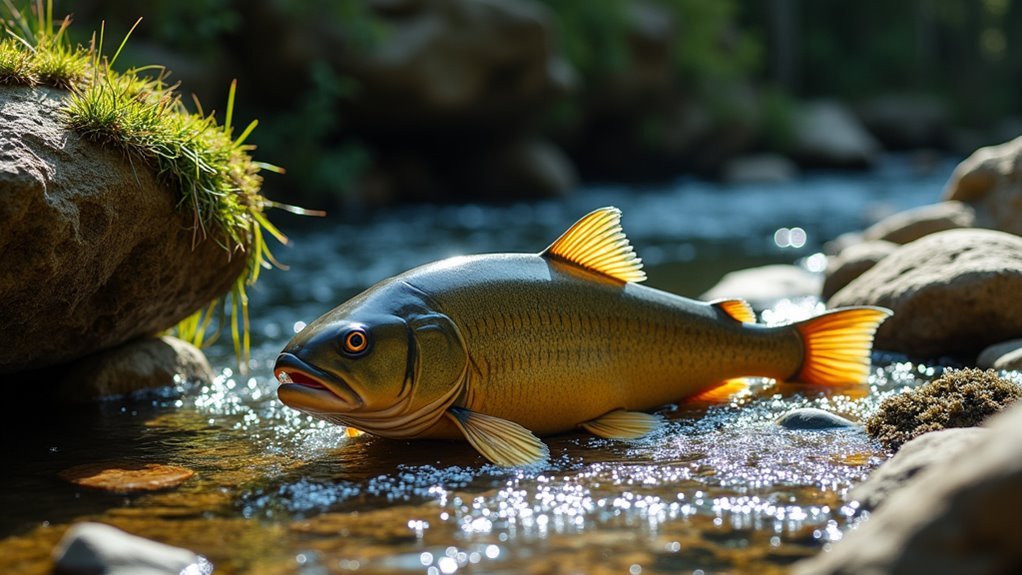
Although they’re often thought of as river giants, the Murray cod is more than just a big fish; I’d say it’s the emblem of Australia’s inland waterways.
I’ve seen descriptions calling it the largest freshwater fish in Australia, able to reach over a hundred kilos and perhaps live eighty years, which is pretty astounding. It likes slow-flowing rivers, deep holes and shelters like hollow logs or hard surfaces for spawning.
They’re territorial predators, feeding on crustaceans, other fish and freshwater mussels — think of an underwater wolf.
Regular temperature management is crucial for Murray cod health and growth.
Reproduction in spring can yield up to 40,000 eggs, hatching in about a week or two; juveniles feed within weeks.
Sadly, overfishing and habitat loss have left wild populations vulnerable. I’m hopeful about conservation, we must act.
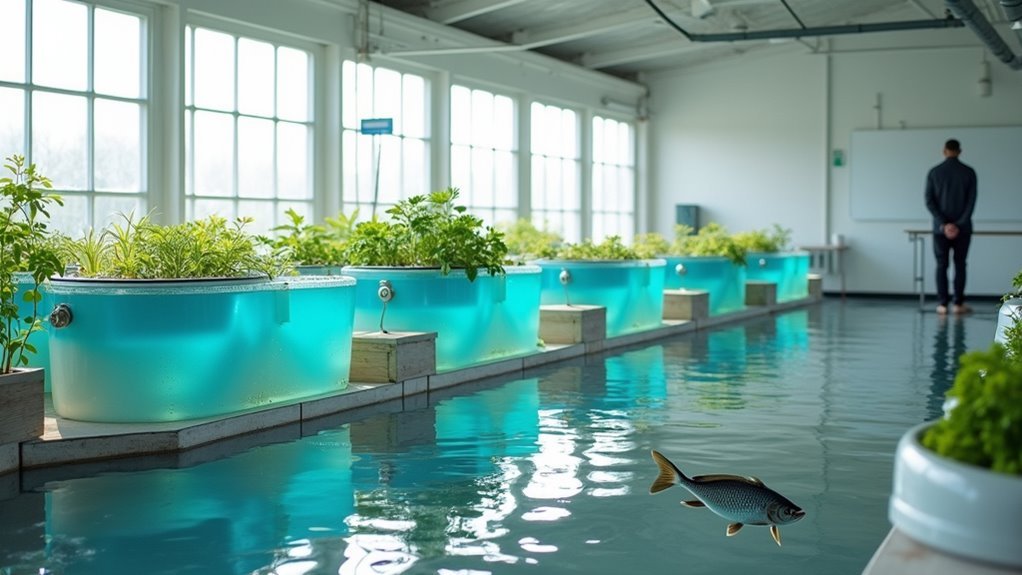
Tank Size and Space Requirements for Aquaponics Systems
| Stage | Min Gallons | Note |
|---|---|---|
| Juvenile | 150 | longer tanks preferred |
| Adult | 300 | allow active swimming |
I think proper tank dimensions matter more than you realize; longer tanks beat deep skinny tubs. Fish spacing is critical — aim low on density, about 30–40 kg per m³. In my experience, mimicking habitat with structure helps wellbeing. It’s not rocket science, but you can’t cram adults together. Maybe you’ll adjust as you learn, I’m not entirely sure, but start conservative and scale up. Also, juveniles need at least 150 gallons; adults, 300, so plan your layout and flow accordingly. really smart.
Additionally, establish robust water quality management by regularly testing pH, ammonia, nitrite, and nitrate levels and performing appropriate water changes.
Water Quality Parameters and Temperature Management
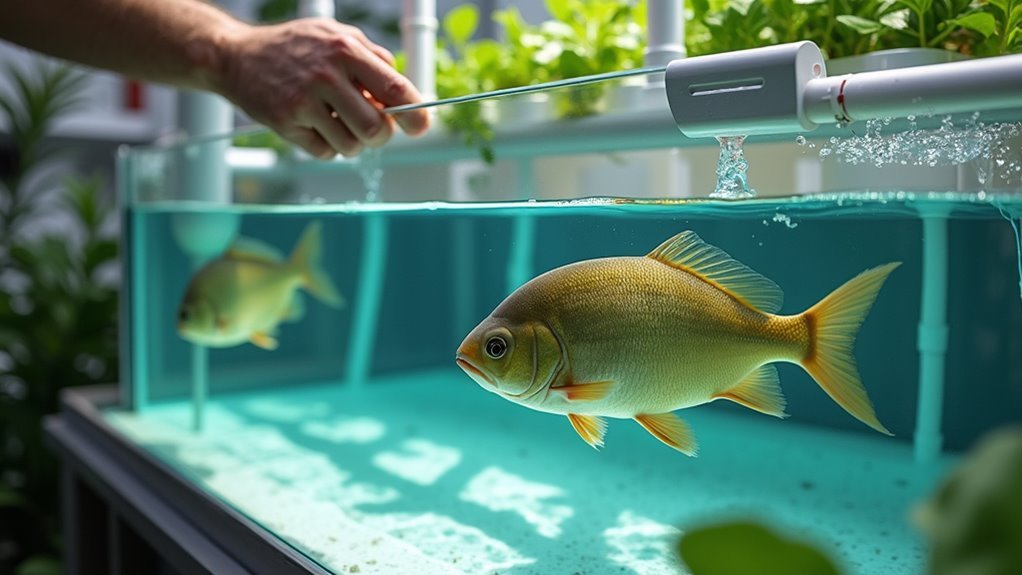
I’ve found that keeping Murray cod at about 24–25°C really makes a difference—it’s where they grow best and stay healthy.
You’ve also got to watch dissolved oxygen; I aim for above 3 mg/L, because anything lower and they’ll struggle, maybe even get stressed.
I’m not entirely sure, but it’s, well, where they thrive—no, thrive; okay, bad grammar, but you know, keeping temp and DO steady is the key.
Optimal Temperature Ranges
Because water temperature really is the single biggest dial you can turn for Murray cod health and growth, I pay close attention to keeping it around 24–25°C — that’s where they grow best. I focus on Temperature regulation to avoid thermal stress; even a few degrees off and feeding drops, immune function falters.
I check thermometers daily and adjust heaters or shade. In cooler months I’ll run heaters; in hot spells I shade and exchange water, you know?
- Maintain 24–25°C for ideal growth.
- Keep within 22–28°C to support metabolism and appetite.
- Monitor regularly with a dependable thermometer.
- Adjust seasonally with heating or cooling measures.
I think consistency matters more than perfect numbers. Maybe small swings are okay if gradual enough.
Dissolved Oxygen Targets
Keeping temperature steady at 24–25°C made me pay attention to dissolved oxygen — they’re tied together more than you’d think. I aim for at least 3 mg/L DO for healthy Murray cod; that’s the baseline.
Warmer water around that range actually helps hold more oxygen than colder water below 20°C, which can drop DO and stress fish. So I balance aquarium filtration and water aeration — filters keep water clean, aerators or air stones keep oxygen up.
I check levels often and tweak heater or aeration; it’s simple, but, well, you learn quick — I mean, you learn quickly. I think monitoring is non-negotiable.
Maybe I’m biased, but in my experience a steady temp plus reliable aeration prevents problems before they start and stay calm.
Nutrition, Diet Formulation, and Feeding Strategies
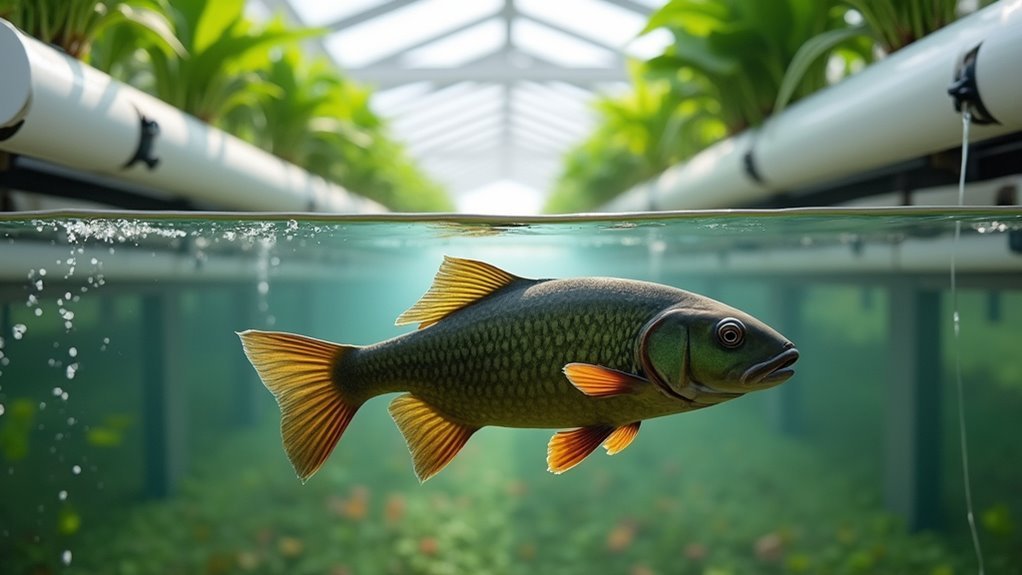
Although Murray cod are obligate carnivores and need a high-protein diet—usually around 45–55% crude protein—I’m convinced that how you present that food matters just as much as what’s in it. Regular monitoring of water quality is essential water quality.
In my experience, Nutrition planning and Feed formulation can’t be an afterthought: pelletized carnivore feeds that mimic fish, crustaceans and insects work best, and occasional live treats boost appetite.
I feed twice daily, adjusting portions by size and activity; it’s simple but requires attention—no, it demands attention. Maybe I’m picky, but good diet reduces stress, improves digestion—like tuning an engine.
I’m not entirely sure, but I think these tips help. does, honestly.
- Match pellets to natural prey.
- Stick to regular schedules.
- Supplement with live food occasionally.
- Adjust portions by growth.
Stocking Density, Grading and Growth Performance
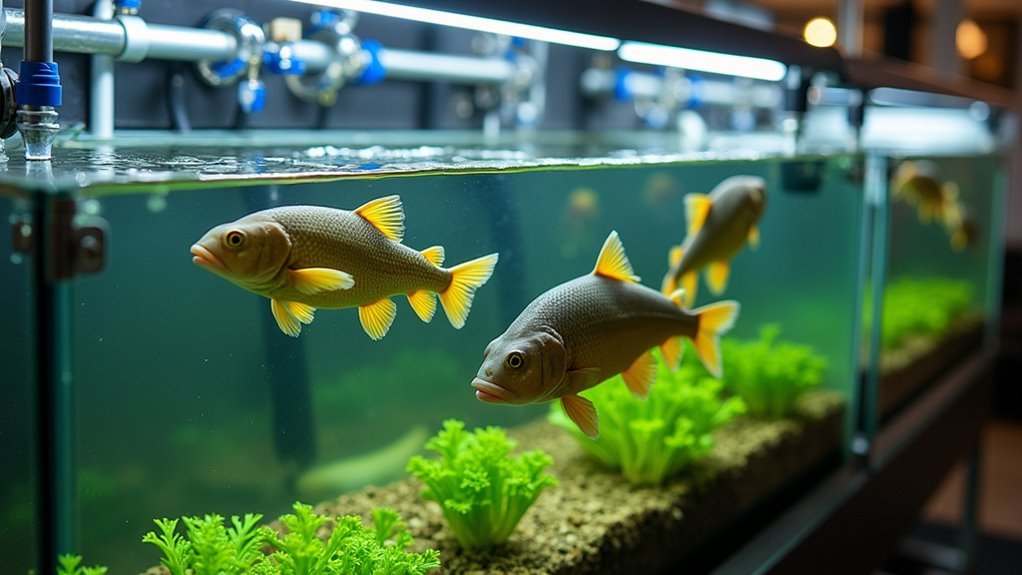
When I set stocking levels I aim for about 30–40 kg per cubic meter in recirculating tanks, since pushing past 60 kg/m³ usually stresses water quality and oxygen — so I try not to cram them in.
Grouping is key; I actually check sizes every few weeks to separate big and small fish because even one overlooked large cod can become a bully and cause injuries. Well, it’s been working for me, I guess—
no, wait, it’s been working for me: measure, sort, move, repeat. Maintaining adequate dissolved oxygen is essential for fish health and stable nitrification, ensuring consistent growth conditions.
Optimal Stocking Densities
If you’re aiming to get the best growth out of Murray cod in a recirculating system, density matters a lot — I’d treat it like arranging people on a crowded train: too packed and things go wrong fast.
I aim for ~40 kg/m³ for ideal growth; 30–60 kg/m³ is acceptable but higher densities demand near-perfect water care. I focus on Pellet formulations and Stress management to keep fish healthy.
Regular grading reduces aggression and improves performance, though I won’t detail protocols here. In my experience balance’s key — you push density for biomass yet risk disease and slower growth.
Maybe you’ll err low at first; that’s fine.
Quick checklist:
- Start ~40 kg/m³
- Maintain water quality
- Monitor behavior
- Adjust feed regularly too
Size-Grading Protocols
Because stocking density and timely grading go hand-in-hand, I always treat size-grading as the backbone of any Murray cod recirculating system — it’s like sorting kids on a playground so the big ones don’t keep stealing the swings. I usually grade every 3–4 months, separating slow growers from fast so cannibalism and aggression drop.
In recirculating tanks you can push density up to about 60 kg/m³, but only if you’re strict with grading and monitoring water quality to avoid toxin buildup. I think regular grading evens out growth, lowers stress and disease.
Well, it’s not foolproof—sometimes you miss a fish—no, you catch it next round. Maybe it’s tedious, but it pays off at harvest and yields more uniform, marketable fish, which I prefer personally.
System Design: Recirculating Tanks, Ponds and Hybrid Options
Although I’ll admit I’m a bit picky about water quality, I think the backbone of any Murray Cod system is choosing the right mix of tanks, ponds or a hybrid, and getting sizes and densities nailed down early.
I’m picky about water quality — the backbone is choosing the right tanks, ponds or hybrid and nailing sizes and densities early
A key design consideration is maintaining a stable water temperature within the recommended range, typically 65–80°F, which should be addressed in any system design temperature range.
I tend to favor recirculating tanks—1000–1300 liter units with tank customization for flow patterns and biofilters—because water circulation is predictable and you can push densities of 30–40 kg/m³.
Hybrid systems: semi-extensive, flexible, environmental enrichment.
3. Pond-only: low tech, lower density, seasonal limits.
4. Accessories: UV, ozonation, biofilters for reliability.
Health Management, Parasites and Disease Prevention
While it’s tempting to focus only on growth and yields, I’ve found that good health management is the backbone of any successful Murray cod system and you’ll save yourself headaches later by getting the basics right now.
Maintaining robust microbial activity that supports the nitrification process helps keep ammonia and nitrites at safe levels.
I monitor ammonia closely — aim below 0.1 mg/L — and keep dissolved oxygen above 3 mg/L, plus temperatures near 24–25°C, because stressed fish invite disease outbreaks.
I quarantine new arrivals in freshwater tanks and treat with safe meds before introducing them; parasite management starts there.
I also use 5–10 ppt salt baths for an hour as prevention and stress recovery.
Do routine checks for lesions, frayed fins or odd swimming, and get vet advice if things look off.
It’s simple, really, but works. Trust me, it’s worth.
Breeding, Hatchery Practices and Fingerling Production
If you want good hatchery results, you’ve got to start with conditioned broodstock and a plan — and I mean a real plan, not just winging it. I collect wild or bred brood, condition them, and consider genetic selection to avoid inbreeding; it matters.
Good hatchery results start with properly conditioned broodstock and a real, detailed plan
We strip-spawn to mix eggs and milt, sometimes using reproductive hormones when timing’s off, though I try natural cues first.
Eggs go into recirculating incubators with tight water control.
Larvae need live feeds — copepods, Artemia — before pellets.
I monitor health, quarantine new fish, and screen for disease; it’s boring but critical.
Maybe I’m obsessive, maybe not.
Here’s quick checklist:
- Condition broodstock and monitor genetics.
- Strip-spawning and controlled fertilization methods.
- Incubation in recirculating systems with water control.
- Larval feeding, quarantine, health screening.
Site Selection, Permits, Escape Prevention and Biosecurity
After you get fingerlings sorted and your hatchery humming, the next thing I always think about is where you’re actually going to put the farm—location matters more than people expect. I pick sites with minimal flood risk, reliable water access and the infrastructure to support strict biosecurity zones; think of it like layers of a bank vault.
Regular testing of water parameters and nutrient levels helps prevent cross-contamination and ensures early detection of issues water parameter testing.
Permit compliance is non-negotiable, especially on eastern drainage areas, so I chase approvals early.
For site security I use reinforced tank lids, sealed entry points and secure containment systems to prevent escapes.
I also set quarantine for new stock, disinfect equipment, control access, and design wastewater management to reduce contamination.
Maybe I’m overly cautious, but it saves headaches later—honest, trust me. Trust me, it’s worth the effort.
Market Opportunities, Economics and Value-Adding Strategies
Because the demand for Murray cod is rising — and honestly, it’s being seen more and more as a premium native product — there’s a real chance to build a profitable niche if you play your cards right.
I’ve found market branding as sustainable, local and premium opens doors to chefs, farmers’ markets and boutique retailers; export potential is real, though regulated.
Economically, farm gate prices around $20/kg mean decent margins, and larger fish fetch more.
Diversify—fillets, smoked fish, live sales, or paired aquaponic greens—to lift returns.
Here are practical steps I’d take:
- Target high-end restaurants with branded story.
- Offer smoked and fillet lines for retail.
- Bundle fish with aquaponic vegetables.
- Explore export channels, certifications and logistics.
It takes time.
Regular water testing remains essential to balance ammonia, nitrite, and nitrate, supporting both fish safety and plant uptake water tests.
Frequently Asked Questions
What Size Fish Tank for Murray Cod?
At least 300 gallons for adults, though I’d recommend 1000 liters (≈264 gallons) or larger for best results; I’ll note Breeding behaviors and Predatory instincts mean you’ll need space, hiding, and stocking to reduce stress.
What Are the Best Conditions for Murray Cod?
They thrive in warm, stable conditions: I’d recommend 24–25°C, large tanks, and good habitat preferences like structure and flow; maintain excellent water quality—low ammonia, high oxygen, pH 6–8—and moderate stocking densities for healthy growth long-term.
What Do Murray Cod Eat?
I find Murray cod eat mostly fish, crustaceans and invertebrates; their Murray cod diet reflects carnivorous feeding on yabbies, small fish, shrimp and mussels, and in aquaculture they’re regularly given high‑protein pellets plus frozen supplements.
What Is the Most Profitable Fish for Aquaponics?
Tilapia is often the most profitable fish for aquaponics; for example, I visited a farm that scaled production to Market demand and Sustainable fishing goals, so I’ll show you real returns if you match demand