I’ve grown kale in aquaponics and I think the core is simple balance—temperature, water flow, oxygen and iron—like tuning a radio to get a clear signal. Well, you know, maybe I’m biased, but keeping roots cool and well-aerated made the biggest difference for me. It’s not rocket science, its—sorry, it’s more practical than that; stick around and I’ll show how.
Why Grow Kale in Aquaponics Systems
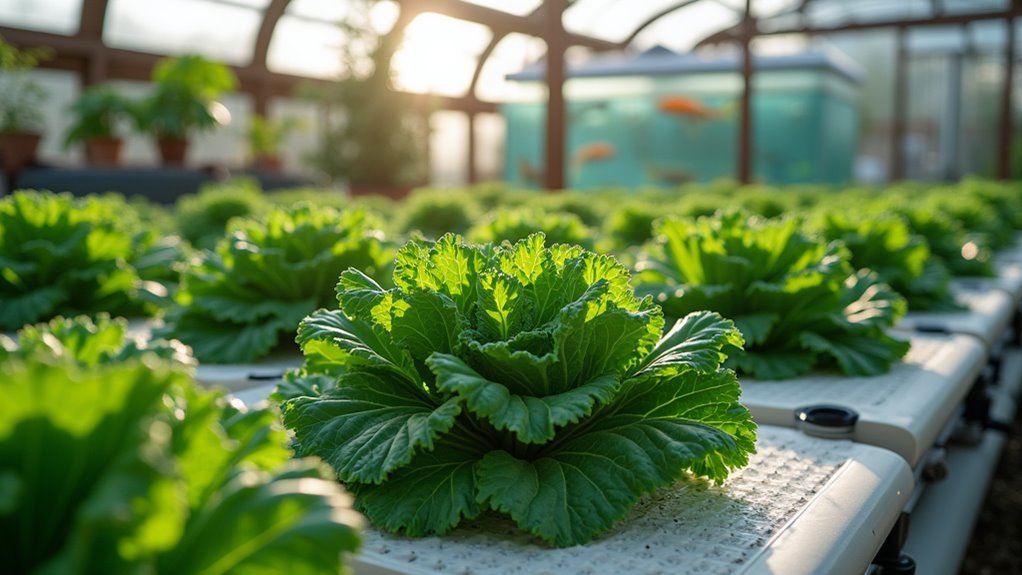
Why would you bother growing kale in aquaponics when you can just buy a bunch at the store? I do it because aquaponics gives me steady nutrients from fish waste, so leaves are darker and more nutrient-dense. It’s like a slow-release fertilizer system that never sleeps.
I think soil health issues disappear — well, there’s no soil to get compacted or drained wrong — so root problems are fewer. Pest control is easier too; the controlled environment cuts down on bugs and disease. Though it’s not perfect, maybe a few aphids show up sometimes.
I’m not entirely sure, but for year-round growth and consistent harvests, aquaponic kale feels worth the effort. It’s rewarding, honestly, and, um, kinda simple — simple, I promise, really, too. Maintaining active biofilters biofilters is key to stable water quality by converting ammonia to nitrate.
Key Components of an Aquaponics Setup
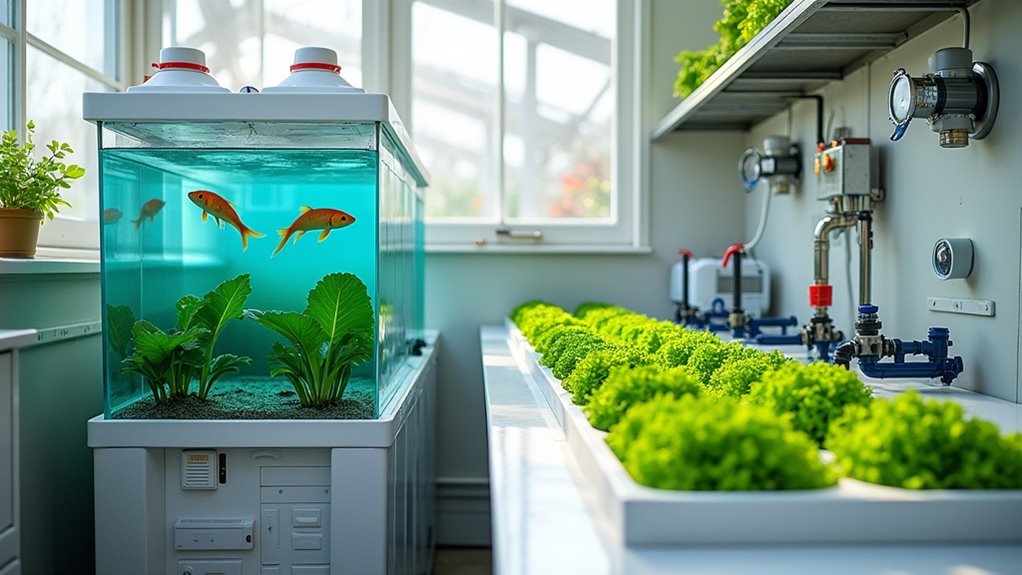
Because a system is only as strong as its parts, I always start by picturing the setup as a little living machine: a fish tank, a grow bed, a water pump and some plumbing that ties everything together. I think of Aquaponics setup like a toolkit. You need Fish tank design for tilapia or trout with stable temperature.
The grow bed uses media — clay pellets or rock wool — to anchor roots and help filtration. Pumps and timers keep water moving; oxygenation matters. You’ve got to monitor pH, temperature and nutrients regularly. Maybe I’m overly cautious, but it’s worth it.
Here’s my quick checklist I use:
- Fish tank choice and layout
- Grow bed media and depth
- Pump, plumbing, and timers
- Monitoring tools and probes
When planning layout, always consider Sunlight exposure to ensure plants get enough light throughout the day.
How the Aquaponics Nutrient Cycle Feeds Kale
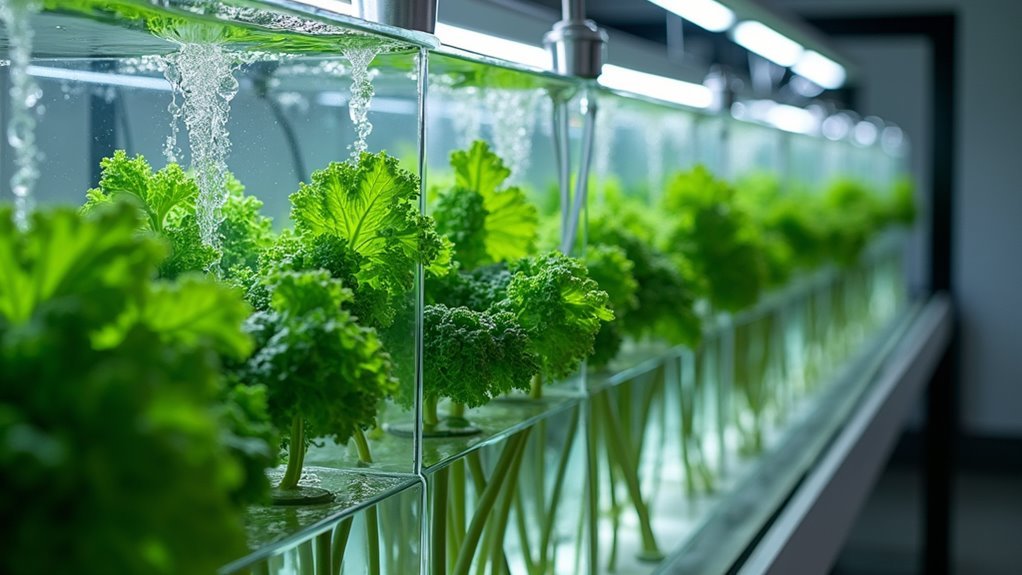
I think of my tank as a tiny kitchen where fish waste gets “cooked” by bacteria into nitrites and then nitrates—the nitrate-rich water is what my kale actually drinks.
The roots take that up constantly, so it’s not a single feeding but a steady buffet, its — I mean, it’s continuous nourishment.
In my experience, well, you’ve got to keep the biofilter and pH in check so the roots can absorb those nutrients efficiently or the leaves will go pale and sad.
Maintaining stable dissolved oxygen levels is crucial for fish health and for preventing stress that can reduce nutrient uptake dissolved oxygen.
Fish Waste to Nitrate
Although it sounds a bit weird, I actually think of my aquaponics system as a tiny, noisy factory where fish waste gets recycled into plant food. I pay attention to Aquaponic pH and which Fish species I use, because bacteria do the heavy lifting: ammonia → nitrite → nitrate.
Nitrates are what kale mainly drinks up, fueling dense leaves. I make sure water flow and oxygenation is steady — no, are steady, so nitrification doesn’t stall. I test nitrates often; I aim for 50–150 ppm, but slightly lower sometimes.
It’s a simple, continuous cycle that keeps feed coming. Key steps I focus on:
- Beneficial bacteria establish and colonize filters
- Maintain flow and good aeration
- Monitor nitrate concentrations regularly
- Choose appropriate fish species and stocking density too
Root Nutrient Uptake
That noisy little factory of mine doesn’t just produce nitrates; it feeds the kale right at the roots. I watch fish waste turn to ammonia and then, thanks to bacteria, into nitrites and nitrates the plants use—it’s beautiful and kind of gross.
Root absorption depends on nutrient solubility in water, so I keep pH around 6.0–7.0. That keeps iron as ferrous iron, soluble and ready for uptake; otherwise high pH makes it precipitate and the leaves yellow.
I think proper aeration and occasional remineralization boost microbial activity and overall uptake. Maybe I’m a bit obsessive about tests, but in my experience those small steps prevent deficiency.
Sorry, obsessive—ok, attentive. It just works.
I’m not entirely sure, but the roots signal when something’s actually missing.
Ideal Air and Water Temperature Ranges for Kale
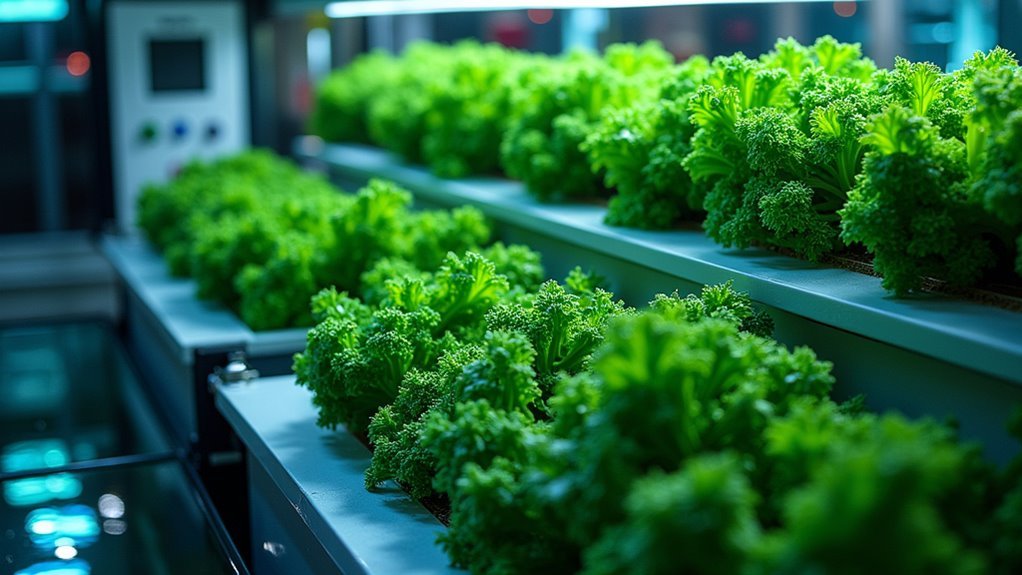
I usually aim for air temps around 60–70°F because I think that’s where kale photosynthesizes best and avoids disease.
For water I try to keep it steady between 55–70°F—healthy roots love that range and big swings stress the plants.
If it gets over 75°F they’ll bolt or stress, and below 55°F growth slows; well, I’m not entirely sure, but that’s been my experience.
Maintaining adequate dissolved oxygen levels is essential for fish, plants, and bacteria to thrive.
Optimal Air Temperatures
When you dial in air temps around 60–70°F and keep water roughly between 55–70°F, kale’s going to thank you with steady growth and good flavor. I aim for stable air temps because temperature fluctuations really stress plants; in my experience, consistency beats extremes.
Cooler nights below 60°F can sharpen flavor, which I like. I use fans and modest air conditioning when summer spikes threaten the canopy — maybe overkill, but it works.
I’m not entirely sure, but slight dips are ok, just don’t let swings be dramatic, you’ll see slow growth or poor leaf quality.
Here are practical points I follow:
- Keep daytime air 60–70°F.
- Allow slightly cooler nights for flavor.
- Avoid rapid temp swings.
- Use air conditioning or ventilation.
Ideal Water Temperatures
How cool should your water be? I aim for 55°F–70°F in my aquaponic system; that range keeps roots healthy and helps prevent root rot from warm, stagnant water. I think cooler temps near 55°F even boost flavor and nutrient density — at least in my experience.
Don’t let it creep above 70°F, because you’ll invite stress and disease susceptibility. Monitoring with a reliable thermometer is essential; I check it daily.
Hydroponic compatibility is good in this range, so systems designed for hydroponics adapt easily, though you’ll see temperature fluctuation during hot days or nights. Maybe you’ll worry about swings — I do too sometimes — but steady monitoring and small adjustments usually fix it, right?
Well, they do for me. Trust the thermometer, really.
Temperature Effects on Growth
Although kale’s tough, it really prefers a fairly narrow temperature window for both air and water — and I’ll say up front, getting that right makes a big difference.
I aim for water at 55–70°F and air around 60–70°F; together they keep roots healthy and photosynthesis steady.
Cooler ranges, near 55–60°F, tend to boost flavor optimization and nutrient density — I think they taste better, actually.
Keep temps under 75°F to avoid stress and bolting.
Maybe obvious, but consistency prevents root rot and improves pest resilience.
It’s like tuning an instrument; small adjustments matter.
Quick tips:
- Water: 55–70°F for root development
- Air: 60–70°F for balanced growth
- Under 75°F avoids bolting
- Cooler temps enhance flavor optimization and overall plant vigor.
Preventing Root Rot: Drainage, Aeration, and Water Flow
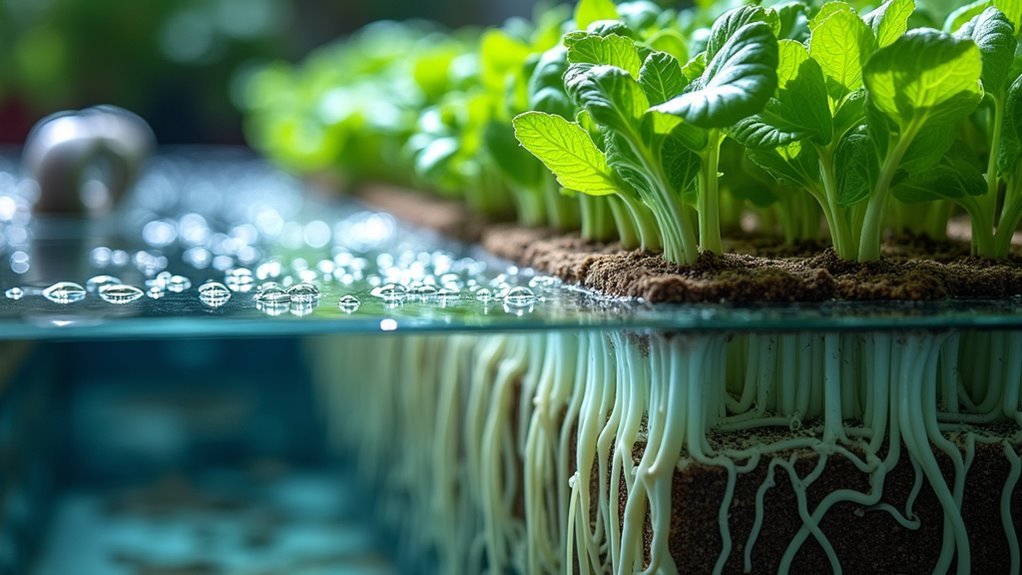
Because good drainage is the backbone of a healthy kale bed, I always start there — you can’t just rely on luck. I make sure beds drain well so roots don’t sit in water and rot.
I use air stones and aeration to boost oxygen — think of roots breathing like lungs. Consistent water flow prevents stagnant zones; check flow rates often and adjust, because pooling is a sneaky killer.
I space plants for airflow and also practice companion planting to reduce humidity and aid pest management, which oddly helps root health.
In my experience, it’s simple but takes attention. Maybe I’m picky, but I regularly test drains and listen to the system; it’s like tuning an instrument, really sometimes messy. I clean, well.
Regularly assess system parameters with water quality monitoring to ensure kale roots stay healthy.
Starting Seeds and Transplanting Seedlings Into Your System
Maintaining a stable pH around 6.8 to 7.2 supports nutrient uptake for kale in aquaponics water quality.
When I start kale seeds, I keep the tray warm — aim for about 60–75°F — and use a moist, well-draining seed mix so they don’t sit in soggy doom (that sounds dramatic, but you get me). I watch seed germination closely; it’s slow at cooler temps and faster near the top of that range.
I transplant when seedlings have 2–3 true leaves and are 3–4 inches tall — that’s my transplant timing rule. I also harden them off over 3–5 days and check water pH is 6.0–7.0.
Spacing matters too. My checklist:
- Warm, moist seed-starting media
- Harden off 3–5 days
- pH 6.0–7.0 at transplant
- Space 15–20 cm
I’m not entirely sure, but it feels reliably repeatable.
Harvesting Techniques to Promote Continuous Production
If you want kale that keeps giving, start by selectively snipping outer mature leaves and leaving that central, cabbage-y heart alone — don’t take the growing tip. I usually harvest in the cool early morning when leaves are tender and taste best; it really makes a difference. Use pruning techniques that remove only damaged or yellowing foliage and never more than 30% at once, or the plant will stress.
Stagger your pickups like rotating small windows so new leaves have space. I think Leaf rejuvenation happens faster when you’re gentle—prune, wait, and watch. Maybe that sounds simple, but it’s true. Sometimes I hesitate, then remember: steady, small cuts beat big, impulsive harvests every time. Its wrong— I mean, it’s easy if you follow this routine. Regular water tests and adjustments help sustain growth, reinforcing the principle of water quality management in a healthy aquaponics system.
Monitoring and Managing Nutrients With a Focus on Iron
Keeping your kale dark green in aquaponics really comes down to watching iron like a hawk and getting the basics right. I check pH stability daily; iron only behaves when pH sits between 6.0 and 7.0.
Maintaining consistent iron availability is central to preserving leaf color and overall system health.
I aim for 2–3 mg/L of iron in the water, and I test often because plants don’t—no, they don’t lie. If levels dip, I add chelated iron—especially in slightly alkaline systems.
Be careful though; too much iron bronzes leaves. I also use tissue tests to see what’s in the leaves.
Here’s the simple routine:
- Test water pH and iron concentration regularly.
- Add chelated iron when needed, slowly.
- Run plant tissue analysis periodically.
- Monitor for toxicity signs and adjust.
I think it’s like tuning a radio; tweaks matter really.
Frequently Asked Questions
How to Grow Kale in Aquaponics?
I grow kale in aquaponics by keeping water cool, stable pH, strong light, and steady nutrients; I’m monitoring iron, practice kale pest control, use selective kale harvesting timing, and harvest outer leaves for continuous production.
What Is the Best Fertilizer for Kale?
The best fertilizer for kale is a fish-based organic mix plus Organic compost and iron chelates; I once watched seedling perk like a marathoner after fish emulsion, and I’m using Controlled lighting while monitoring nutrients
How Long to Grow Kale Hydroponically?
About 6–12 weeks; I’ve seen fast varieties ready in 6–8 weeks with optimized nutrients, and take 8–12 weeks. I’ll emphasize pest management and light optimization, since they speed growth and protect yields and plant health.
What Is the Best Hydroponic System for Kale?
I once helped a rooftop garden thrive with vertical stacking NFT, so I recommend NFT or DWC hybrid for kale; for rapid growth, it’s great preventing root rot, optimizing space, and effectively using organic supplements.