Running an aquaponics carp system is like conducting an orchestra—get one section out of tune and the whole thing sounds off, so you’ll want to keep going… I’ve run a few systems and, in my experience, carp are forgiving but demand steady water quality and good solids removal. I think you’ll learn fast, maybe make mistakes (it’s balance, no—I mean its balance matters), but you’ll improve.
Why Choose Carp for Aquaponics?
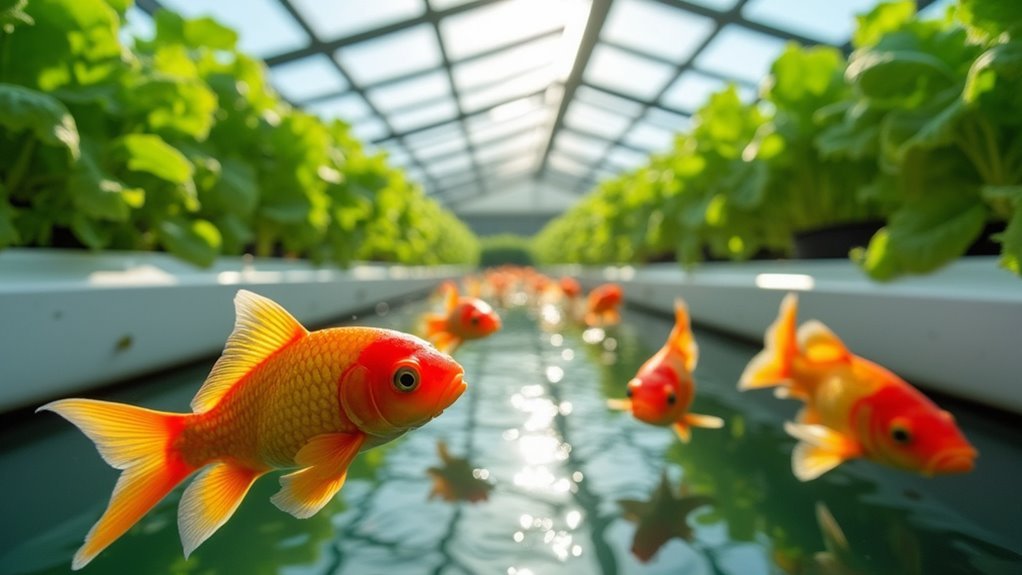
Why pick carp for an aquaponics setup? I pick them because they’re tough, tolerant of pH swings (6.8–8.0), temperature changes and some ammonia, so beginners don’t panic.
There — sorry, their omnivorous diet — pellets, vegetables, duckweed and microbes — makes feeding simple. In my experience their high waste output is a feature, not a bug: it feeds plants when your filtration is right.
Carp behavior is generally calm, adaptable and suited to variable oxygen levels, though they can stir up sediment.
Breeding considerations matter if you want fry; they breed readily but need space and careful stock control, or you’ll get more mouths than beds.
I think they’re practical, maybe not flashy, but reliable. I’m not entirely sure, but they’re hardier than most, honestly.
Carp Species Selection and Which Is Right for You
So you’ve picked carp for the system — smart, practical choice — now you’ve got to pick which kind of carp fits your goals. I think about purpose first: food, ornament, or weed control. Consider these quick distinctions:
- Common carp — hardy, 2–5 kg, tolerant of varying Water chemistry; great for beginners.
- Koi — 1–3 kg, ornamental, need cleaner water and space; like living art, a bit fussy.
- Grass carp — >10 kg, fast-growing, ideal for large systems aimed at plant control and biomass.
Also weigh Genetic breeding lines, climate, and your maintenance tolerance. Maybe you want yield, maybe beauty. I’m not entirely sure, but choose deliberately — it colors everything that follows.
Start small, learn fast, and adapt; experience teaches what books sometimes can’t, it matters.
Tank Size, Space and System Layout
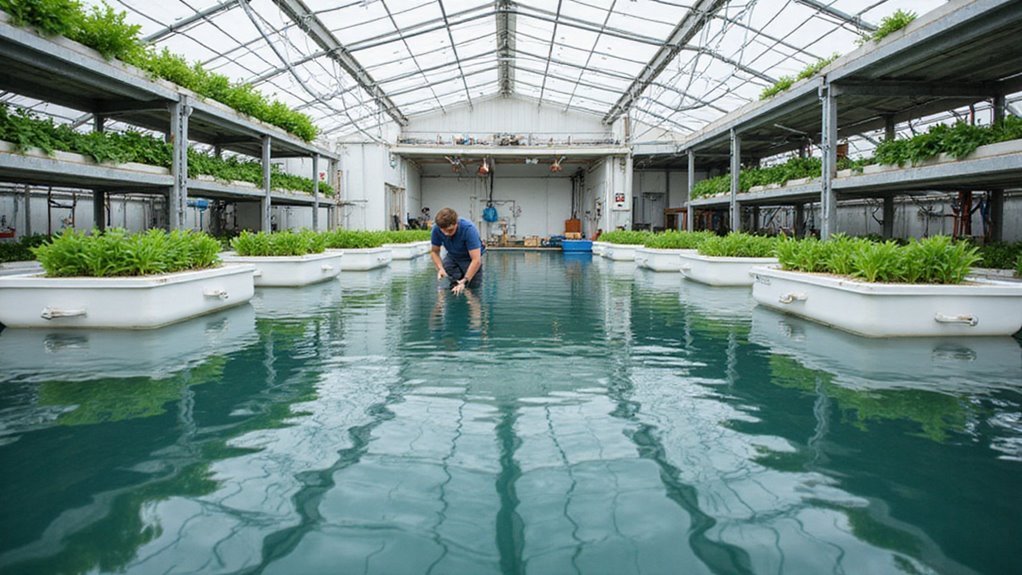
Although tank size might seem like just a number, I’ve learned it’ll make or break how well your carp do — I’d start with at least a 500‑liter tank for common or koi.
And really aim for 1,000+ liters if you want ideal growth and less daily fuss.
I prefer depths of two feet or more; they give cool refuges and reduce stress.
Lay out tanks, filters and grow beds so water circulation is smooth — think of pipes like veins.
Leave workspace around tanks for feeding, maintenance and expansion; you’ll thank yourself later.
Position tanks shaded to avoid temperature swings.
Tank aesthetics matter to me; a tidy setup looks good and helps spot issues sooner.
Maybe I’m picky, but it really works.
Water Quality and Optimal Parameters for Carp
If you want your carp to thrive, water quality is the thing you can’t let slide — think of it like air for us; mess that up and everything else falls apart.
I check basics daily: temperature, oxygen, pH stability and general water chemistry.
Keep pH 6.8–8.0 and temperature around 17–25°C; outside that range growth slows, simple as that.
I also watch ammonia and nitrite — they must stay near zero, or carp suffer.
Oxygen should stay above 5 mg/L; low oxygen stresses fish fast.
I’m not perfect, maybe I forget sometimes — then I test and fix things.
In my experience, regular monitoring beats panic later.
Here’s a short checklist:
- pH 6.8–8.0
- Temp 17–25°C
- Ammonia/nitrite ~0; O2 >5 mg/L
Do this consistently, you’ll see.
Filtration, Solids Removal and Aeration Essentials
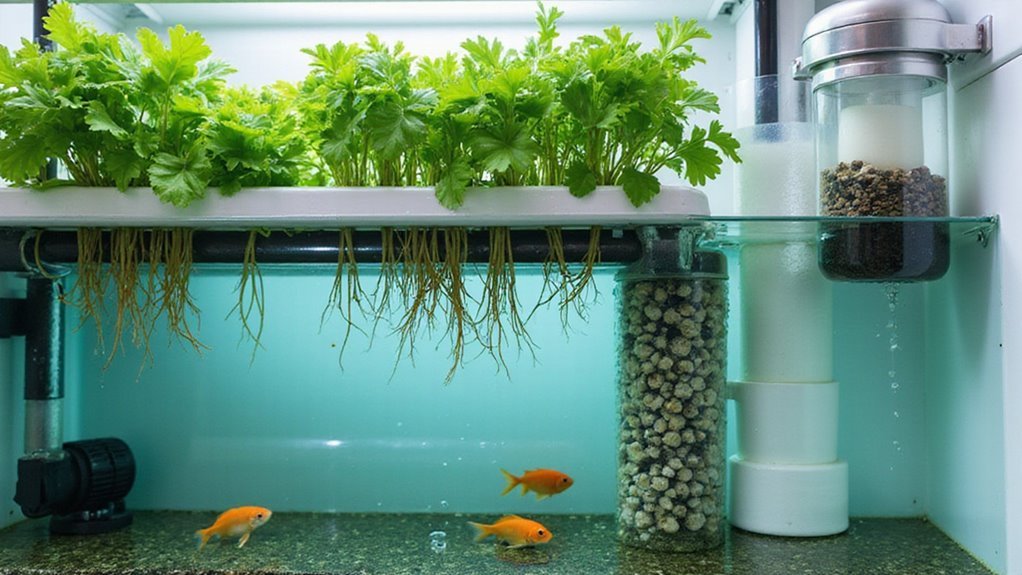
Now we need to talk about filtration, because mechanical systems like settling basins, micro‑screens and bead filters are the backbone of any carp aquaponics setup—I’m a big believer in them.
Solids removal methods, from clarifiers and routine cleaning of media beds to using gravel or sand filters that mineralize trapped waste into plant food, keep oxygen from tanking and stop toxic build‑ups that would stunt growth.
And aeration—surface agitation, aerators or natural water movement—has to keep dissolved oxygen above about 5 mg/L for carp health; I’m not entirely sure, but that’s works for me—no, that works for me most of the time.
Mechanical Filtration Systems
Because solids are the silent killers in aquaponics, I’ve come to treat mechanical filtration as the system’s backbone. I really rely on swirl and cyclonic clarifiers plus bead filters to keep settleable and fine suspended solids from stressing carp; it’s like giving the system a sieve and a sponge.
I also balance biofiltration techniques, water flow optimization and aeration so bacteria thrive and oxygen stays high. In my experience regular cleaning and occasional backwashing keeps flow steady. Over time you’ll tweak it.
I’m not entirely sure, but gravity-based designs cut manual work, or least they seem to.
Tips:
- Choose a primary clarifier for bulk solids.
- Add bead filters or microscreens for fine particles.
- Ensure aerators near filtration to offset oxygen dips.
Solids Removal Methods
Although solids often go unseen, they’ll ruin a system faster than most pests, and I’ve come to treat their removal like triage: catch the big stuff early with settling basins or tube separators, then polish the flow with microscreens, bead filters or cylindro-conical clarifiers so plant roots and carp aren’t choking on gunk.
I use basins for >100 micron grit; they do the heavy lifting. Microscreens and bead filters handle suspended fines.
Gravel beds need regular flooding/draining to boost microbial mineralization and prevent clogging — I think it’s — no, it’s essential.
Worms in media speed decomposition — a game changer.
For finer sediment I use cylindro-conical clarifiers and netting.
Biofilm management matters; sludge dewatering is part of routine maintenance, it’s boring but necessary.
Aeration and Oxygenation
Getting the gunk out was step one; keeping oxygen in the water is step two — and honestly, I treat them like a tag team. I aim for above 5 mg/L, because carp get stressed below that; in my experience, you notice it fast.
Mechanical air stones or paddlewheel aerators work — they stir the surface, boost exchange; water aeration techniques matter. A solid biofiltration setup helps microbes break down waste and improves gas exchange.
I use settling basins first, then add aeration when stocking is high or cold snaps hit. Maybe I’m cautious, but I think it’s worth it. Here’s a simple checklist:
- Install mechanical aeration (air stones, paddlewheels).
- Maintain biofiltration setup and clean filters.
- Monitor oxygen regularly and add backup aeration.
Stocking Density and Management Strategies
If you’re new to aquaponics, I’d start by keeping things simple and conservative with stocking — aim for about 10–15 kg of carp per 1,000 liters of water and don’t rush to fill every tank. I gradually increase numbers, but only after careful water testing and watching fish behavior; it’s easy to get greedy. Use good filtration and aeration—I’ve pushed systems to 20–25 kg/1,000 L, but that’s managed, not casual. I watch for stress signs and stage-harvest larger fish to keep balance; it’s like trimming a bonsai. Maybe I’m picky, but regular checks, small fixes, and patience pay off.
| Stage | Density | Action |
|---|---|---|
| Start | 10–15 kg | Observe |
| Grow | 15–20 kg | Aerate |
| Mature | 20–25 kg | Harvest |
| Notes | Test water | Watch behavior |
I’m learning too, step by step.
Feeding Regimes, Diets and Growth Optimization
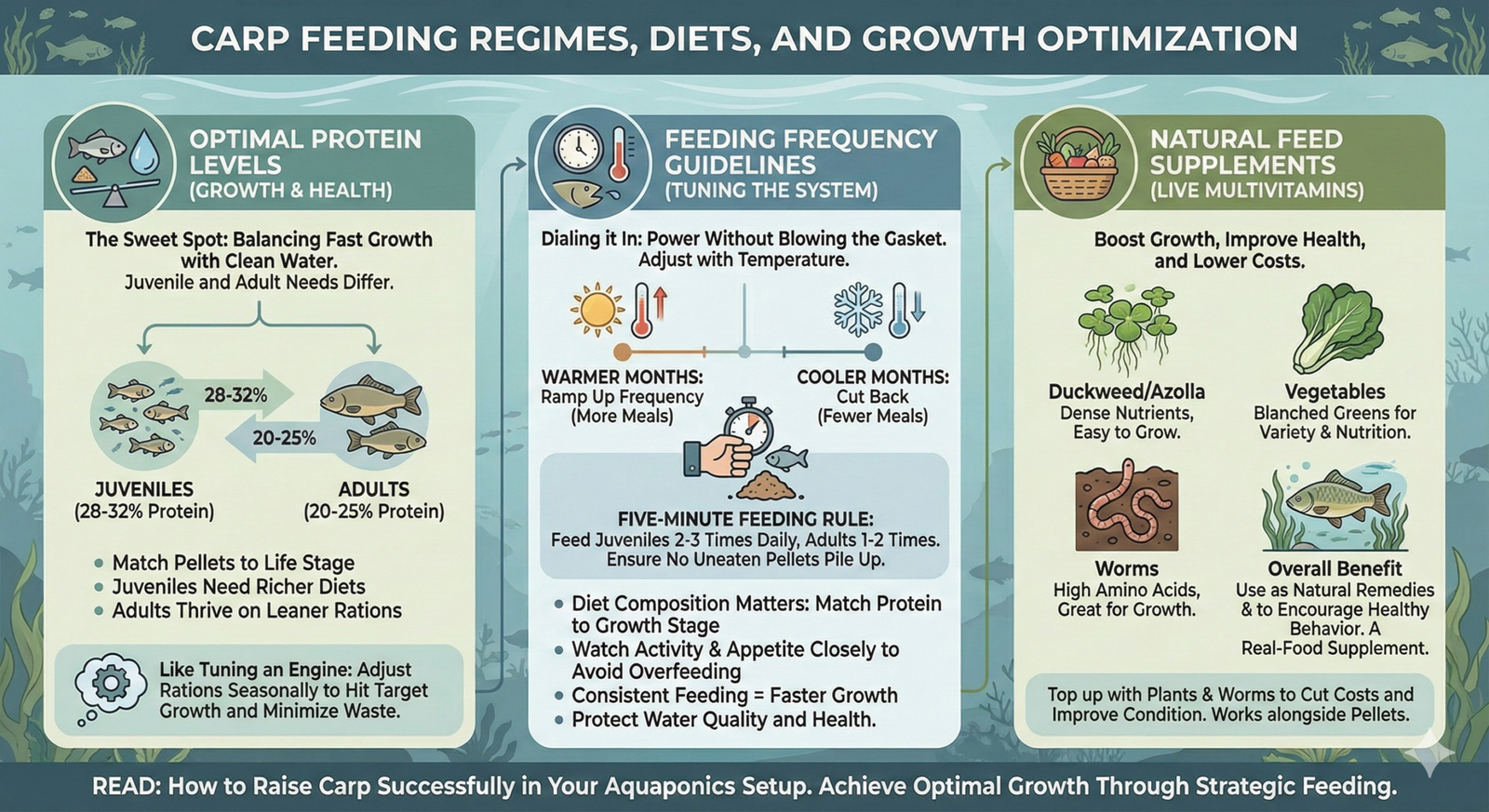
I usually feed carp high-quality pellets—28–32% protein for juveniles and 20–25% for adults—because getting protein right really matters.
I stick to 2–3 feedings a day using the five-minute feeding rule to avoid overfeeding and water issues. I ramp up frequency in warm months and cut back when it gets cold, which seems to speed growth without wrecking the system.
I also add natural feeds like duckweed or azolla to lower costs and improve health; it’s kind of like giving them a live multivitamin. Well, sort of—no, actually a real-food supplement. Maybe that sounds odd, but it works.
Optimal Protein Levels
How do you hit the sweet spot between fast growth and clean water? I focus on Protein levels and smart Feed formulation because they steer growth and tank health.
In my experience, juvenile carp need richer diets while adults do fine on leaner rations — it’s simple, really. I use three rules of thumb:
- Match pellets to life stage: 28–32% protein for juveniles, 20–25% for adults.
- Supplement with duckweed or azolla to lower costs and boost nutrition.
- Adjust rations seasonally to hit target growth rates and minimize waste.
I think this balance feels like tuning an engine; maybe I’m overdoing the metaphor, but it helps. Oh — I mean, it helps me decide feed amounts. every single day.
Feeding Frequency Guidelines
When you’re dialing in feeding frequency, think of it like tuning that engine I kept mentioning — you want power without blowing the gasket.
I feed juveniles two to three times daily, using the five-minute feeding rule so uneaten pellets don’t pile up. Adults get one or two meals.
In my experience diet composition matters as much as schedule. I use 28–32% protein pellets for fast juvenile growth, then drop to 20–25% for mature carp.
Adjust frequency with temperature — warmer months, more meals; cooler months, fewer.
Watch activity and appetite closely to avoid overfeeding; it’s the easiest mistake to make, and it’s bad for water quality and health. Maybe that’s obvious, but I’m saying it anyway.
I think you’ll see faster growth if consistent.
Natural Feed Supplements
Although carp will happily munch pellets all day, I’ve found that adding natural feed supplements — duckweed, azolla, veggies, worms — really evens things out and boosts growth in ways pellets alone don’t.
I use them as natural remedies and to encourage healthy fish behavior; it’s like a multivitamin. Juveniles need high‑protein pellets 2–3 times daily, adults once or twice with lower protein, but I top up with plants and worms to cut costs and improve condition.
I follow the five‑minute feeding rule and watch activity, temperature, and water clarity.
Here are options I rely on:
- Duckweed/azolla — dense nutrients, easy to grow.
- Vegetables — blanched greens for variety.
- Worms — high amino acids, great for growth.
Maybe actually that’s obvious, but it works.
Monitoring, Disease Prevention and Fish Health Care
Because keeping carp healthy depends so much on water quality and plain old paying attention, I make a point of testing ammonia, nitrites, nitrates and pH every week. Ammonia and nitrites should be zero and pH around 6.8–7.2.
I watch the fish daily for any odd behavior or discoloration. I rely on straightforward water testing and pragmatic disease management; if one fish looks listless or pale, I isolate it right away.
I use salt baths at 2–3 ppt for parasites, and I often aerate heavily so oxygen never drops. I do partial water changes and keep filters clean; poor water invites trouble.
Honestly, I think staying observant and reacting fast is half the care—well, maybe more. It really pays off, honestly.
Best Plants to Pair With Carp and Nutrient Balancing
I usually pair carp systems with leafy greens and herbs like spinach, kale, basil and mint because they thrive on the high nitrogen the fish provide and grow fast.
For fruiting plants—tomatoes, cucumbers, peppers—you need a more mature system and steady nitrates to set good fruit. It’s kind of like waiting for the oven to preheat.
Balancing stocking density and feeding keeps nutrients in check; I’m not entirely sure of the exact numbers for every setup—well, you’ll need to test and adjust, sorry, adjust as you go.
Leafy Greens & Herbs
When you’re pairing carp with plants, leafy greens and herbs usually make the easiest, most rewarding roommates. I grow spinach, kale, and arugula because they gobble up the nitrogen carp produce, and herbs like basil, mint, and parsley love the steady feed. Greenhouse integration helps extend seasons, and pH balancing keeps nutrients available.
In my experience, quick harvest cycles—four to six weeks—prevent buildup and keep things tidy. I think balancing fish density and feed is key; too many fish and you’ll overshoot, too few and plants starve. It’s pretty simple, really. Maybe that sounds obvious, but it took me a season to get right.
My tip: monitor, adjust, harvest, repeat.
- Fast-growing leafy greens
- Steady-supply herbs
- Maintain stocking and feed rates faithfully
Fruiting Plants Needs
Since fruiting plants demand a steadier, richer diet than quick-turn greens, I tend to only add tomatoes, peppers and cucumbers once the carp system’s mature and stable. I like those three because they use more of the fish-produced nutrients, and in my experience pairing them with leafy greens keeps harvests steady — like mixing slow and fast gears.
You do need to watch for plant disease and take pest control seriously; I check leaves daily, remove affected parts, and encourage beneficial insects. Maybe it’s obvious, but start small and expand as confidence grows.
I’m not entirely sure, but you’ll find variety helps use nutrients efficiently. Well, it’s a bit of balance, trial and error, honestly. Give plants time — patience rewards steady, abundant fruit later often.
Balancing Nutrient Load
Although carp throw off a steady stream of nitrogen that leafy greens just gobble up, you’ve got to balance which plants you pair with them so the system doesn’t tip over.
I’ve found spinach, kale and fast herbs like basil respond quickly, while tomatoes and peppers do better once nitrates climb in a mature tank.
I monitor stocking density, do Water testing, and pH adjustment—ideally 6.8–7.2—to keep nutrients available.
Maybe I sound cautious, but Its saved my fish—no, it’s saved my fish.
Here’s a simple plan I use:
- Start with leafy greens to absorb initial nitrogen.
- Add fast-growing herbs for steady uptake.
- Introduce fruiting plants gradually as nitrate levels rise.
I think that works, mostly. I’m still learning, but it’s rewarding.
Harvesting Strategies, Humane Methods and System Sustainability
If you’re planning to harvest carp from an aquaponic system, I’ll tell you right up front that a little planning goes a long way.
I usually harvest when carp hit about 1–2 pounds, typically 12–18 months, and that timing keeps quality high. Think hunting ethics applied to aquaculture: respect the fish population and remove larger fish first so the rest can grow.
Humane methods matter — I use ice slurry or a quick blow to stun, it’s efficient and reduces suffering — I mean it reduces suffering. Check water quality and system health before any harvest; otherwise you risk disease or stress.
Partial harvesting helps avoid overcrowding and sustains production. I think it’s obvious, but important.
I’m not entirely sure, but I feel confident
Frequently Asked Questions
What Is the Most Profitable Fish for Aquaponics?
Tilapia is the most profitable fish for aquaponics; I focus on fish breeding, efficient feed, and controlling water temperature to maximize growth, yield, and marketability, and I’ll guide you through practical steps and new techniques.
Can Carp Live With Tilapia?
Like roommates, yes—I believe carp compatibility with tilapia is feasible; I’d say fish cohabitation succeeds if I manage overlapping temperatures, pH, oxygen, stocking density and feeding to balance waste, filtration and overall health and growth.
What Cannot Be Grown in Aquaponics?
Root-heavy crops like carrots and potatoes, large fruit trees or woody shrubs, mycorrhiza-dependent plants (strawberries), some submerged mosses and grains generally can’t be grown in aquaponics; I mention water temperature and disease management limits too.
Will Carp Clean a Pond?
Yes, like living rakes, carp will clean a pond; I’ll watch them stir sediments and nibble algae. For carp pond management I advise stocking control and monitoring to maintain pond ecosystem balance and prevent overforaging.